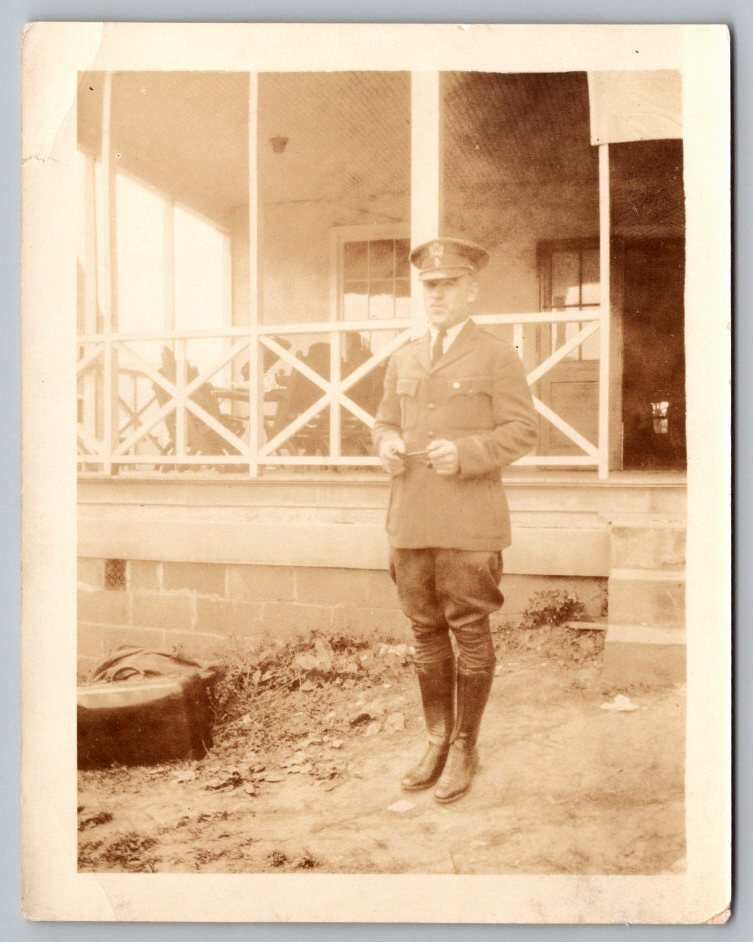
1910s WWI Red Cross Officer Captain Bryant Sepia Photo Snapshot
📸 Click any thumbnail to inspect Front, Back & Angles (2 Photos)
As an eBay Partner, we may earn a commission if you make a purchase.
Item Specifications
- Era: 1910s WWI Era
- Subject: Captain Bryant Red Cross Institute
- Tone: Sepia Tone Print
- Provenance: Handwritten Inscription Verso
- Condition: Vintage Original
- Originality: Original Vintage
- Category: Vintage Photography
- Format / Type: Snapshots
Looking for Modern Alternatives?
Explore top-rated, modern Vintage Photography and related historical accessories on Amazon.
Shop Vintage Photography on Amazon →As an Amazon Associate, we earn from qualifying purchases.
Historical Context & Overview
This original sepia snapshot from the World War I era offers a rare, intimate glimpse into the home-front and relief efforts of the late 1910s. The photograph depicts an American military or auxiliary officer identified as Captain Bryant, standing in uniform before the screened porch of a building associated with the Red Cross Institute. Captured during a period of massive mobilization and humanitarian response, the image serves as an enduring historical document of the personnel who coordinated medical, rehabilitation, and aid services during and immediately following the Great War.
Uniform and Visual Details
In the main snapshot image, Captain Bryant stands posed outdoors with a dignified stance. He wears a tailored Service Dress tunic complete with breast pockets and shoulder straps, high riding breeches, and polished tall dark leather field boots. His peaked officer cap features an emblem insignia, consistent with officer dress standards of the World War I period. Behind him, the architectural background features an expansive screened porch with characteristic geometric cross-bracing and raised block foundations—typical of institutional cantonment or temporary administrative facilities established during the war effort.
The reverse side of the snapshot provides crucial historical context, bearing contemporary handwritten inscriptions. In clear ink, the name "Captain Bryant" is inscribed, accompanied by a secondary pencil notation referencing the "Red Cross Institute." These markings transform an otherwise anonymous portrait into an authentic, cataloged artifact of early 20th-century humanitarian history.
The Red Cross Institute and WWI Relief Efforts
During the First World War, the American Red Cross expanded dramatically, creating specialized divisions and institutes to handle complex war-related challenges. Key among these was the Red Cross Institute for Crippled and Disabled Men (established in New York in 1917) and the Red Cross Institute for the Blind (Evergreen in Baltimore, Maryland). These pioneering facilities focused on vocational rehabilitation, physical therapy, and re-skilling returning wounded servicemen, laying the groundwork for modern physical rehabilitation and occupational therapy standards.
Officers assigned to Red Cross administrative and institute duties carried vital responsibilities, managing hospital wards, educational workshops, logistics, and personnel affairs. Photographs capturing individual personnel on site at these facilities remain scarce, making candidate artifacts like this snapshot particularly meaningful for researchers examining institutional history.
Collector Appeal and Historical Significance
For collectors of military photography, World War I memorabilia, and Red Cross heritage, this vintage snapshot combines visual clarity with verifiable provenance on the reverse. The rich sepia tones and clear focus allow detailed study of early 20th-century uniform tailoring, boot design, and period architecture. Whether added to a specialized collection of medical service artifacts or framed for display alongside Great War ephemera, this original photograph remains a compelling connection to the men and women who served behind the scenes of global relief efforts.