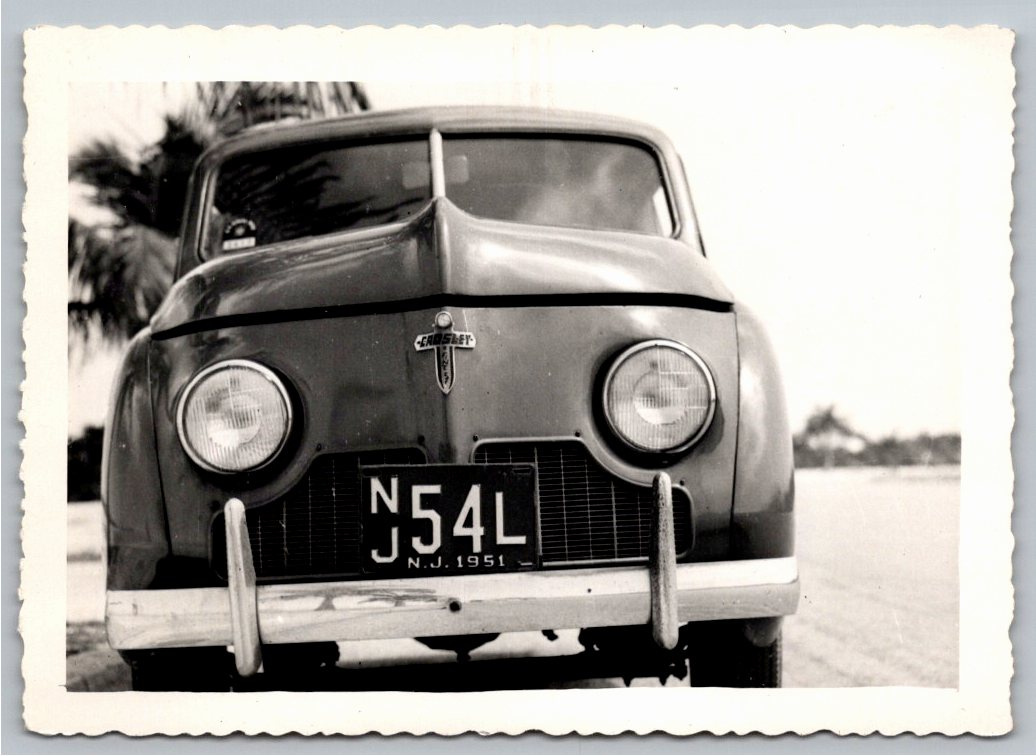
1951 Crosley Automobile B&W Photo with New Jersey License Plate
📸 Click any thumbnail to inspect Front, Back & Angles (2 Photos)
As an eBay Partner, we may earn a commission if you make a purchase.
Item Specifications
- Era: 1950s Automotive
- Subject: 1951 Crosley Automobile
- Location: New Jersey
- Paper Finish: Deckled Edge
- License Plate: N.J. 1951 (NJ 54L)
- Originality: Original Vintage
- Category: Vintage Photography
- Format / Type: Snapshots
Looking for Modern Alternatives?
Explore top-rated, modern Vintage Photography and related historical accessories on Amazon.
Shop Vintage Photography on Amazon →As an Amazon Associate, we earn from qualifying purchases.
Historical Context & Overview
This striking original mid-century black-and-white photograph offers a close-up direct encounter with a uniquely fascinating piece of mid-twentieth-century American automotive history: a Crosley microcar featuring a crisp 1951 New Jersey license plate. Framed on classic deckled-edge photo paper characteristic of personal snapshot photography from the era, the image captures the head-on silhouette of Powel Crosley Jr.’s ambitious compact automobile design.
Powel Crosley Jr. and the American Compact Pioneer
Before post-war fuel crises and imported compacts reshaped the domestic market, industrialist Powel Crosley Jr. envisioned an affordable, ultra-efficient vehicle for every American family. Known as the "Henry Ford of Radio" for his mass-market electronics empire, Crosley established Crosley Motors Inc. in 1939, producing lightweight, small-footprint cars out of manufacturing facilities in Cincinnati, Ohio, and Marion, Indiana.
Following World War II, Crosley resumed commercial production with updated styling and innovative engineering. While major Detroit automakers pushed toward longer, wider, and chrome-laden "land yachts," Crosley stubbornly championed efficiency and minimalism. The post-war models were powered by tiny four-cylinder engines—initially the tin-block CoBra engine and later the cast-iron CIBA overhead-cam engine. Despite their diminutive dimensions, Crosley vehicles achieved legendary fuel economy, frequently exceeding 40 miles per gallon at a time when fuel was cheap and heavy V8 engines dominated American highways.
Anatomy of the Snapshot: 1951 New Jersey Registration and Design Details
The photograph highlights key visual elements that defined late-era Crosley production. Prominently mounted on the front nose above the dual grille panels is Crosley's distinctive hood ornament featuring a central propeller graphic—a subtle nod to aviation styling popular in post-war industrial design. The round, widely spaced headlights, sculpted hood line, and upright bumper guards give the subcompact vehicle its cheerful, instantly recognizable countenance.
Directly beneath the grille sits a dark-painted 1951 New Jersey license plate bearing the alphanumeric designation "NJ 54L" and stamped "N.J. 1951" along the bottom edge. Period license plates serve as vital historical anchors for collectors, placing this photograph precisely in time during the post-war suburban transformation of the Garden State. Handwritten pencil notations on the reverse side reference the late 1940s to 1950 production period, adding contextual authenticity to the physical print.
The Enduring Appeal of Mid-Century Vernacular Photography
By 1952, facing overwhelming competition from Detroit's major manufacturers offering larger vehicles at aggressive price points, Crosley ended automotive assembly. Today, surviving Crosley automobiles and authentic original photographs documenting them are highly sought after by microcar enthusiasts and transportation historians.
Vernacular snapshots like this item record real-world motor history beyond stylized factory promotional photos. Preserved in its original snapshot format, this piece captures an authentic slice of 1950s streetscapes and celebrates one of America's most daring early microcar experiments.