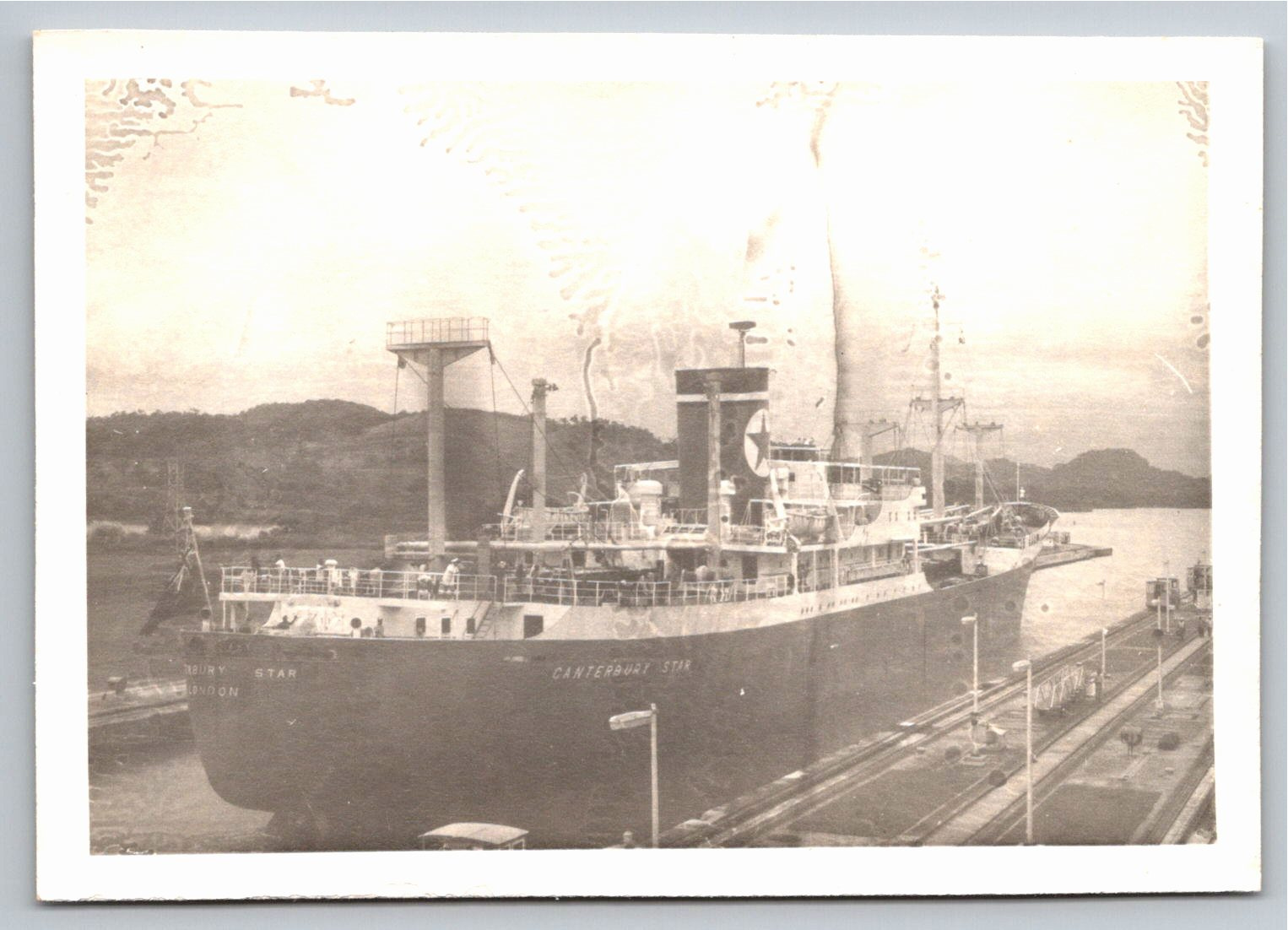
1960s Photo Canterbury Star Ship Panama Canal Blue Star Line
📸 Click any thumbnail to inspect Front, Back & Angles (2 Photos)
🔗 Embed / Cite This Archival Image (Free with Attribution)Get HTML Code
© USA RESELL. Bloggers, historians, and researchers may embed this image for free by keeping the credit link below intact:
As an eBay Partner, we may earn a commission if you make a purchase.
Item Specifications
- City: Panama City
- State: Panama Canal Zone
- Country: Panama
- Era: 1960s
- Subject: Maritime
- Original/Licensed Reprint: Original Vintage
- Category: Vintage Photography
- Format / Type: Vintage Photographs
Looking for Modern Alternatives?
Explore top-rated, modern Vintage Photography and related historical accessories on Amazon.
Shop Vintage Photography on Amazon →As an Amazon Associate, we earn from qualifying purchases.
Historical Context & Overview
Mid-Century Maritime Engineering: The MV Canterbury Star
In the post-World War II era, global ocean freight experienced a dynamic transformation characterized by purpose-built general cargo ships designed to connect distant international trade routes. Among the most prominent fleets flying the British merchant flag was the Blue Star Line, an iconic shipping firm renowned for its refrigerated and general cargo vessels serving routes across the Atlantic, Pacific, and South America. Built in 1960 by the Bartram & Sons shipyard in Sunderland, United Kingdom, the MV Canterbury Star represented the pinnacle of mid-century British shipbuilding and maritime design.
This original black-and-white photograph captures the Canterbury Star as it maneuvers through the locks of the Panama Canal during the 1960s. Adorned with the signature Blue Star Line emblem on its funnel—a bold star set against a blue circle within a white band—the ship displays its full deck superstructure, intricate rigging, deck cranes, and classic hull lines. The composition reveals the vessel's stern, complete with lettering identifying London as its home port of registry, offering a captivating look at an epoch when merchant ships possessed distinct aesthetic grace alongside their industrial purpose.
Navigating the Panama Canal Locks
Transiting the Panama Canal was a defining operational milestone for mid-century trans-oceanic freighter routes, saving thousands of nautical miles compared to navigating the treacherous waters around Cape Horn. This photograph vividly captures the operational atmosphere of the Canal Zone during the 1960s. Parallel to the vessel's starboard side along the lock wall, electric towing locomotives—famously known as "mules"—are visible, guiding the heavy cargo liner with precise cable tension to prevent contact with the concrete lock chamber walls.
In the background, the lush tropical hills of the Panama Canal Zone contrast with the heavy industrial machinery and steel structural elements of the vessel. The snapshot records not only the ship itself but also the historic engineering infrastructure that enabled mid-twentieth-century global trade to flourish, making it a compelling primary visual document for maritime historians and Panama Canal collectors alike.
Materiality and Archival Significance
Printed on authentic vintage glossy photo paper, this piece features a classic silver gelatin finish characteristic of mid-20th-century press snaps and personal photography. Measuring approximately 4.8 by 3.4 inches, the print exhibits natural tonal warmth and light age-appropriate handling marks consistent with its historic origin. The plain reverse side retains a subtle pencil notation, confirming its authenticity as a true vintage photograph rather than a modern postcard or photo mechanical reprint.
For collectors of ocean liner memorabilia, naval transport history, and authentic mid-century photography, this image stands as a fine artifact of post-war merchant marine history. Whether presented in a custom matting and archival frame or curated into a dedicated maritime collection, it offers a tangible link to the golden age of international ocean freight.