Vintage May/June 1992 The Plain Truth Magazine Human Cyborg Cover
📸 Click any thumbnail to inspect Front, Back & Angles (3 Photos)
As an eBay Partner, we may earn a commission if you make a purchase.
Item Specifications
- Era: 1990s
- Publisher: Worldwide Church of God
- Issue Date: May/June 1992
- Title: The Plain Truth
- Subject: Technology & Human Identity
- Language: English
- Category: Vintage Books & Manuals
- Format / Type: Books & Publications
Looking for Modern Alternatives?
Explore top-rated, modern Vintage Books & Manuals and related historical accessories on Amazon.
Shop Vintage Books & Manuals on Amazon →As an Amazon Associate, we earn from qualifying purchases.
Historical Context & Overview
Exploring the Intersection of Faith and Modern Technology in 1992
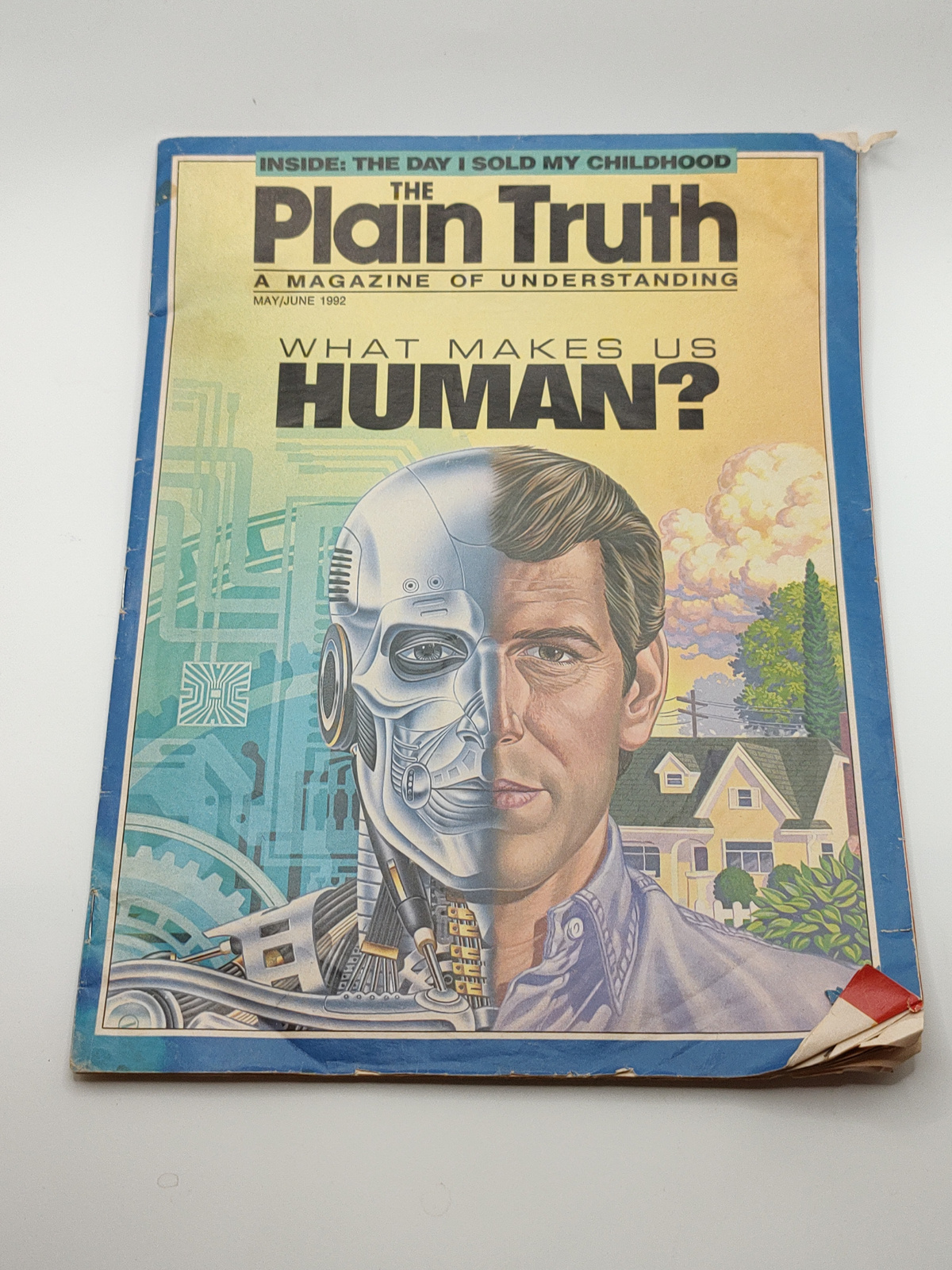
In the early 1990s, the world stood at a dramatic cultural and technological precipice. The rise of personal computing, early bioengineering, and the dawn of the public internet sparked intense debates regarding what it truly meant to be human. Capturing this pivotal moment in visual culture, the May/June 1992 issue of The Plain Truth magazine features one of the most memorable and striking cover illustrations of its era: a half-man, half-cyborg face emblazoned with the provocative headline, "What Makes Us Human?"
The Plain Truth and Mid-Century Religious Publishing
Founded in 1934 by evangelist Herbert W. Armstrong, The Plain Truth was the flagship publication of the Worldwide Church of God. Distributed free of charge to millions of households globally at its peak, the magazine combined geopolitical analysis, socio-cultural critiques, and biblical prophecy. Known for its high-quality production, full-color graphic illustrations, and direct editorial tone, the periodical frequently addressed contemporary societal anxieties through a distinct theological lens.
By 1992, as the World Tomorrow television program reached broad audiences, the magazine shifted its aesthetic focus to address modern ethical dilemmas posed by rapid advancements in science, automation, and synthetic integration. The publication's artistic direction often used bold, surrealist imagery to provoke philosophical reflection among its readership.
Retro-Futurism and Cybernetic Aesthetics
The May/June 1992 cover design remains a dramatic example of 1990s retro-futurism. The striking artwork contrasts a detailed anatomical portrait of an everyday individual against a cold, metallic cyborg shell complete with circuit boards, gears, and fiber-optic wiring. This visual dichotomy mirrored contemporary pop-culture themes explored in science fiction films of the late 1980s and early 1990s, translating those pop-cultural fears into a thought-provoking spiritual question.
Inside, the issue dives into human identity, moral degradation, and societal evolution. Key feature articles include "The Day I Sold My Childhood," an exploration of changing family structures and the loss of youth innocence in an increasingly digitized and commercialized world. Coupled with back-cover advertisements for broadcast television programming asking fundamental existential questions, the issue offers a fascinating time capsule of early 1990s media rhetoric.
A Collector’s Time Capsule of 1990s Media History
For collectors of vintage magazines, sci-fi art ephemera, and modern religious history, this 1992 issue of The Plain Truth stands out as a unique crossover artifact. It bridges the gap between mid-century religious literature and the cyberpunk artistic movement that swept through the early 1990s. As a piece of print history, it offers an engaging glimpse into how mass-market periodicals wrestled with the technological transformations reshaping modern society at the turn of the millennium.