1908 St. Louis Butler Brothers Building Vintage Postcard History
📸 Click any thumbnail to inspect Front, Back & Angles (2 Photos)
As an eBay Partner, we may earn a commission if you make a purchase.
Item Specifications
- Era: Divided Back (1907-1915)
- Publisher: Arrow Post Card Co.
- Location: St. Louis, Missouri
- Subject: Butler Brothers Building
- Postmark Date: 1908
- Originality: Original Vintage
- Category: Postcards & Ephemera
- Format / Type: Vintage Postcards
Looking for Modern Alternatives?
Explore top-rated, modern Postcards & Ephemera and related historical accessories on Amazon.
Shop Postcards & Ephemera on Amazon →As an Amazon Associate, we earn from qualifying purchases.
Historical Context & Overview
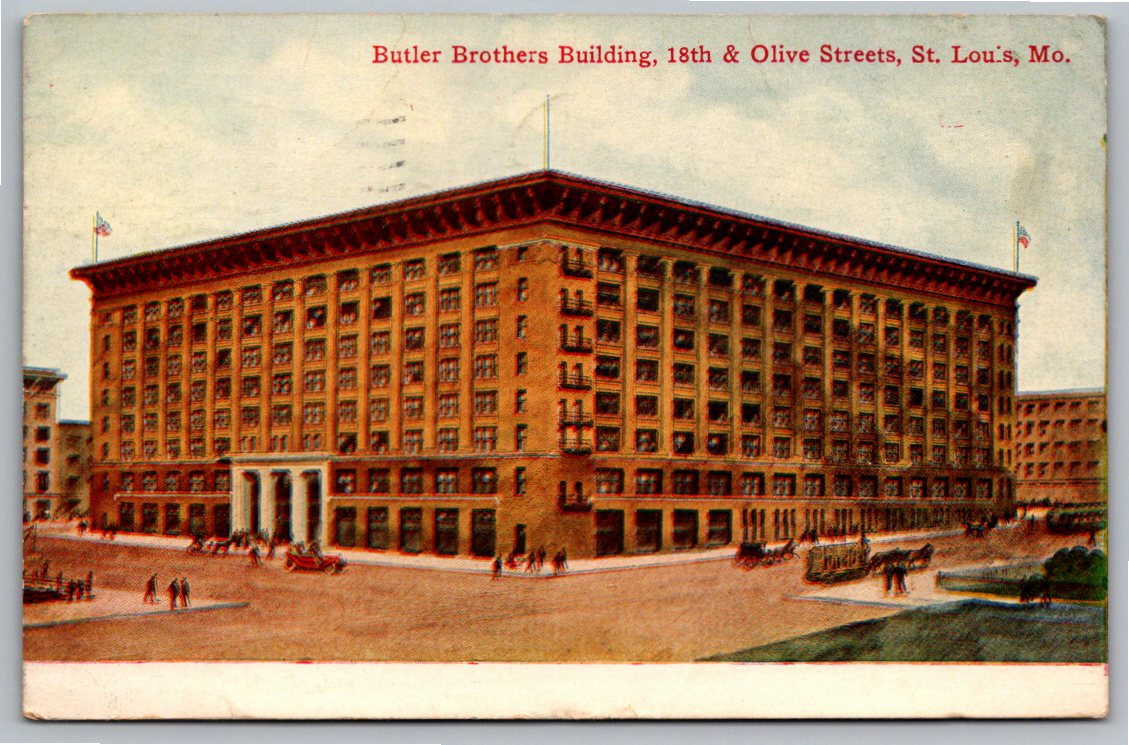
At the turn of the twentieth century, St. Louis, Missouri, stood as one of North America's premier industrial and mercantile gateways. Situated along key rail corridors and river trade routes, the city attracted major national firms seeking expansive regional distribution hubs. Among the most impressive monuments to this era of commercial expansion was the colossal Butler Brothers Building, located at 18th and Olive Streets in downtown St. Louis. Published by the local Arrow Post Card Company and postmarked in July 1908, this vintage color postcard captures the formidable structure in its prime.
The Mail-Order Wholesale Powerhouse
Founded in Boston in 1877 by brothers George, Edward, and Charles Butler, Butler Brothers pioneered the concept of mail-order wholesaling. Unlike traditional storekeeping suppliers, Butler Brothers distributed comprehensive mail-order catalogs directly to independent merchants and department store proprietors nationwide. To service their vast network, the company erected massive warehouse complexes across major metropolitan nodes, including Chicago, New York, Minneapolis, Dallas, and St. Louis.
The St. Louis complex, completed in the early 1900s, occupied an entire city block near Union Station. Built in the monumental Commercial Style with subtle Classical and Renaissance Revival details, the structure featured thousands of square feet of reinforced floor space. Brick piers, large multi-pane windows, and a prominent overhanging cornice gave the building a fortress-like yet refined aesthetic. It housed vast inventories ranging from dry goods and housewares to hardware and seasonal novelties, serving thousands of small-town shopkeepers across the American Midwest and South.
A Translucent Snapshot of Turn-of-the-Century Transport
The front color illustration of the postcard provides a captivating view of city transit during a key transitional era. Horse-drawn delivery wagons and carriages share cobblestone streets with early motorcars, illustrating the shift from equine to automotive transport in Midwestern urban centers. Pedestrians stroll along wide sidewalks, while American flags flutter from the corners of the building’s expansive flat roof.
The reverse side of this card tells its own historical story. Postmarked on July 23, 1908, at 9:30 AM in St. Louis, it bears a green 1-cent Benjamin Franklin postage stamp (Scott #300). Sent to an address in Gallatin, Missouri, the handwritten cursive note offers a brief glimpse into daily life and personal correspondence during the golden age of American postcards (1907–1915), when split-back cards allowed senders to write messages directly beside the recipient's address.
Enduring Legacy in Modern St. Louis
The Butler Brothers Building survived long past the mail-order wholesale boom, serving various industrial and commercial uses throughout the mid-to-late twentieth century. Recognized for its historical and architectural significance, the timber-and-brick giant has undergone major historic restoration in recent years, repurposing its expansive floorplates into loft apartments and modern commercial spaces while retaining its historical exterior facade.
For collectors of Missouri ephemera, architectural history, and turn-of-the-century postal history, this original 1908 postcard serves as an authentic visual artifact documenting St. Louis when it reigned as a central engine of American commerce.