Vintage F7U Cutlass Jet Postcard Naval Air Missile Center Point
📸 Click any thumbnail to inspect Front, Back & Angles (2 Photos)
As an eBay Partner, we may earn a commission if you make a purchase.
Item Specifications
- Era: 1950s Chrome
- Publisher: Columbia Wholesale Supply
- Location: Point Mugu, California
- Subject: Vought F7U Cutlass Jet Aircraft
- Military Branch: U.S. Navy
- Facility: Naval Air Missile Test Center
- Category: Postcards & Ephemera
- Format / Type: Vintage Postcards
Looking for Modern Alternatives?
Explore top-rated, modern Postcards & Ephemera and related historical accessories on Amazon.
Shop Postcards & Ephemera on Amazon →As an Amazon Associate, we earn from qualifying purchases.
Historical Context & Overview
A Window into Early Naval Jet Aviation at Point Mugu
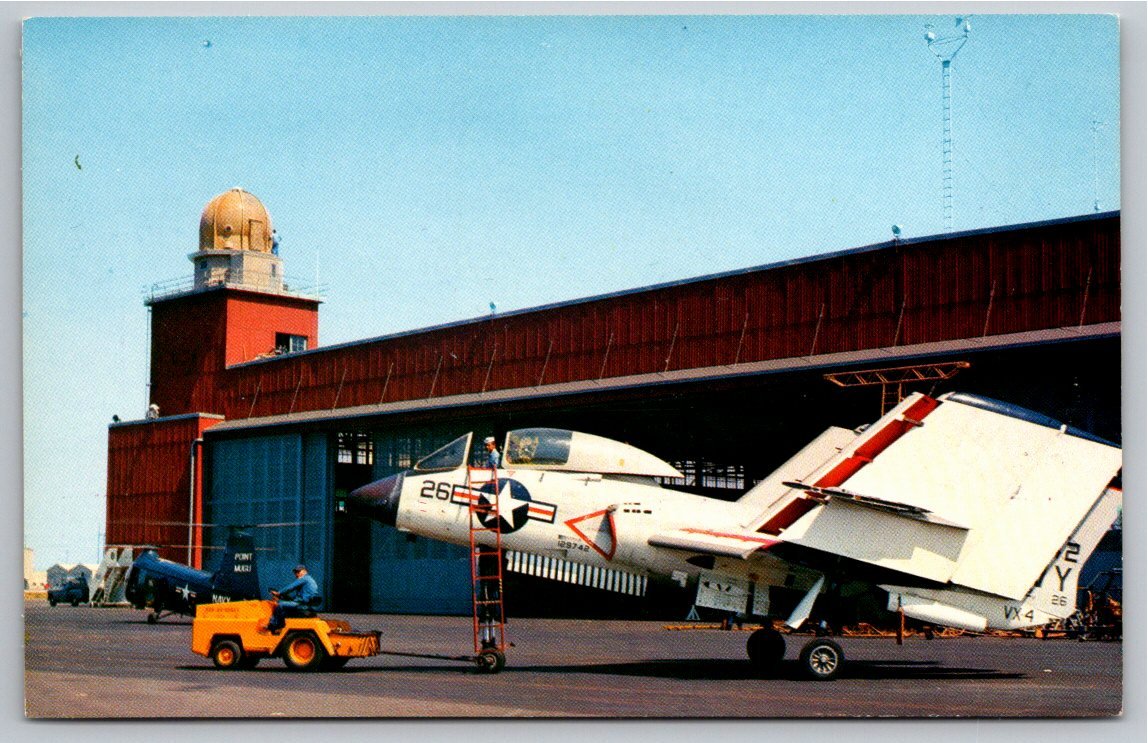
During the dawn of the Cold War, naval aviation underwent a dramatic revolution as propeller-driven aircraft gave way to high-speed jet fighters and guided missile technology. Captured in vivid mid-century color, this original Chrome postcard features one of the most radical military aircraft of the era: the Vought F7U Cutlass, depicted on the flight line at the United States Naval Air Missile Test Center (NAMTC) at Point Mugu, California.
The Radical Design of the Vought F7U Cutlass
Designed in the late 1940s by Chance Vought, the F7U Cutlass was a startling departure from traditional fighter design. Featuring a tailless configuration, swept wings, twin vertical fins mounted on the trailing edges of the wings, and early Westinghouse afterburning turbojets, the Cutlass looked like something straight out of science fiction. The aircraft featured on the card wears the tail code "2Y" and unit marking "VX-4", representing Air Development Squadron Four (later Air Test and Evaluation Squadron Four), stationed at Point Mugu to evaluate operational capabilities and advanced weapons integration.
Despite its striking aesthetic and futuristic promise, the Cutlass earned a formidable reputation among naval aviators. Powered by early turbojet engines that often lacked sufficient thrust, the aircraft possessed an unusually high landing attitude due to its elongated nose gear strut. Nevertheless, the F7U played an indispensable role as a pioneering testbed, pushing the boundaries of aerodynamic design, carrier operations, and air-launched missile deployment.
Point Mugu and the Dawn of Missile Warfare
Point Mugu, located along the Ventura County coast of Southern California, was established in the post-WWII era as the Navy's premier site for testing guided missiles and drone targets. As noted on the reverse of this vintage postcard, Cutlass aircraft at Point Mugu were frequently utilized as launch platforms for early air-to-air missiles, specifically the pioneering AAM-N-2 (AIM-7) Sparrow missile system.
This testing was critical in transitioning naval air combat from visual-range cannon dogfights to Beyond-Visual-Range (BVR) missile engagements, laying the technological foundation for modern naval air power.
Collectible Mid-Century Military Ephemera
Published by Columbia Wholesale Supply of Hollywood, California (catalog number H-2419 / 24414), this postcard is a prime example of mid-20th-century military photography. The crisp image captures a bright yellow aircraft tug positioning the Cutlass in front of Point Mugu's iconic red hangar and observation tower, complete with radar domes and active ground crew on the ramp. For aviation historians, naval defense collectors, and vintage postcard enthusiasts, this piece offers a fascinating snapshot of American military innovation during the golden age of jet flight testing.