Vintage 1910 St. Louis Postcard: The Grotto at Benton Park, MO
📸 Click any thumbnail to inspect Front, Back & Angles (2 Photos)
As an eBay Partner, we may earn a commission if you make a purchase.
Item Specifications
- Era: Divided Back (1907–1915)
- Year: 1910
- Location: St. Louis, Missouri
- Publisher: S. H. Knox & Co.
- Printer: Printed in Germany
- Subject: Benton Park Grotto
- Category: Postcards & Ephemera
- Format / Type: Vintage Postcards
Looking for Modern Alternatives?
Explore top-rated, modern Postcards & Ephemera and related historical accessories on Amazon.
Shop Postcards & Ephemera on Amazon →As an Amazon Associate, we earn from qualifying purchases.
Historical Context & Overview
A Window into Edwardian St. Louis: Benton Park’s Picturesque Grotto
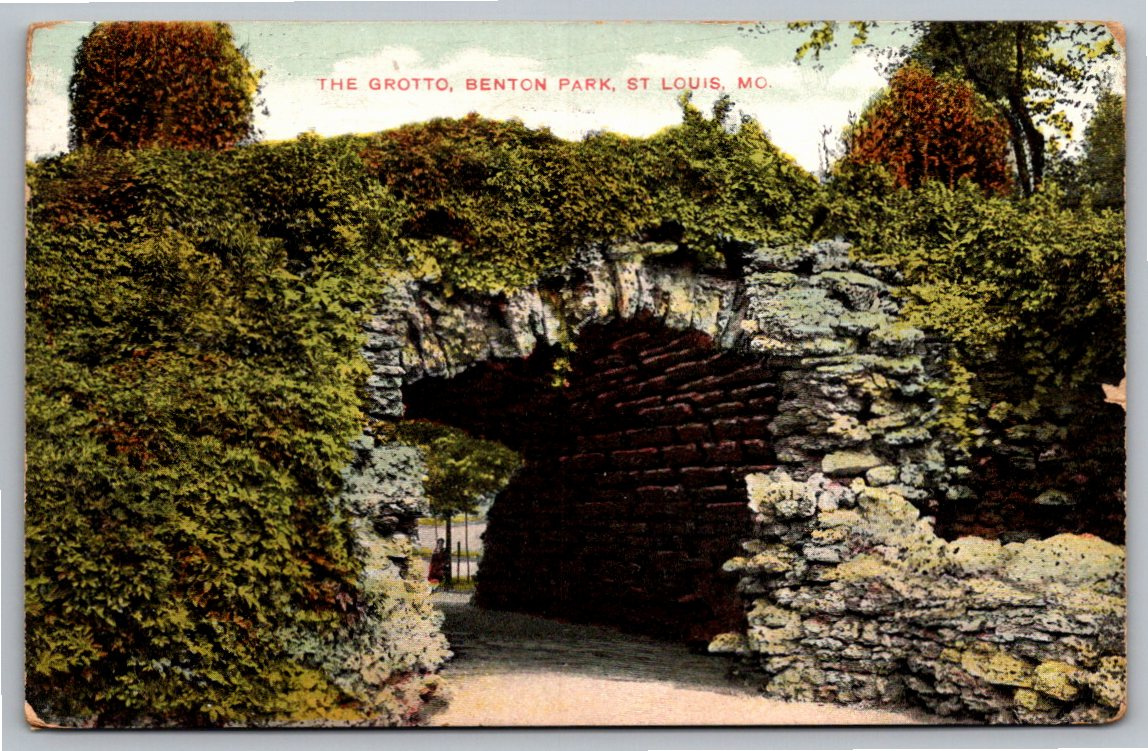
Established in 1866 on land previously used as the City Cemetery, Benton Park stands as one of the oldest public green spaces in St. Louis, Missouri. Named in honor of Thomas Hart Benton, Missouri's long-serving U.S. Senator, the park was transformed during the late 19th and early 20th centuries into a lush neighborhood sanctuary featuring rolling hills, footbridges, artificial lakes, and elaborate masonry. This original 1910 color postcard captures one of the park’s most beloved architectural features: the rustic stone archway known simply as "The Grotto."
Victorian Landscape Architecture and the Allure of the Grotto
During the Victorian and Edwardian eras, American urban planners drew heavy inspiration from the English Picturesque movement, incorporating artificial caves, rugged rockwork, and overgrown masonry into municipal parks. These grottoes served both functional and aesthetic purposes—offering visitors a cool, shaded retreat during scorching Midwestern summers while creating romantic, ruined-castle aesthetics within expanding industrial cities. The scene depicts a dramatic arch constructed from heavy, rough-hewn stone heavily draped in climbing ivy, framing a tree-lined pathway that invited parkgoers into a peaceful botanical escape.
German Lithography and the S. H. Knox Retail Empire
This postcard is a classic product of the "Golden Age of Postcards" (1907–1915). Produced via chromolithography in Germany—the world center for high-end color printing prior to World War I—the card exhibits rich tonal depth, fine detail, and soft color application. The reverse side notes that it was "Made expressly for S. H. Knox & Co." Founded by Seymour H. Knox I in 1884, S. H. Knox & Co. operated a vast chain of successful five-and-ten-cent stores across the United States before merging into the iconic F. W. Woolworth Company in 1912. Retailers like Knox frequently commissioned custom view-cards of local landmarks to sell as affordable souvenirs to residents and travelers alike.
Postal History: A Message Sent in the Spring of 1910
Beyond its visual appeal, the postcard retains its complete postal history on the back. Stamped at the St. Louis Annex post office on April 11, 1910, at 7:00 PM, it carries a green one-cent Benjamin Franklin stamp. The divided-back format—introduced by the U.S. Post Office in 1907 to allow written correspondence on the left side of the back—contains a handwritten message from a sender named Anna to her "Darling Parents" in Gallatin, Missouri. Such personal touches turn an already striking architectural view into an intimate time capsule of daily Midwestern life at the dawn of the 20th century.
An Authentic Artifact for St. Louis Ephemera Collectors
For historians, regional collectors, and enthusiasts of early American landscape architecture, this 1910 postcard offers an evocative look at St. Louis’s civic pride during its post-World’s Fair golden era. Its preserved color quality, verified postmark, and publisher provenance make it an exceptional specimen of early 20th-century Missouri history.