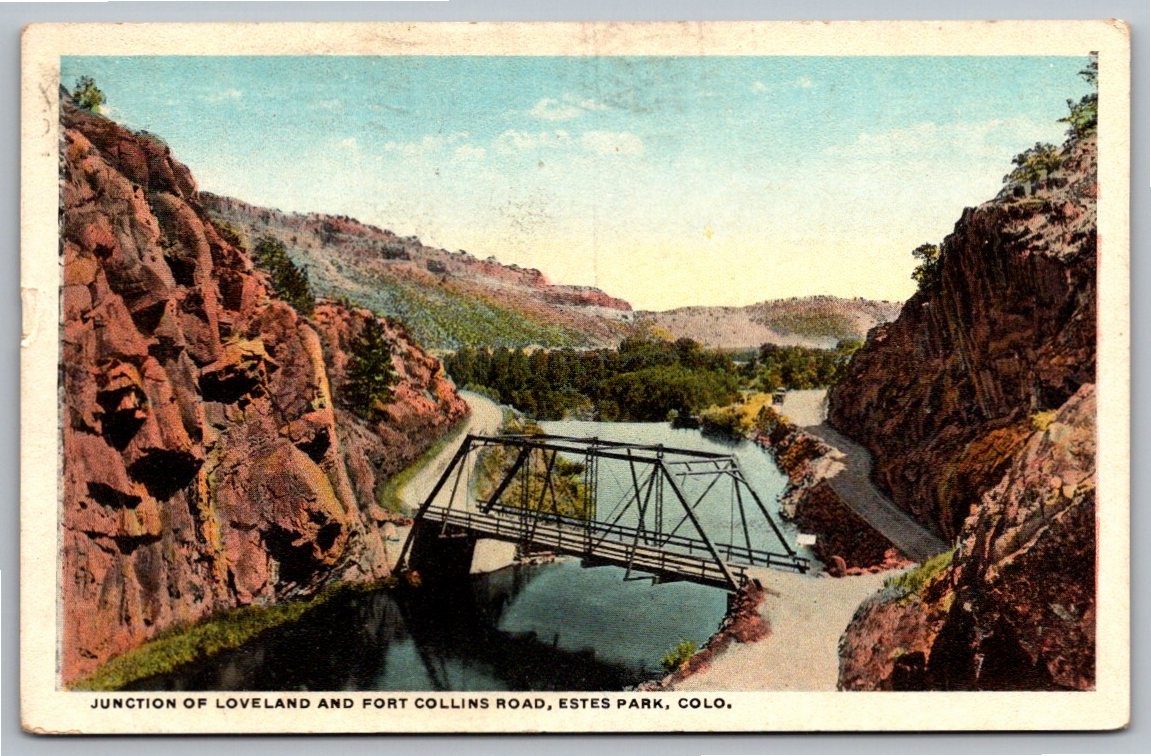
1922 Antique Postcard: Junction of Loveland & Fort Collins Road
📸 Click any thumbnail to inspect Front, Back & Angles (2 Photos)
As an eBay Partner, we may earn a commission if you make a purchase.
Item Specifications
- Era: White Border (1915-1930)
- Year: 1922
- Publisher: W.T. Parke
- Location: Estes Park, Colorado
- Subject: Canyon Bridge & Mountain Road
- Postmark Date: July 8, 1922
- Category: Postcards & Ephemera
- Format / Type: Vintage Postcards
Looking for Modern Alternatives?
Explore top-rated, modern Postcards & Ephemera and related historical accessories on Amazon.
Shop Postcards & Ephemera on Amazon →As an Amazon Associate, we earn from qualifying purchases.
Historical Context & Overview
A Window into Early Colorado Automobile Tourism
In the early decades of the twentieth century, the American West witnessed an extraordinary boom in automobile travel. Following the establishment of Rocky Mountain National Park in 1915, travelers from across the nation flooded into Colorado to experience what contemporary travel literature championed as the "Playground of the World." This vintage White Border postcard, postmarked in July 1922, captures a vital piece of infrastructure from that pioneering era: the steel truss bridge at the junction of the Loveland and Fort Collins roads near Estes Park.
Engineering the Canyon: The Loveland and Fort Collins Junction
Navigating the rugged terrain of northern Colorado's river canyons required innovative engineering. As motor cars replaced horse-drawn wagons, timber crossings were systematically replaced by durable steel truss bridges capable of supporting heavier automotive traffic. The scenic view depicted on the front of this postcard highlights a classic pony truss bridge spanning a rushing river channel flanked by towering, sun-drenched granite cliffs. These canyon routes were crucial arteries, funneling vacationers from northern Front Range communities like Loveland and Fort Collins directly into the gateway of Estes Park.
The White Border Era and Publisher W.T. Parke
Produced during the White Border era of postcard production (roughly 1915 to 1930), this card exhibits the characteristic unprinted paper margin surrounding the hand-colored, lithographic view. Leaving a white border allowed publishers to conserve ink during wartime material shortages and post-war economic adjustments while maintaining vibrant visual detail. This specific card was published locally by W.T. Parke, a prominent Estes Park distributor who captured and commercialized iconic vistas for the region's burgeoning tourist trade.
A Handwritten Memory from July 1922
Beyond its value as an architectural and geographic artifact, the reverse side of this postcard offers an intimate slice of social history. Cancelled with a sharp green one-cent Washington stamp and a clear "Loveland, Colo. Jul 8 1922" postmark, the card carries a handwritten letter from a traveler named Ruth to Miss Jennie Nelson in Wamego, Kansas. Ruth writes glowingly of her mountain adventures, noting that the peaks were "so much more wonderful than I ever imagined" and recounting hikes along the main road to Estes Park. Such personal ephemera provides modern collectors with an authentic connection to the enthusiasm of Roaring Twenties vacationers exploring the majesty of the American Rockies.