1910s George Washington Coat of Arms Windermere Church Postcard
📸 Click any thumbnail to inspect Front, Back & Angles (2 Photos)
As an eBay Partner, we may earn a commission if you make a purchase.
Item Specifications
- Era: 1910s
- Location: Windermere, Cumbria, England
- Subject: George Washington Heraldry & Stained Glass
- Site: Windermere Parish Church (St. Martins)
- Card Type: Printed Ephemera
- Condition: Unposted Vintage
- Category: Postcards & Ephemera
- Format / Type: Vintage Postcards
Looking for Modern Alternatives?
Explore top-rated, modern Postcards & Ephemera and related historical accessories on Amazon.
Shop Postcards & Ephemera on Amazon →As an Amazon Associate, we earn from qualifying purchases.
Historical Context & Overview
The English Origins of American Symbolism in Cumbrian Stained Glass
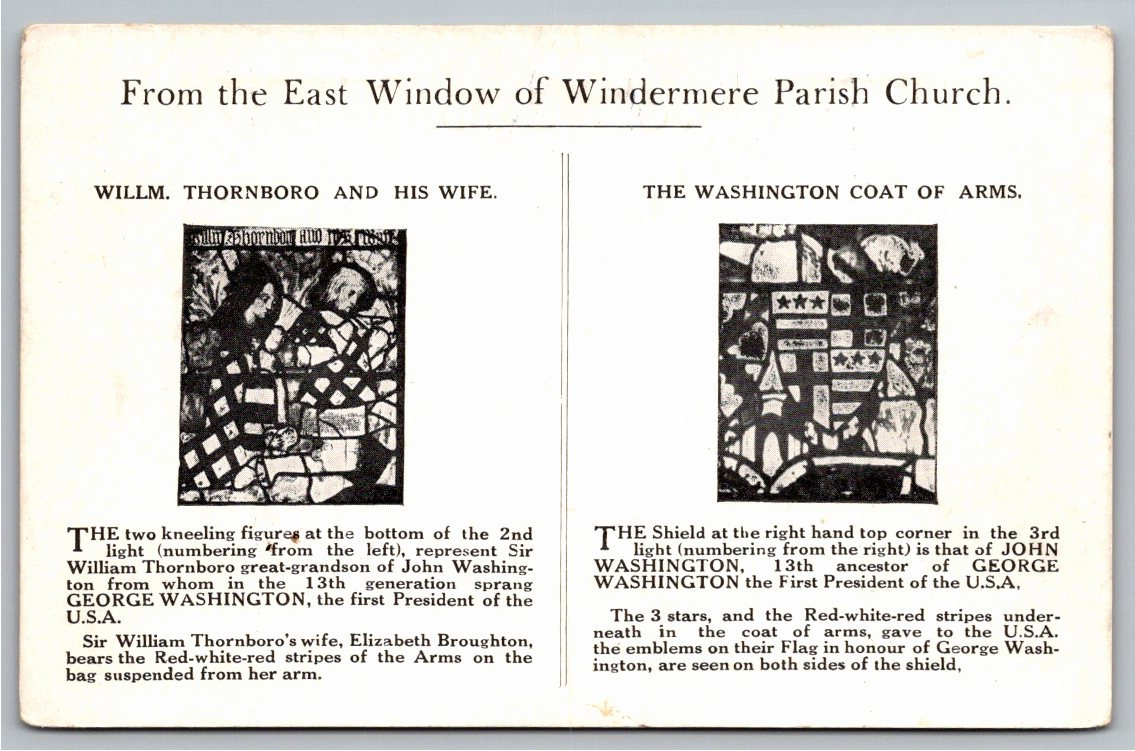
In the heart of England's Lake District, within the historic walls of Windermere Parish Church (St. Martin’s Church in Bowness-on-Windermere), lies a fascinating piece of medieval history directly tied to the lineage of America’s founding president. This rare 1910s postcard illustrates a set of intricate stained glass panels from the church’s famed East Window, depicting medieval heraldry that traces the ancestry of George Washington back through generations of northern English gentry.
An Archival Window into the Washington Ancestry
The East Window of St. Martin's is renowned for incorporating 15th-century stained glass salvaged from monastic and manorial sites following the Dissolution of the Monasteries. Among these treasured leaded panels are family crests and donor portraits. As highlighted on the face of this postcard, one panel depicts Sir William Thornboro and his wife, Elizabeth Broughton. Thornboro was a descendant of John Washington, placing him squarely within the ancestral chain that led, thirteen generations later, to George Washington, the first President of the United States.
Adjacent to the figures, the postcard details the heraldic shield attributed to John Washington. The coat of arms presents a classic heraldic charge: three five-pointed stars (mullets) positioned above two horizontal red bars on a light field. Heraldic scholars and historians have long pointed to this specific armorial arrangement as a primary visual inspiration for the coat of arms adopted by the Washington family at Mount Vernon, and ultimately as an influential precursor to the design of the American national flag—the Stars and Stripes.
A Favorite Stop for Early 20th-Century Transatlantic Pilgrims
By the turn of the 20th century, the Lake District was not only a sanctuary for romantic poets and nature enthusiasts, but also a growing destination for American tourists eager to trace the roots of American democracy back to the English countryside. Postcards like this example were printed in small runs during the 1910s to cater to educated travelers seeking tangible connections to presidential history.
Published with detailed textual commentary on the front, this postcard functioned as both a souvenir and an educational guide. It highlights subtle heraldic details—such as the red-and-white motif visible on Elizabeth Broughton's armorial bag—offering a fascinating glimpse into how medieval genealogy was understood and celebrated at the dawn of the modern era.
A Rare Find for Ephemera and Heraldry Collectors
For collectors of early 20th-century paper ephemera, presidential memorabilia, or heraldic iconography, this unposted postcard represents a unique crossover piece. Its crisp typography, high-contrast monochrome photomechanical imagery, and clean reverse make it an outstanding documentary record of early British-American heritage tourism and the enduring legacy of the Washington family heraldry.