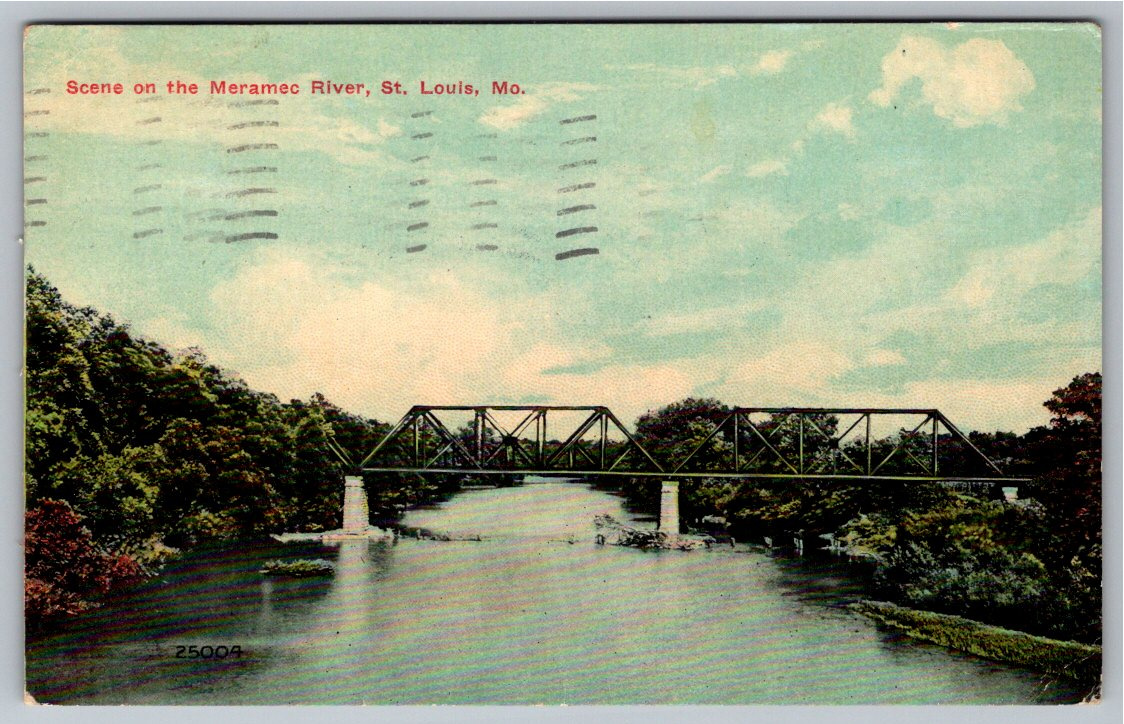
Vintage 1911 Meramec River Steel Truss Bridge St. Louis Postcard
📸 Click any thumbnail to inspect Front, Back & Angles (3 Photos)
As an eBay Partner, we may earn a commission if you make a purchase.
Item Specifications
- Era: Divided Back (1907-1915)
- Year: 1911
- Location: St. Louis, Missouri
- Subject: Meramec River Steel Truss Bridge
- Postmark Date: August 1911
- Originality: Original Vintage
- Category: Postcards & Ephemera
- Format / Type: Vintage Postcards
Looking for Modern Alternatives?
Explore top-rated, modern Postcards & Ephemera and related historical accessories on Amazon.
Shop Postcards & Ephemera on Amazon →As an Amazon Associate, we earn from qualifying purchases.
Historical Context & Overview
A Snapshot of Early 20th-Century Missouri Infrastructure
At the turn of the twentieth century, the waterways surrounding St. Louis were vital corridors for trade, travel, and leisure. Among these, the Meramec River carved a scenic path through the Ozark foothills and southern St. Louis County. As suburban expansion and industrial transport accelerated, robust civil engineering became necessary to connect communities across the winding river. This vintage postcard, produced during the height of the Golden Age of Postcards, captures a classic pin-connected steel truss bridge spanning the quiet waters of the Meramec around 1911.
Steel truss bridges were the backbone of American transportation infrastructure in the late nineteenth and early twentieth centuries. Engineered for durability, lightness, and efficiency, these structures relied on interconnected triangular units to distribute heavy loads evenly. The bridge depicted in this scene features dual-through-truss spans supported by massive masonry piers anchored firmly in the riverbed. Such designs allowed both heavy railway traffic and early automobiles to traverse the region's river valleys safely, facilitating the growth of St. Louis as a central Midwestern transportation hub.
The Golden Age of Divided Back Postcards
This postcard is a classic exemplar of the Divided Back Era, which lasted from 1907 until 1915. Prior to March 1907, United States postal regulations dictated that only the recipient's address could be written on the back of a postcard, leaving senders to squeeze handwritten notes onto the narrow white borders surrounding the front image. When Congress lifted this restriction, publishers began splitting the back down the middle, reserving the right side for the address and the left side for personal correspondence.
Postmarked in St. Louis in August 1911, this piece preserves intimate personal history alongside its industrial vista. The reverse features a clear circular hand-cancel alongside a green one-cent Benjamin Franklin postage stamp, typical for postcard rate delivery during the Taft presidency. The handwritten script offers a glimpse into everyday family communication over a century ago, reflecting the bridge's real-time role in daily life when it was a modern engineering marvel.
Collector Appeal and Historical Significance
Regional St. Louis Memorabilia
For local history enthusiasts and deltiologists specializing in Missouri, postcards showcasing historic bridges over the Meramec River are highly sought after. They document localized landscapes before the mid-century suburban boom drastically reshaped St. Louis County's natural boundaries.
Civil Engineering & Ephemera Value
Beyond its local charm, the postcard serves as a primary visual source for industrial historians studying early American bridge engineering and early 1900s lithographic printing techniques. The soft color tinting over a photographic base provides a nostalgic aesthetic unique to early twentieth-century print culture.