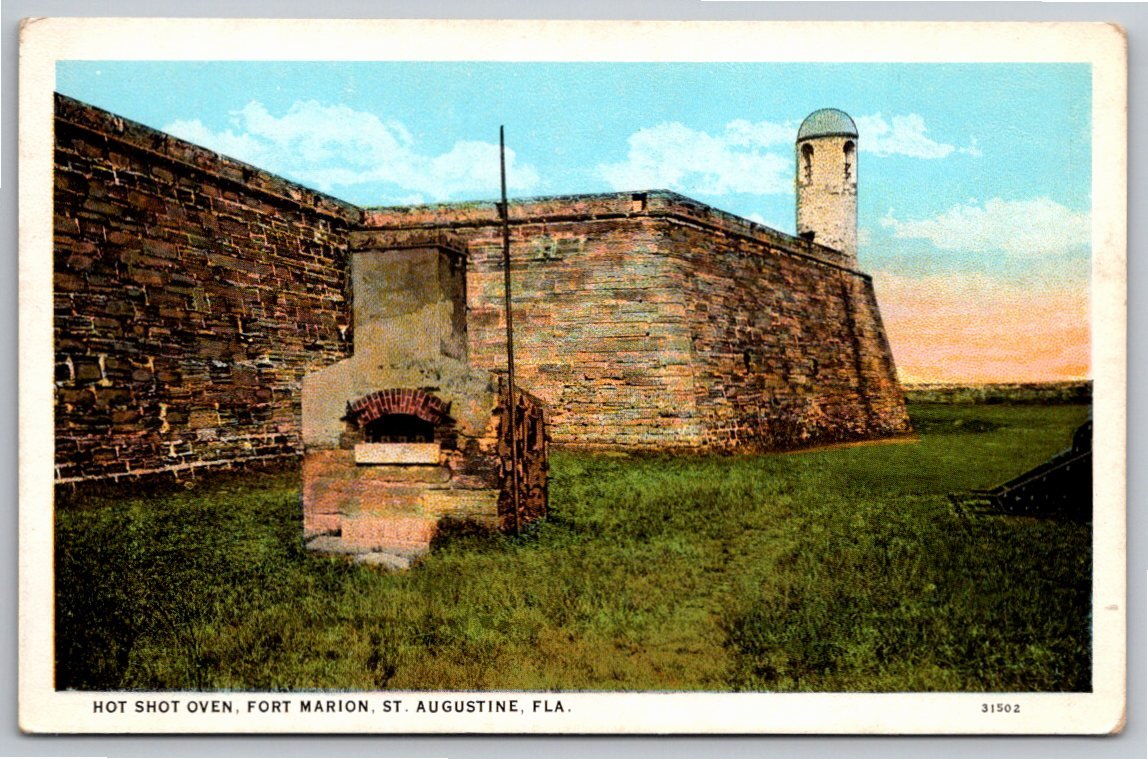
Vintage Postcard: Hot Shot Oven at Fort Marion, St. Augustine
📸 Click any thumbnail to inspect Front, Back & Angles (2 Photos)
As an eBay Partner, we may earn a commission if you make a purchase.
Item Specifications
- Era: 1915-1930 White Border
- Publisher: W. J. Harris Co.
- Printer: Curt Teich & Co.
- Location: St. Augustine, Florida
- Subject: Hot Shot Oven & Fort Marion
- Originality: Original Vintage
- Category: Postcards & Ephemera
- Format / Type: Vintage Postcards
Looking for Modern Alternatives?
Explore top-rated, modern Postcards & Ephemera and related historical accessories on Amazon.
Shop Postcards & Ephemera on Amazon →As an Amazon Associate, we earn from qualifying purchases.
Historical Context & Overview
Preserved in vivid color from the early twentieth century, this White Border era postcard depicts a fascinating piece of military engineering set against the ancient coquina walls of Fort Marion in St. Augustine, Florida. The central focus of the image is the specialized hot shot oven, an essential component of nineteenth-century coastal fortifications designed to deliver devastating incendiary fire against wooden enemy warships.
The Science and Strategy of Hot Shot Ovens
During the era of wooden-hulled naval combat, coastal garrisons sought innovative methods to defend harbor entrances against invading fleets. Ordinary iron cannonballs could pierce a vessel’s timber hull, but a red-hot iron ball possessed the terrifying capability to ignite dry wood, rigging, and gunpowder stores upon impact. To achieve this, military engineers constructed specialized furnace structures known as hot shot ovens.
Positioned near artillery batteries along the fort's perimeter, the oven featured an inclined internal rack. Cold cannonballs were loaded at the upper rear opening and rolled down over an intense coal or wood fire toward the grate near the front furnace door. Within twenty to thirty minutes, the iron shot reached a glowing cherry-red temperature. Artillery crews used custom iron tongs and insulated scoops to transfer the heated shot directly to the cannons, where wet wadding was placed between the gunpowder charge and the red-hot iron to prevent premature detonation. A single direct hit from hot shot could trigger an unextinguishable fire inside an enemy warship, making these furnaces formidable defense mechanisms.
Fort Marion and St. Augustine’s Military Heritage
Originally constructed by the Spanish Empire between 1672 and 1695 as the Castillo de San Marcos, the fortress was built from local coquina—a unique stone formed from compressed prehistoric seashells. The porous stone famously absorbed enemy cannonball impacts rather than shattering under fire, rendering the structure virtually impenetrable. Following the transfer of Florida to the United States, the stronghold was renamed Fort Marion in 1821 in honor of Revolutionary War hero General Francis Marion, a title it retained until its original Spanish name was restored in 1942.
Publishing History and Collector Ephemera
This historic postcard was published locally by the W. J. Harris Company of St. Augustine and produced by the famed Curt Teich Company of Chicago using their proprietary "C.T. American Art Colored" printing process. Dating to the White Border era (circa 1915 to 1930), the print displays the characteristic unprinted white margin that defined postcard production during the interwar years to conserve ink. For collectors of Florida ephemera, military history, and early twentieth-century American print culture, this card offers a captivating glimpse into Florida's oldest city and its enduring defensive architecture.