1914 Vintage Photo Family Beach Boardwalk Concession Hats
📸 Click any thumbnail to inspect Front, Back & Angles (2 Photos)
🔗 Embed / Cite This Archival Image (Free with Attribution)Get HTML Code
© USA RESELL. Bloggers, historians, and website owners may embed this image for free by copying the HTML code below (which includes the required credit link back to this page):
USA RESELL is a living historical archive. Because original artifacts are one-of-a-kind and source records change rapidly, use the button above to check live marketplace availability or locate surviving examples. As an eBay Partner, we may earn a commission on qualifying purchases.
Item Specifications
- City: Unspecified
- Country: United States
- Era: 1910s
- Subject: Beach
- Theme: Americana
- Year of Production: 1914
- Category: Vintage Photography
- Format / Type: Vintage Photographs
Historical Context & Overview
Visual Overview: An Edwardian Seaside Gathering in 1914
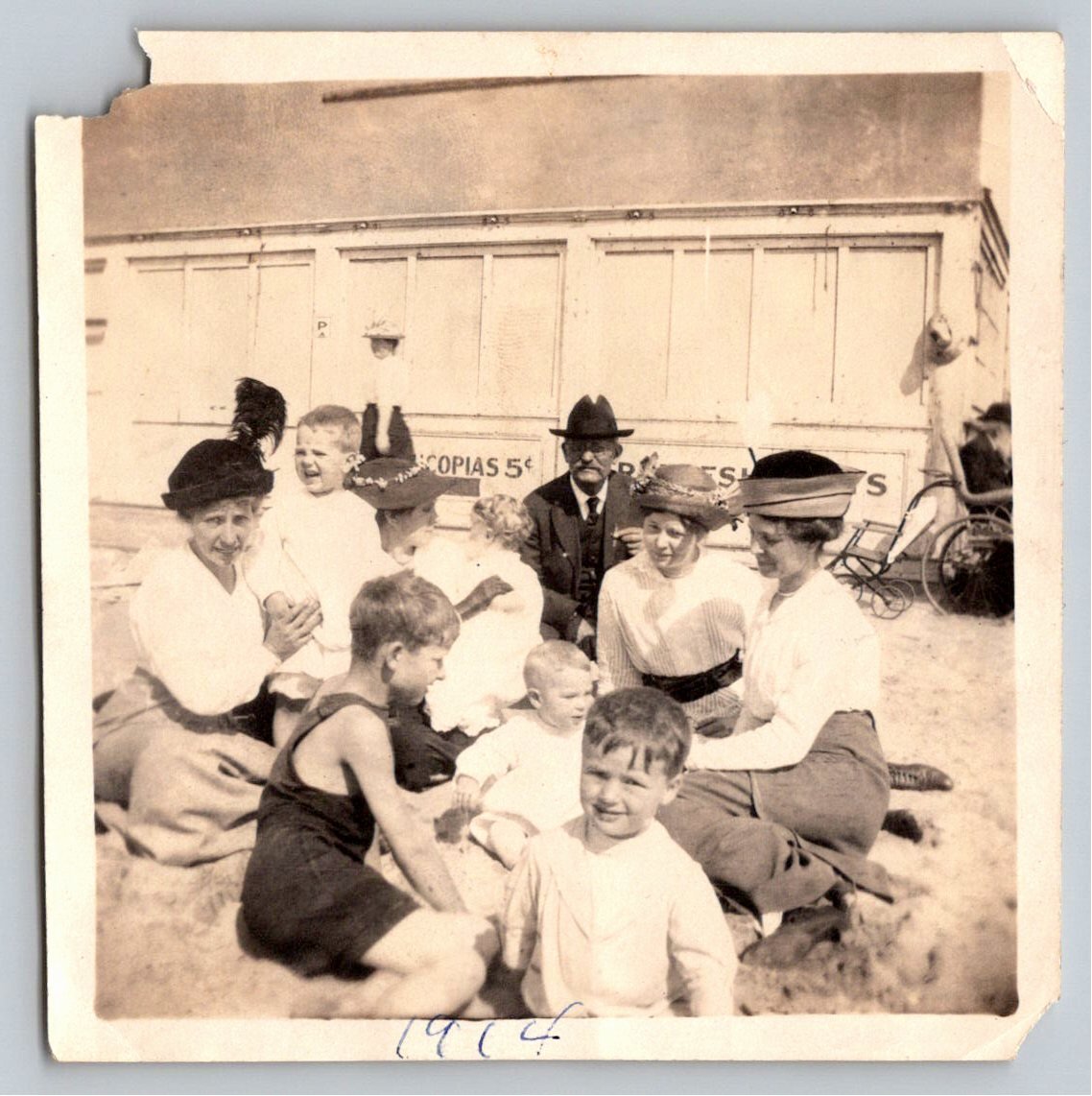
This evocative candid print captures an intimate slice of early American resort leisure during the summer of 1914. Spanning multiple generations, a family group rests directly upon the sand, nestled before the painted wooden facade of a coastal pavilion or bathhouse. Prominently displayed along the exterior panels are vintage commercial concession advertisements, including a sign reading "Cornucopias 5¢" alongside notices for cold refreshments. Resting nearby near the walkway edge, a period wicker perambulator or bath chair provides a distinct reminder of early twentieth-century holiday convenience.
The composition provides an exceptional cross-section of pre-First World War beach fashion. The women wear high-collared Edwardian summer blouses and long skirts, complemented by decorative wide-brimmed millinery adorned with plumes and ribbons. An elder gentleman sits centrally attired in a tailored dark suit and fedora, maintaining Victorian sartorial standards despite the shoreline environment. Meanwhile, the younger generation exhibits greater freedom; an adolescent boy reclines in the sand clad in an authentic dark woolen tank-style bathing suit, surrounded by younger children and infants in light summer cottons.
Historical Context: The Rise of the Boardwalk and Snapshot Photography
By the summer of 1914, coastal boardwalks had transformed into vibrant centers of American recreational life. Destinations like Atlantic City, Coney Island, and regional seaside towns accommodated growing middle-class families seeking respite from industrial metropolitan centers. Concession stands offering inexpensive treats such as cornucopias—waffle cones filled with ice cream or sweets—symbolized the emergence of commercialized seaside culture where working and middle-class patrons could indulge in casual treats alongside ocean bathing.
Simultaneously, the photographic medium was undergoing a profound cultural democratization. Handheld roll-film cameras, popularized by consumer market innovators like George Eastman, empowered everyday individuals to document domestic holidays outside of formal portrait studios. The spontaneous staging of this snapshot—complete with candid facial expressions, an inquisitive infant in the foreground, and figures casually glancing across the frame—embodies the candid authenticity that defined early amateur snapshot photography just prior to the global upheaval of World War I.
Provenance, Physical Attributes, and Collector Value
Dating precisely to 1914 via a contemporary handwritten annotation in blue ink along the lower front margin, this authentic original print measures approximately 3.5 by 3.5 inches. The reverse exhibits standard photographic stock lacking any photograph markings, featuring the handwritten inventory number "67" in soft pencil. Prominent residual paper fibers and darkened adhesive remnants across the back confirm its provenance as a carefully preserved keepsake originally mounted within an antique family scrapbook album.
The artifact is in fair condition, marked by a missing fragment at the upper left corner and minor edge softening consistent with handling over the span of more than a century. The image retains a warm sepia tone with well-balanced midtone contrast, preserving sharp architectural lettering and fine textile details. For collectors of vernacular photography, vintage beach ephemera, and early twentieth-century social history, this snapshot offers a rare and candid window into quintessential pre-war American seaside leisure.