Vintage 1917 St. Louis Municipal Free Bridge Moonlight Postcard
📸 Click any thumbnail to inspect Front, Back & Angles (2 Photos)
As an eBay Partner, we may earn a commission if you make a purchase.
Item Specifications
- Era: Divided Back
- Year: 1917
- Location: St. Louis, Missouri
- Subject: Municipal Free Bridge
- Theme: Moonlight Night Scene
- Originality: Original Vintage
- Category: Postcards & Ephemera
- Format / Type: Vintage Postcards
Looking for Modern Alternatives?
Explore top-rated, modern Postcards & Ephemera and related historical accessories on Amazon.
Shop Postcards & Ephemera on Amazon →As an Amazon Associate, we earn from qualifying purchases.
Historical Context & Overview
An Architectural Triumph in the Moonlight
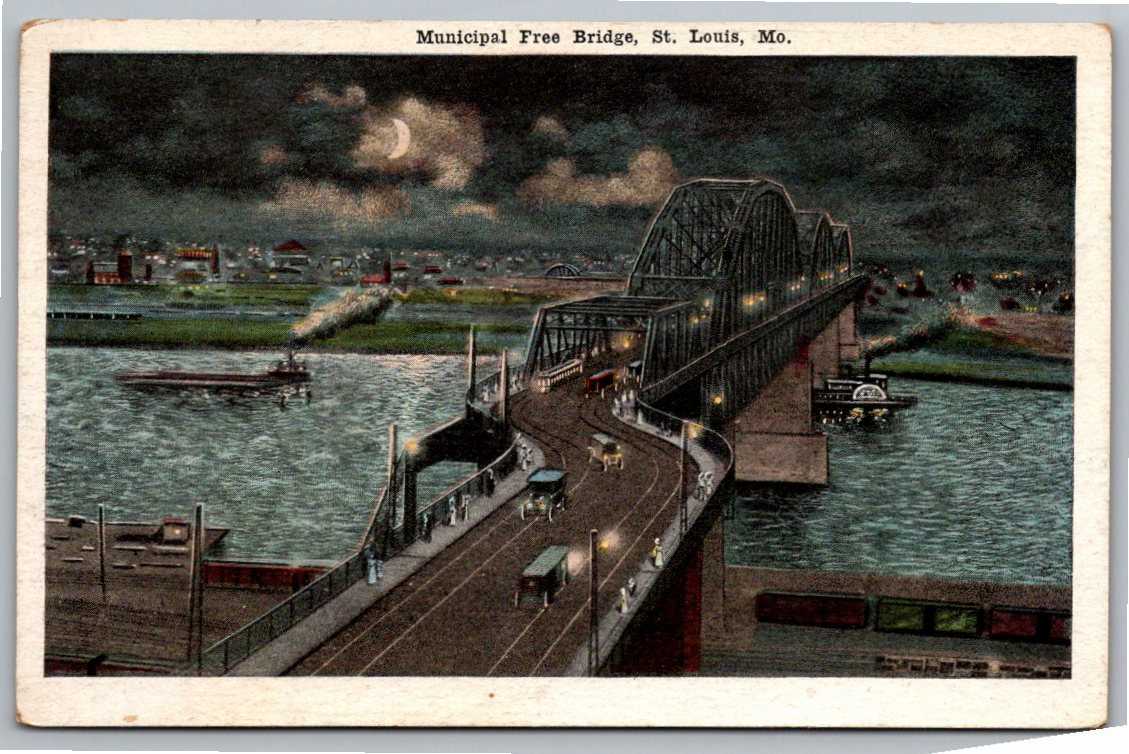
Bathed in the ethereal glow of a crescent moon breaking through atmospheric clouds, this vintage 1917 postcard captures one of the most significant civil engineering achievements in St. Louis history: the Municipal Free Bridge. Illuminated streetlamps, glowing car headlights, and steamships churning across the dark waters of the Mississippi River evoke the bustling energy of the Gateway City during the dawn of the motorized era.
Breaking the Mississippi River Monopoly
Prior to the construction of the Municipal Free Bridge, crossing the Mississippi River at St. Louis meant paying steep tariffs to private railroad syndicates that controlled the existing bridges. In response to public outcry, the citizens of St. Louis voted to fund a municipally owned, toll-free crossing. Dedicated in January 1917 at an impressive cost of approximately six million dollars, the structure represented a major victory for public infrastructure, connecting 7th Street and Chouteau Avenue on the Missouri bank directly to Illinois.
Engineering Marvel of the Progressive Era
The bridge was designed as a heavy-duty, double-deck steel truss structure capable of handling multiple modes of transportation simultaneously. The upper deck was dedicated to automotive traffic, pedestrian walkways, and electric streetcar lines, while the lower level was engineered to carry heavy freight and passenger trains. The main span stretched over 2,022 feet across the river, supported by thousands of feet of complex elevated steel approaches on either side. Decades later, the bridge would be renamed the MacArthur Bridge in honor of General Douglas MacArthur, but early 20th-century memorabilia preserves its original, triumphant title.
The Golden Age of Nocturnal Lithography
During the golden age of postcards, "night scenes" or "moonlight views" were amongst the most technically demanding and sought-after art styles. Printers utilized specialized color lithography to lay down deep indigo and charcoal undertones, overprinting them with brilliant yellow and white highlights. This technique created a dramatic visual contrast, making the glowing lamps along the curved highway approach and the glistening reflections on the river surface appear almost luminous to the viewer.
A Collector's Keepsake of St. Louis History
Unposted and featuring a detailed historical breakdown of the bridge's dimensions and construction costs on its reverse side, this postcard serves as both an artistic artifact and an educational record. For urban historians, bridge enthusiasts, and collectors of Missouri deltiology, this nocturnal view offers a evocative glimpse into the nocturnal rhythms of early 20th-century American commerce and transit.