Vintage Antietam Battlefield MD Burnside Bridge Postcard
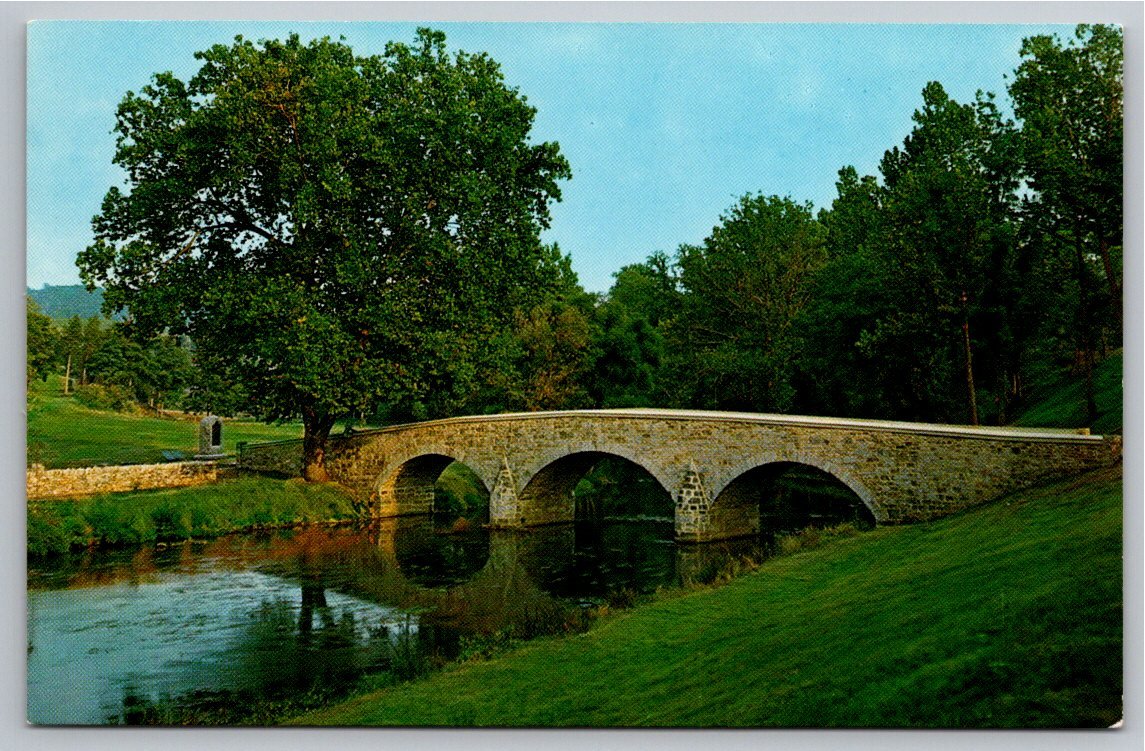
📸 Click any thumbnail to inspect Front, Back & Angles (4 Photos)
As an eBay Partner, we may earn a commission if you make a purchase.
Item Specifications
- Publisher: Artvue Post Card Co.
- Series: Kolorvue
- Location: Sharpsburg, Maryland
- Subject: Burnside Bridge & Antietam Battlefield
- Photographer: R. L. Lagemann
- Era: 1960s Photochrome
- Category: Postcards & Ephemera
- Format / Type: Vintage Postcards
Looking for Modern Alternatives?
Explore top-rated, modern Postcards & Ephemera and related historical accessories on Amazon.
Shop Postcards & Ephemera on Amazon →As an Amazon Associate, we earn from qualifying purchases.
Historical Context & Overview
The Architectural and Military Legacy of Antietam's Burnside Bridge
Constructed in 1836 out of local Maryland limestone, the triple-arch bridge over Antietam Creek near Sharpsburg was originally built to facilitate commerce and transport for local agricultural communities. Known initially as Lower Bridge, the structure gained everlasting historic prominence on September 17, 1862, during the pivotal Battle of Antietam—the bloodiest single day of combat in American military history.
On that fatal morning, Major General Ambrose E. Burnside and his Union IX Corps attempted to force a crossing across the narrow stone bridge. Positioned on the bluffs overlooking the creek, a small contingent of Confederate riflemen from Georgia under General Robert Toombs successfully pinned down thousands of Union soldiers for hours. The bottleneck created a heroic yet costly tactical delay. By the time Union troops finally breached the position around 1:00 p.m. and pushed across the span, Confederate reinforcements under General A.P. Hill arrived from Harpers Ferry to blunt the Union advance. The structure was forever renamed Burnside Bridge in memory of the dramatic conflict that transpired across its cobblestone path.
Capturing Mid-Century Civil War Commemoration
In the post-World War II era, interest in preserving and visiting landmark Civil War battlefields surged across the United States. National Military Parks like Antietam became essential educational destinations for American families, veterans, and historical enthusiasts. To document these visits, high-quality souvenir ephemera was produced by prominent publishers, bringing the preserved landscapes into living rooms nationwide.
This vintage postcard set, produced by the Artvue Post Card Company of New York under their signature Kolorvue line, captures the tranquil majesty of the battlefield in the mid-20th century. Featuring vivid photography by R. L. Lagemann, the imagery highlights both Burnside Bridge and Cornfield Avenue. Notable details include the grand sycamore tree standing adjacent to the bridge—a famous "witness tree" that was merely a young sapling during the 1862 battle—alongside field artillery cannons and commemorative regimental monuments positioned along the rolling perimeter of David R. Miller's historic cornfield.
Collector Significance and Preservation
Mid-century photochrome postcards occupy a revered niche among ephemera collectors and Civil War historians. The rich color reproduction of the Kolorvue process provides a vivid snapshot of park preservation during the mid-1960s, documenting how landmark sites were interpreted and maintained for visitors. For philatelists and deltiologists alike, these cards serve as tangible links to both 19th-century military history and 20th-century American heritage tourism, offering timeless educational and aesthetic value.