Vintage 1920s Ford Model T Touring Car Black & White Snapshot
📸 Click any thumbnail to inspect Front, Back & Angles (2 Photos)
As an eBay Partner, we may earn a commission if you make a purchase.
Item Specifications
- Era: 1920s
- Subject: Ford Model T Touring Car
- Paper Stock: Velox Paper
- Medium: Silver Gelatin Print
- Condition: Very Good Vintage
- Originality: Original Vintage
- Category: Vintage Photography
- Format / Type: Snapshots
Looking for Modern Alternatives?
Explore top-rated, modern Vintage Photography and related historical accessories on Amazon.
Shop Vintage Photography on Amazon →As an Amazon Associate, we earn from qualifying purchases.
Historical Context & Overview
An Iconic Emblem of the American Road
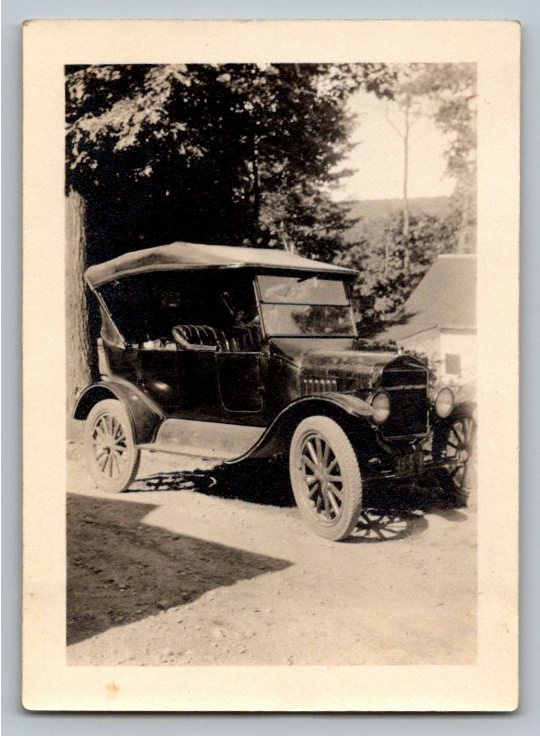
By the dawn of the 1920s, Henry Ford's vision of universal motor transport had fundamentally altered the landscape of everyday American life. Known affectionately as the "Tin Lizzie," the Ford Model T was no longer just an automotive innovation—it was a societal centerpiece. This original black-and-white snapshot captures an early 1920s Ford Model T Touring Car parked along a sun-dappled rural drive, offering a candid glimpse into the golden era of early motoring.
Anatomy of the 1920s Touring Model
The Touring Car was among the most versatile and widespread body configurations offered by the Ford Motor Company. Designed to seat five passengers comfortably across two rowed benches, it featured an open-sided construction paired with a folding fabric top. In this photograph, the dark canvas roof is fully raised, emphasizing the upright, stately profile that characterized Ford's assembly lines during the early post-World War I years.
Several key visual features anchor this vehicle firmly in the early 1920s design window. Notice the traditional wooden artillery-spoked wheels, a structural staple before steel disk and wire wheels gained widespread adoption later in the decade. The gloss of the dark body panels reflects the surrounding greenery, testifying to the iconic high-gloss black enamel finish that was standardized on assembly lines to accelerate drying times. Up front, the dual headlights and crowned front fenders frame the classic radiator shell, showing a vehicle built for durability across rugged country roads.
Vernacular Photography and the Velox Stamp
Beyond its automotive significance, this photograph serves as a charming document of early 20th-century personal photography. The reverse side features the iconic "Velox" stamp, a silver chloride photographic paper developed by Leo Baekeland and produced by Eastman Kodak. Velox paper revolutionized amateur photography by allowing prints to be developed under artificial light without needing direct sunlight, making home developing and local studio printing far more accessible to the public.
During the 1920s, personal ownership of both automobiles and handheld cameras exploded simultaneously. Car owners took immense pride in their vehicles, often posing them outside suburban homes, farmsteads, or along scenic country routes. Handwritten on the back in vintage pencil is the period identification "Early '20's FORD 'T'", preserving the personal cataloging of a collector or family historian from decades past.
For historians of early American transportation, vernacular photo collectors, and Model T enthusiasts, this original snapshot represents an authentic artifact of early 20th-century culture—where freedom, mobility, and photography intersected on the open road.