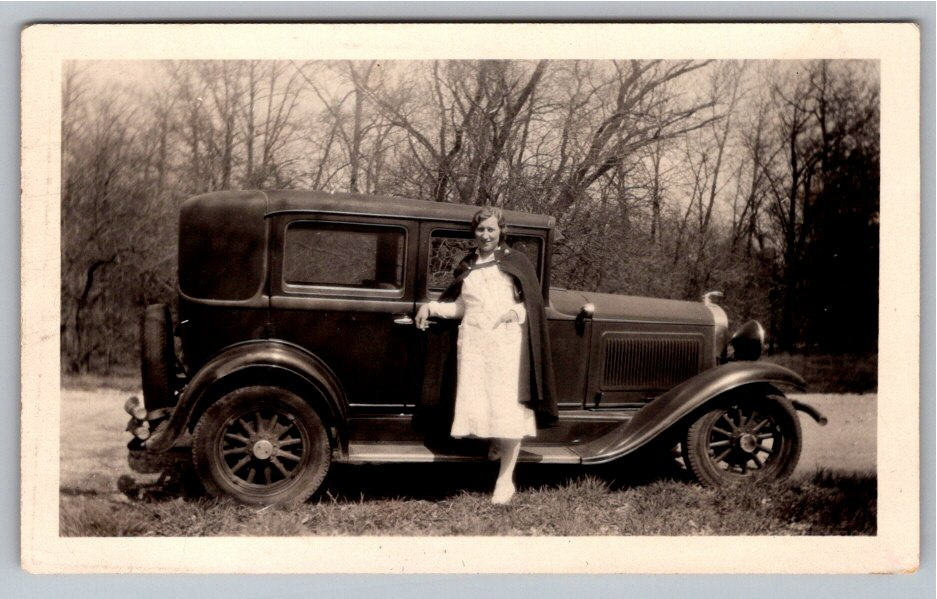
Vintage 1930 Nurse Standing with Willys Whippet Sedan B&W Photo
📸 Click any thumbnail to inspect Front, Back & Angles (2 Photos)
As an eBay Partner, we may earn a commission if you make a purchase.
Item Specifications
- Era: c. 1929-1930
- Subject: Nurse in Uniform & Cape
- Automobile: Willys Whippet Sedan
- Medium: Black & White Photography
- Language: Czech Inscription on Verso
- Originality: Original Vintage Print
- Category: Vintage Photography
- Format / Type: Snapshots
Looking for Modern Alternatives?
Explore top-rated, modern Vintage Photography and related historical accessories on Amazon.
Shop Vintage Photography on Amazon →As an Amazon Associate, we earn from qualifying purchases.
Historical Context & Overview
A Striking Window Into Interwar Mobility and Medical Service
This original black-and-white snapshot captures a compelling moment from the cusp of the 1930s, bridging the histories of American automotive design and women in medicine. Positioned alongside a handsome 1929–1930 Willys Whippet four-door sedan, a woman clad in full nurse’s attire—complete with a dark woolen nursing cape, crisp white dress, and traditional headpiece—poses with unstudied confidence. The photograph serves not merely as a personal keepsake, but as an evocative artifact documenting early female automobility and public health history.
Engineering Accessibility: The Willys Whippet Automobile
Introduced by the Willys-Overland Company in 1926 as a compact, economical alternative to heavier contemporary vehicles, the Whippet quickly became a cornerstone of late 1920s motoring. Engineered to compete directly with Ford's Model A and Chevrolet's six-cylinder line, the Whippet boasted advanced features for its class, including mechanical four-wheel brakes, wood-spoke artillery wheels, and the innovative 'Finger Tip Control' button on the steering column wheel, which managed ignition, lights, and horn from a single mechanism.
By the time production ceased in 1931 amidst the economic headwinds of the Great Depression, the Whippet had earned a widespread reputation for reliability and nimble handling. For rural practitioners, visiting district nurses, and working professionals who required dependable transport over unpaved interwar roads, compact sedans like this Whippet provided an unprecedented degree of personal freedom and operational efficiency.
The Uniform and Identity of the Early 20th-Century Nurse
The subject’s attire offers a rich study in early 20th-century nursing vestments. Wearing a pristine white uniform paired with a heavy dark cape draped over her shoulders, her ensemble reflects the strict professional standards of the late 1920s and early 1930s. Nursing capes, often lined in contrasting felt or wool, were essential outerwear for visiting nurses traveling between clinical settings and home appointments during cold weather. Beyond their practical utility, these capes served as cherished symbols of professional pride and institutional affiliation.
Ephemera and Historical Nuance
Adding significant historical depth to this photograph is the handwritten inscription on the reverse. Written in Czech, the cursive note identifies the subject in her white uniform and cap while making explicit mention of the 1929–1930 Whippet. This personal commentary offers a direct, intimate link between the photographic subject, her heritage, and her pride in both her profession and her motor car.
For collectors of vernacular photography, vintage automotive ephemera, and medical history, candid real-photo snapshots like this offer an unfiltered perspective on everyday life between the World Wars. It stands as a superb example of how early automobile culture empowered working women during a pivotal era in modern history.