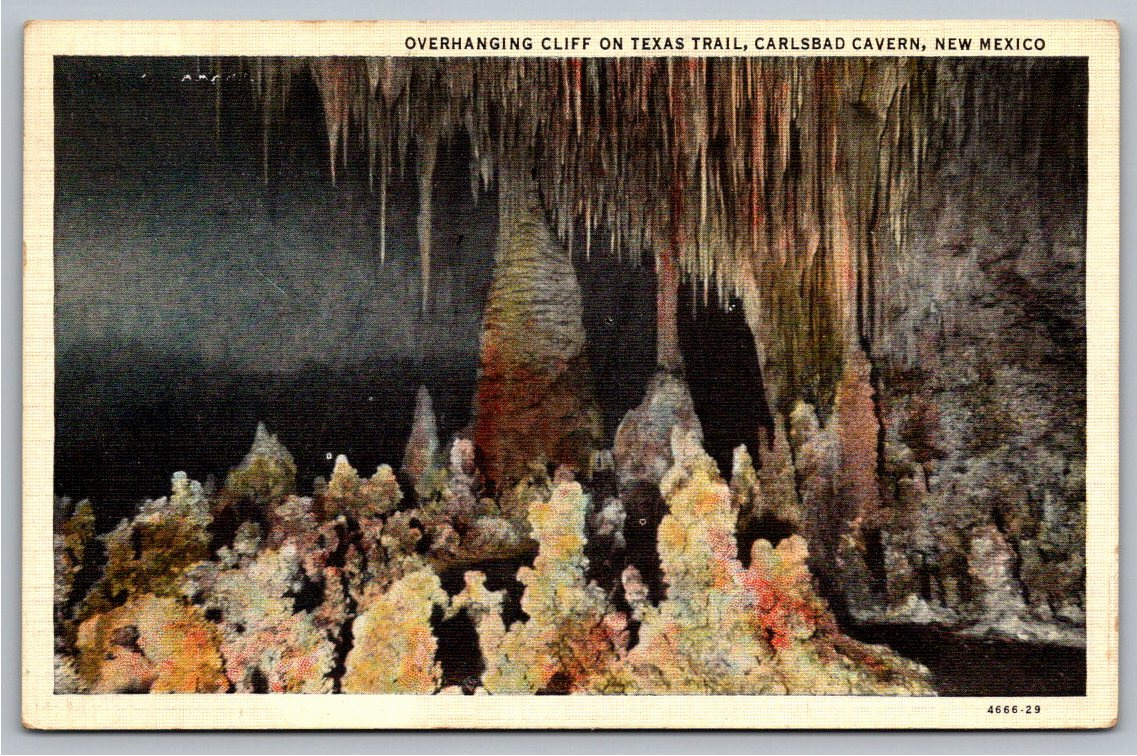
1937 Carlsbad Caverns Vintage Postcard: Texas Trail Overhanging
📸 Click any thumbnail to inspect Front, Back & Angles (2 Photos)
As an eBay Partner, we may earn a commission if you make a purchase.
Item Specifications
- Era: 1930s Linen
- Publisher: Curt Teich & Co.
- Location: Carlsbad Caverns, New Mexico
- Subject: Overhanging Cliff on Texas Trail
- Postmark Year: 1937
- Originality: Original Vintage
- Category: Postcards & Ephemera
- Format / Type: Vintage Postcards
Looking for Modern Alternatives?
Explore top-rated, modern Postcards & Ephemera and related historical accessories on Amazon.
Shop Postcards & Ephemera on Amazon →As an Amazon Associate, we earn from qualifying purchases.
Historical Context & Overview
Exploring the Subterranean Wonders of Carlsbad Caverns
In the 1930s, as automobile tourism surged across the American Southwest, few destinations captured the public imagination quite like Carlsbad Caverns National Park in southeastern New Mexico. Designated a national park in 1930, the massive subterranean limestone chambers were carved over millions of years by sulfuric acid dissolved in groundwater, creating otherworldly rock formations that dazzled early 20th-century travelers. Among the famous interior walkways laid out for visitors was the Texas Trail, a route that guided intrepid subterranean tourists past towering stalagmites, curtain-like flowstone, and looming overhangs deep beneath the Chihuahuan Desert.
This vintage postcard captures the dramatic vista known as the "Overhanging Cliff on Texas Trail." A forest of delicate stalactites hangs suspended from the cavern ceiling, while intricately layered speleothems rise up from the cave floor. During the Great Depression, infrastructure work by the Civilian Conservation Corps (CCC) helped build paved trails, safety railings, and lighting systems inside Carlsbad Caverns, making views like this accessible to thousands of everyday road-trippers journeying down U.S. Route 62.
The Golden Age of Curt Teich Linen Postcards
Produced by the famous printing house Curt Teich & Co. of Chicago, Illinois, this card is a classic example of the "Linen Era" of postcard manufacturing, which dominated the souvenir industry from 1931 through the 1950s. Printed using Teich’s trademarked Art-Colortone process, the card features a high-rag content paper with a distinct embossed linen texture. This surface allowed offset lithography inks to absorb richly, producing the vibrant, almost painterly colors characteristic of vintage mid-century American travel ephemera.
Curt Teich postcards were meticulously crafted from black-and-white photographs taken on site, which artists then hand-retouched and colorized. This technique gave natural landmarks—such as the shadows and subtle mineral hues of Carlsbad's limestone chambers—an ideal, romanticized brilliance that seduced postcard buyers and recipients across the nation.
A Handwritten Window into 1937 Travel
Beyond its striking visual presentation, this piece offers a fascinating personal record of pre-war American tourism. Postmarked at Carlsbad, New Mexico, on January 31, 1937, with a green one-cent George Washington stamp, the reverse carries a handwritten message sent home to Kansas. The traveler vividly recounts their experience deep underground:
"Went thru Caverns today. Grandest sight have ever seen... ate dinner today 750 ft. under ground and walked over 5 1/2 miles underground."
The message captures the awe inspired by the park's famous underground lunchroom—located 750 feet below the surface—where visitors could pause for refreshment mid-tour. For collectors of Southwestern history, National Park memorabilia, and vintage linen ephemera, this 1937 postcard stands as a poignant artifact of early American adventure travel.