Antique c. 1910s Armour Meat Packing Plant Slaughterhouse
📸 Click any thumbnail to inspect Front, Back & Angles (2 Photos)
As an eBay Partner, we may earn a commission if you make a purchase.
Item Specifications
- Era: 1910s
- Company: Armour and Company
- Location: Chicago, Illinois
- Subject: Industrial Meatpacking & Livestock
- Production Method: Lithograph Print
- Condition: Unposted Vintage
- Category: Postcards & Ephemera
- Format / Type: Vintage Postcards
Looking for Modern Alternatives?
Explore top-rated, modern Postcards & Ephemera and related historical accessories on Amazon.
Shop Postcards & Ephemera on Amazon →As an Amazon Associate, we earn from qualifying purchases.
Historical Context & Overview
An Industrial Artifact of Progressive-Era Meatpacking
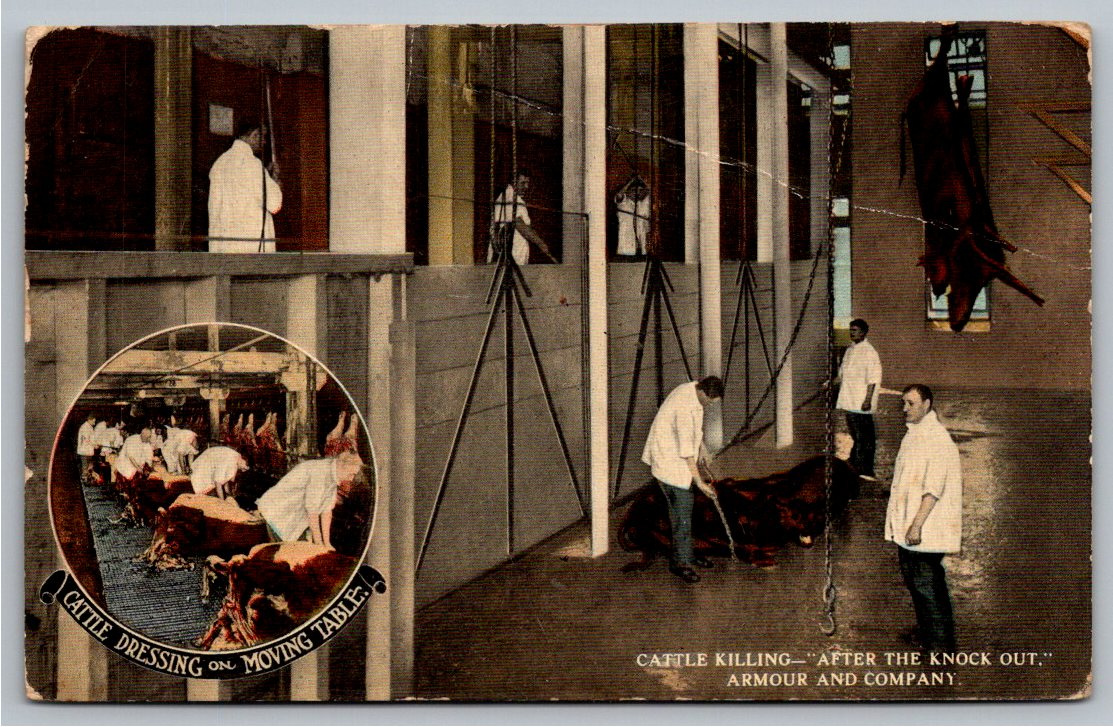
In the early twentieth century, the Union Stock Yards in Chicago stood as an undisputed marvel of American industrial efficiency and scale. Among the titan firms dominating the industry was Armour and Company, an enterprise that transformed livestock processing into a hyper-rationalized science. This rare c. 1910s postcard offers an unfiltered, historic look into the operational floor of Armour’s cattle processing facility—a raw testament to the dawn of modern mass production.
Visualizing the Disassembly Line
The postcard prominently depicts workers outfitted in white coats operating along the slaughterhouse floor under the caption, "Cattle Killing—'After the Knock Out,' Armour and Company." An inset circular view shows "Cattle Dressing on Moving Table," highlighting the intense mechanization that defined early twentieth-century American meatpacking. In an era when corporate photography was increasingly used to showcase industrial might, major packing houses proudly circulated postcards detailing their operational mechanics. Rather than obscuring the process, firms like Armour framed it as evidence of mechanical efficiency, systematic organization, and technological progress.
Intriguingly, the continuous-overhead track system and division of specialized labor shown here played a significant role in industrial engineering history. Henry Ford famously drew inspiration from observing the rapid, continuous workflow of Chicago's meatpacking "disassembly lines," adapting the overhead conveyor concept to build his legendary automotive assembly line for the Model T.
Historical Context: The Post-Jungle Era
Circulated in the years following the 1906 publication of Upton Sinclair's landmark muckraking novel The Jungle and the subsequent passage of the Pure Food and Drug Act and Meat Inspection Act, promotional material from major meatpackers carried an intentional public relations component. By highlighting clean, white-clad workers navigating orderly machinery, Armour aimed to reassure a nervous public of the hygiene and modern oversight within their massive packing houses.
A Unique Document of Early American Industry
For collectors of industrial history, social historians, and deltiologists, early twentieth-century postcard view cards represent a vital visual archive. Printed with a classic divided back layout and period typography, this postcard captures a pivotal moment when American manufacturing was redefining labor, technology, and corporate scale on a global stage.