1955 Hospital Patients Wheelchairs Casts Vintage Photo
📸 Click any thumbnail to inspect Front, Back & Angles (2 Photos)
🔗 Embed / Cite This Archival Image (Free with Attribution)Get HTML Code
© USA RESELL. Bloggers, historians, and website owners may embed this image for free by copying the HTML code below (which includes the required credit link back to this page):
USA RESELL is a living historical archive. Because original artifacts are one-of-a-kind and source records change rapidly, use the button above to check live marketplace availability or locate surviving examples. As an eBay Partner, we may earn a commission on qualifying purchases.
Item Specifications
- City: Unspecified
- Country: United States
- Era: 1950s
- Subject: Hospital Patients Orthopedic Casts Wheelchairs Convalescence
- Theme: Medical
- Year of Production: 1955
- Category: Vintage Photography
- Format / Type: Snapshots
Historical Context & Overview
Mid-Century Convalescence and Orthopedic Care
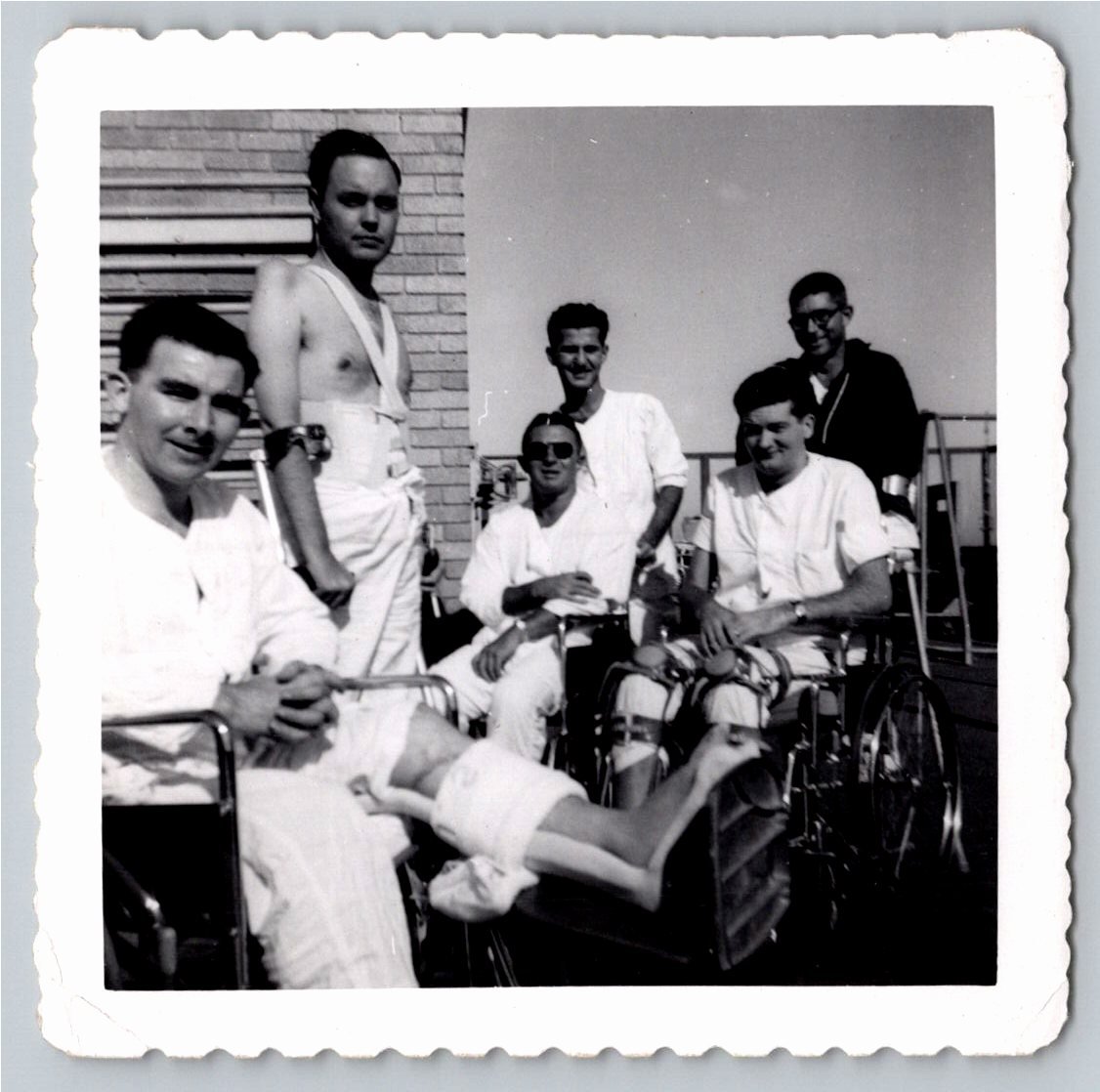
This evocative 1950s silver gelatin snapshot provides a candid, authentic look into institutional medical care and recovery during the post-war era. Gathered on an open-air hospital terrace or rooftop patio bathed in bright daylight, a group of young and middle-aged men share a moment of fellowship away from their indoor wards. Several of the men rest in classic chrome-framed, folding tubular wheelchairs. In the immediate foreground, a patient sits with his heavily bandaged right leg propped straight on an extended leg rest, exposing bare toes alongside a thick plaster-and-gauze orthopedic dressing.
Beside him, an upright companion wears an elaborate torso harness and supportive stabilization wrap, looking resolutely into the lens. In the middle ground, fellow convalescents—including one wearing dark sunglasses and another seated upright in a chair—are joined by hospital orderlies or nursing attendants standing near the perimeter railing. The architectural backdrop of utilitarian brick masonry underscores the mid-twentieth-century sanitarium or military veterans' hospital aesthetic, where fresh air and sun therapy remained cornerstone elements of the post-operative healing regimen.
The Culture of Fellowship in Post-War Rehabilitation
During the 1950s, medical institutions across North America and Western Europe placed heavy emphasis on rehabilitation, particularly as techniques in orthopedic surgery and physical therapy rapidly advanced following World War II and the Korean War. Prolonged bed rest was gradually replaced by mobilization protocols, which encouraged patients with major fractures, joint reconstructions, or spinal alignments to gather outdoors. Moving patients onto sun porches not only promoted vitamin D synthesis and circulation but also boosted moral endurance through shared conversation.
The camaraderie palpable in this frame reflects the informal social fabric that developed among extended-stay patients. Dressed in standard-issue white hospital shirts, loose trousers, and medical wraps, these men convey a mixture of relaxed confidence and wry resilience. Candid photography taken by patients, visitors, or nursing staff offered a meaningful way to document long recoveries, preserving genuine moments of humor and patience amidst the sterile routine of daily clinical treatment.
Format, Paper Chemistry, and Archival Preservation
Printed on traditional square-format silver gelatin paper measuring roughly 3.5 by 3.4 inches, the photograph exhibits characteristic decorative scalloped or deckle border edges. This perimeter treatment was extremely popular in commercial photo lab processing throughout the mid-1950s, providing a distinctive vintage silhouette that immediately dates the print. The fiber-base paper maintains strong tonal fidelity, featuring deep blacks in the shadowed recesses, balanced mid-tones across the hospital garb, and crisp highlights on the sunlit brick wall.
The reverse side of the snapshot is completely blank, displaying clean, naturally aged off-white photographic paper without studio ink stamps or contemporary inscriptions. The print is preserved in sound vintage condition, showing only minimal corner handling wear consistent with careful private album keeping over the decades. As an original mid-century historical artifact, it serves as a fascinating visual document of twentieth-century medical history, vintage mobility equipment, and mid-century vernacular photography.