1957 Mechanics Repairing 1940s Classic Car Snapshot - 1950s
📸 Click any thumbnail to inspect Front, Back & Angles (2 Photos)
🔗 Embed / Cite This Archival Image (Free with Attribution)Get HTML Code
© USA RESELL. Bloggers, historians, and website owners may embed this image for free by copying the HTML code below (which includes the required credit link back to this page):
USA RESELL is a living historical archive. Because original artifacts are one-of-a-kind and source records change rapidly, use the button above to check live marketplace availability or locate surviving examples. As an eBay Partner, we may earn a commission on qualifying purchases.
Item Specifications
- City: Unspecified
- Country: United States
- Era: 1950s
- Subject: Automobile Mechanics Car Repair
- Theme: Transportation Americana
- Year of Production: 1957
- Category: Vintage Photography
- Format / Type: Snapshots
Historical Context & Overview
Mid-Century American Automotive Culture in Focus
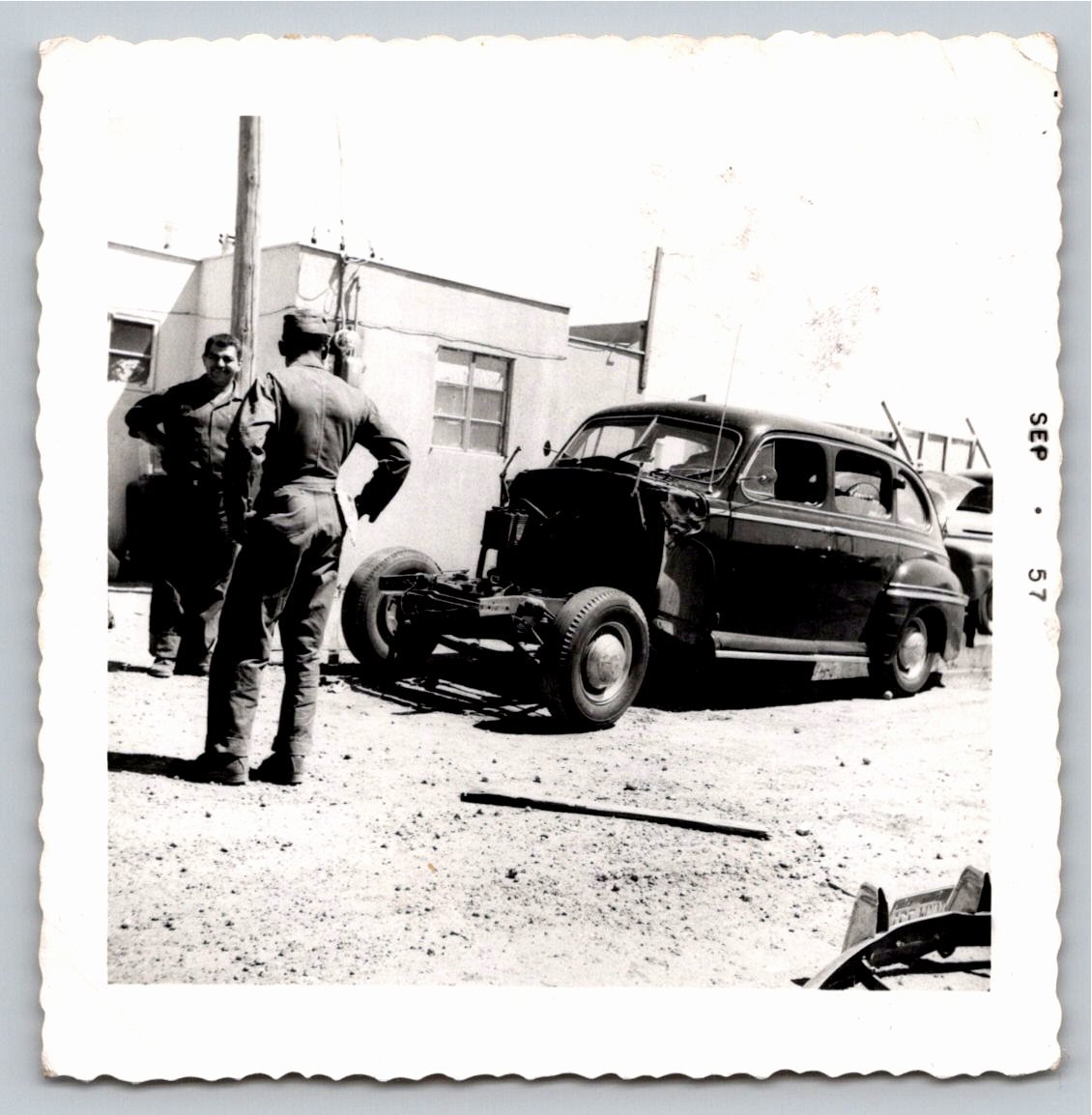
Dating precisely to September 1957, this evocative vintage gelatin silver snapshot offers an authentic window into mid-century American mechanical work and do-it-yourself car culture. Captured under intense sunlight on a dusty, gravel-strewn service lot, the frame features two tradesmen dressed in standard work utility fatigues pausing beside an ambitious automotive rebuild project. The vehicle at center stage is a late-1940s sedan—strongly resembling a post-war Ford or Mercury passenger car—which has undergone significant front-end disassembly. Its outer sheet metal, hood, and front fenders have been cleanly unbolted, exposing the structural chassis rails, steering linkage, and front suspension assemblies to the open air.
The stark outdoor light casts deep, geometric shadows across the sunbaked ground, articulating every texture from the coarse gravel lot to the utilitarian lines of the stucco commercial building in the background. One mechanic stands casually in three-quarter profile facing the camera, while his companion stands in back-view with hands resting near his hips, surveying the stripped chassis. Scattered workshop hardware, including a detached bumper section resting in the foreground dust, underscores the unscripted reality of roadside mechanics and garage rebuilds during the golden age of American automobility.
The Evolution of Post-War Garage Craftsmen
During the late 1950s, the American automobile landscape transformed rapidly as tailfins, sweeping chrome, and overhead-valve V8 engines dominated showroom floors. Consequently, stout family sedans produced during the immediate post-World War II period quickly became prime candidates for second lives as affordable daily transportation, work commuters, or the foundation for grassroots hot rods. Maintaining, repairing, and reconditioning these older flathead-powered cars was a common endeavor for neighborhood service stations, trade mechanics, and backyard enthusiasts who possessed the technical knowledge to keep aging iron running strong.
This candid photograph embodies the collaborative spirit of the era's automotive workforce. Rather than working within an air-conditioned modern bay, mid-century mechanics routinely tackled heavy teardowns, front-end alignments, and motor swaps directly out in open service yards. The authentic machine date imprint running vertically down the right white margin reads "SEP • 57", providing an ironclad temporal anchor that firmly situates this workshop scene squarely within the late Eisenhower era.
Format, Paper Chemistry, and Archival Provenance
This original vintage print is executed on classic fiber-based gelatin silver photographic paper, characterized by its luminous tonal scale and deep, rich black values. Measuring approximately 3.5 by 3.5 inches, the print displays distinctive die-cut scalloped deckle edges around its entire perimeter, a popular decorative edge style produced by commercial photo processing labs throughout the 1950s. The photographic emulsion exhibits crisp sharpness across the vehicle components, from the painted wheel hubs and rounded passenger cabin down to the exposed frame horns.
The print is preserved in strong vintage condition, with the front image displaying exceptional clarity, smooth glossy sheen, and crisp white borders showing minimal handling wear. On the reverse, the snapshot exhibits remnants of black paper adhesion, evidence of its historical preservation in a period family photo album or personal scrapbook. This backing residue remains stable and purely on the reverse, with zero bleed-through or structural compromise to the front composition. It remains an exceptional piece of vernacular Americana, perfectly suited for collectors of transportation history and mid-century photography.