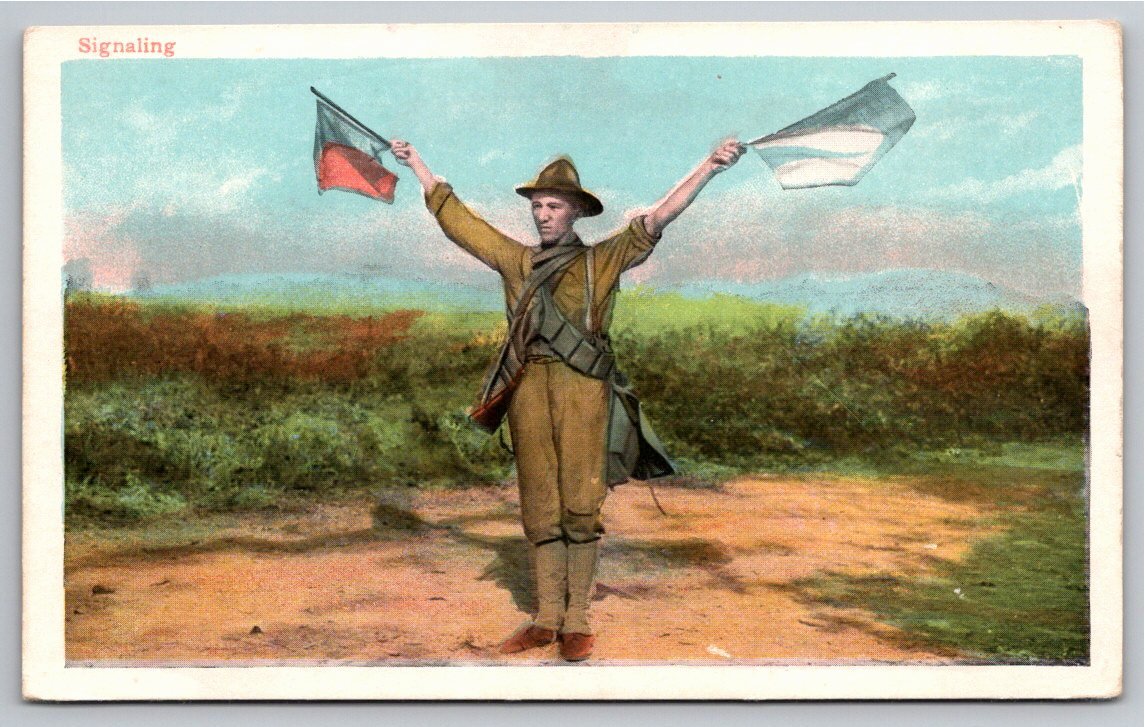
WWI US Military Signal Corps Semaphore Flag Illustrated Postcard
📸 Click any thumbnail to inspect Front, Back & Angles (2 Photos)
As an eBay Partner, we may earn a commission if you make a purchase.
Item Specifications
- Era: 1910s WWI Era
- Publisher: Illustrated Postal Card & Novelty Co., N.Y.
- Subject: US Army Signal Corps Semaphore Signaling
- Originality: Original Vintage
- Country/Region of Manufacture: United States
- Card Type: Divided Back
- Category: Postcards & Ephemera
- Format / Type: Vintage Postcards
Looking for Modern Alternatives?
Explore top-rated, modern Postcards & Ephemera and related historical accessories on Amazon.
Shop Postcards & Ephemera on Amazon →As an Amazon Associate, we earn from qualifying purchases.
Historical Context & Overview
Before the dominance of field radio or modern digital communications, military commanders during the First World War relied heavily on visual signaling to maintain command and control across active combat sectors. This vibrant early twentieth-century color lithograph postcard captures an American doughboy soldier demonstrating the precise art of semaphore flag signaling. Set against a serene landscape background, the soldier stands in full field kit, holding two distinct flags aloft to spell out messages letter by letter across open terrain.
The Vital Role of Field Visual Communications
During World War I, visual communications were indispensable to the United States Army Signal Corps. Heavy artillery bombardments frequently severed field telephone lines, while early radio transmitters were bulky and vulnerable to enemy location tracking. Under strict operational radio silence or in fast-moving tactical scenarios, visual flag signaling provided an immediate, line-of-sight link between forward observers, artillery batteries, and command posts.
The semaphore system required holding two flags at specific angular positions to represent letters of the alphabet, punctuation, and numerical codes. Signalmen underwent rigorous training to master high transmission speeds and clear visibility. Because sending flag signals required operators to stand upright in exposed positions, signal personnel faced immense risk from enemy snipers and field observation units.
Doughboy Field Attire and Historical Iconography
The imagery rendered on this postcard offers a vivid visual snapshot of American military uniform styling during the World War I era. The featured signalman wears classic field attire, including a wide-brimmed felt campaign hat, khaki shirt, wool trousers with canvas leggings, and a webbed cartridge belt. Slung across his shoulder is a messenger pouch, illustrating the standard equipment carried by signal personnel operating near training grounds or combat zones.
Publisher Heritage and Postal Collectibility
Produced by the Illustrated Postal Card & Novelty Company of New York, this postcard reflects the surge of patriotic military imagery produced in the United States between 1910 and 1918. Popular among servicemen, families on the home front, and postcard enthusiasts, these illustrated cards served a dual purpose: facilitating personal mail while showcasing military branches and tactical skills to the general public.
Featuring a clean divided back layout and remaining unposted, this postcard survives as a remarkably well-preserved example of early twentieth-century military publishing. It represents a quintessential addition for military history enthusiasts, postal history archivists, and collectors of vintage US Signal Corps ephemera.