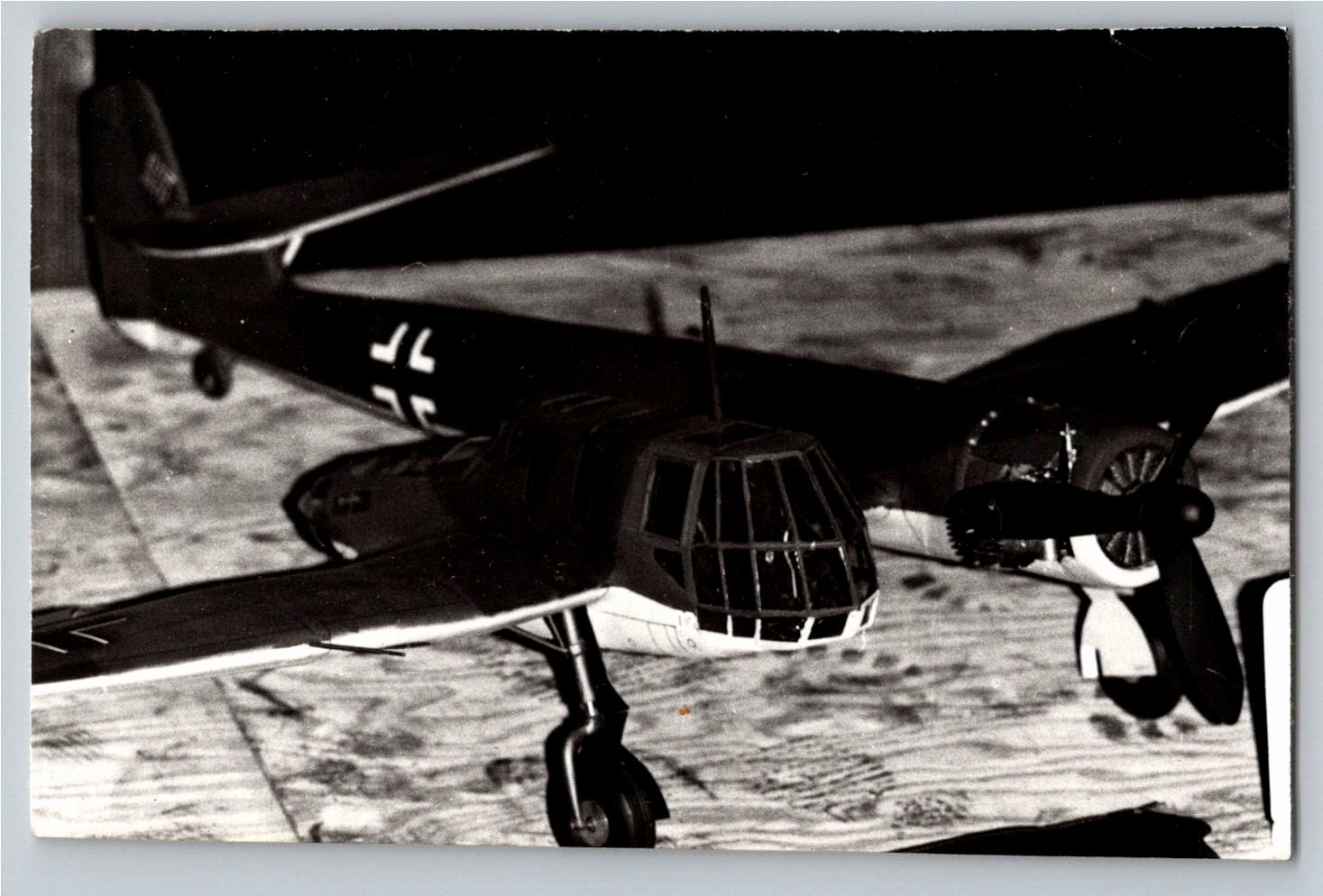
1942 Blohm & Voss BV 141 Asymmetric Aircraft Model Photo
📸 Click any thumbnail to inspect Front, Back & Angles (2 Photos)
🔗 Embed / Cite This Archival Image (Free with Attribution)Get HTML Code
© USA RESELL. Bloggers, historians, and website owners may embed this image for free by copying the HTML code below (which includes the required credit link back to this page):
USA RESELL is a living historical archive. Because original artifacts are one-of-a-kind and source records change rapidly, use the button above to check live marketplace availability or locate surviving examples. As an eBay Partner, we may earn a commission on qualifying purchases.
Item Specifications
- City: Unspecified
- Country: United States
- Era: WWII (1939-1945)
- Subject: Blohm and Voss BV 141 Aircraft
- Theme: Militaria
- Year of Production: 1942
- Category: Vintage Photography
- Format / Type: Vintage Photographs
Historical Context & Overview
Visual and Structural Profile of an Unorthodox Warplane
This striking original silver gelatin print documents an intricate scale model of one of aviation history’s most daring experiments: the Blohm & Voss BV 141. Captured against a darkened background while resting upon a patterned wooden surface, the miniature reveals every unconventional contour of the German tactical reconnaissance design. Dominated by its dramatic asymmetry, the craft positions the crew’s multi-pane glazed gondola along the starboard wing, completely separated from the main fuselage boom that houses the radial engine, empennage, and tail surfaces. This configuration created an unobstructed panoramic field of view for aerial observation and reconnaissance photography.
The close-up camera angle accentuates critical structural details, including the extended landing gear strut, the engine cowling with its three-bladed propeller, and the antenna mast rising above the greenhouse cockpit. The fuselage displays the unmistakable national German Balkenkreuz insignia, standing out sharply against the dark camouflage finish of the model. By utilizing high-contrast lighting, the photographer captured subtle reflections along the framed canopy and painted wing surfaces, immortalizing an aircraft that challenged traditional aerodynamic symmetry during the height of World War II.
Engineering Dr. Vogt’s Radical Asymmetrical Concept
Conceived in the late 1930s by chief designer Dr. Richard Vogt, the Blohm & Voss BV 141 emerged in response to an official German Air Ministry specification for a single-engine reconnaissance aircraft offering superb visibility. Rather than compromising cockpit placement around a center-mounted radial engine, Vogt eliminated conventional fuselage symmetry entirely. The resulting layout compensated for the engine's intense propeller torque through uneven wing loading and an offset center of gravity, achieving surprisingly stable flight dynamics during extensive testing at the Rechlin experimental testing facility.
Despite its proven handling characteristics and favorable pilot reports, the BV 141 never entered mass production, eclipsed politically by competing designs like the Focke-Wulf Fw 189 twin-boom aircraft and constrained by shortages of preferred BMW 801 radial engines. Archival scale models, such as the one documented in this print, played a pivotal operational and technical role throughout the war. Precision miniatures were widely deployed for wind tunnel aerodynamics testing, aircraft recognition training for Allied and Axis gunners, and official intelligence evaluations, serving as tangible blueprints of groundbreaking aeronautical ingenuity.
Print Medium, Technical Specifications, and Archival Preservation
Measuring approximately 4.6 by 3.0 inches, this photograph is rendered on authentic period silver gelatin paper with a smooth, glossy surface finish. The tonal range features pitch-black shadows, well-modulated gray midtones, and clean white highlights accentuating the cockpit glazing and national insignias. The photographic emulsion exhibits sharp focal clarity across the forward sections of the aircraft model, providing clear documentation of the propeller hub, cowl flaps, and structural framework.
The reverse side of the paper remains completely blank, bearing light vintage toning natural to mid-20th-century photographic stocks without stamps or writing. In very good vintage condition, the piece shows minimal handling along the borders and clean edges, having been preserved within historical archives over the decades. As photographic evidence of mid-century experimental military aviation, this original wartime print offers historians and militaria collectors an exceptional glimpse into the unconventional aircraft design concepts of the Second World War.