Antique Fort Riley Military Barracks Kansas Vintage Postcard
📸 Click any thumbnail to inspect Front, Back & Angles (2 Photos)
As an eBay Partner, we may earn a commission if you make a purchase.
Item Specifications
- Era: Divided Back (c. 1907-1915)
- Publisher: E. D. Zellner
- Printer: Curt Teich & Co.
- Location: Fort Riley, Kansas
- Subject: Military Barracks
- Originality: Original Vintage
- Category: Postcards & Ephemera
- Format / Type: Vintage Postcards
Looking for Modern Alternatives?
Explore top-rated, modern Postcards & Ephemera and related historical accessories on Amazon.
Shop Postcards & Ephemera on Amazon →As an Amazon Associate, we earn from qualifying purchases.
Historical Context & Overview
Established in 1853 along the Kansas River in the heart of the Flint Hills, Fort Riley stands as one of the United States Army's most historically significant garrisons. Originally created to protect settlers, traders, and mail coaches traveling along the Santa Fe and Oregon Trails, the fort quickly evolved from an isolated frontier outpost into a bustling military epicenter. By the turn of the twentieth century, Fort Riley had assumed a prominent role as the premier training center for the U.S. Cavalry and Light Artillery, fostering a rich tradition of military readiness and architectural heritage.
A Window into Frontier Military Architecture
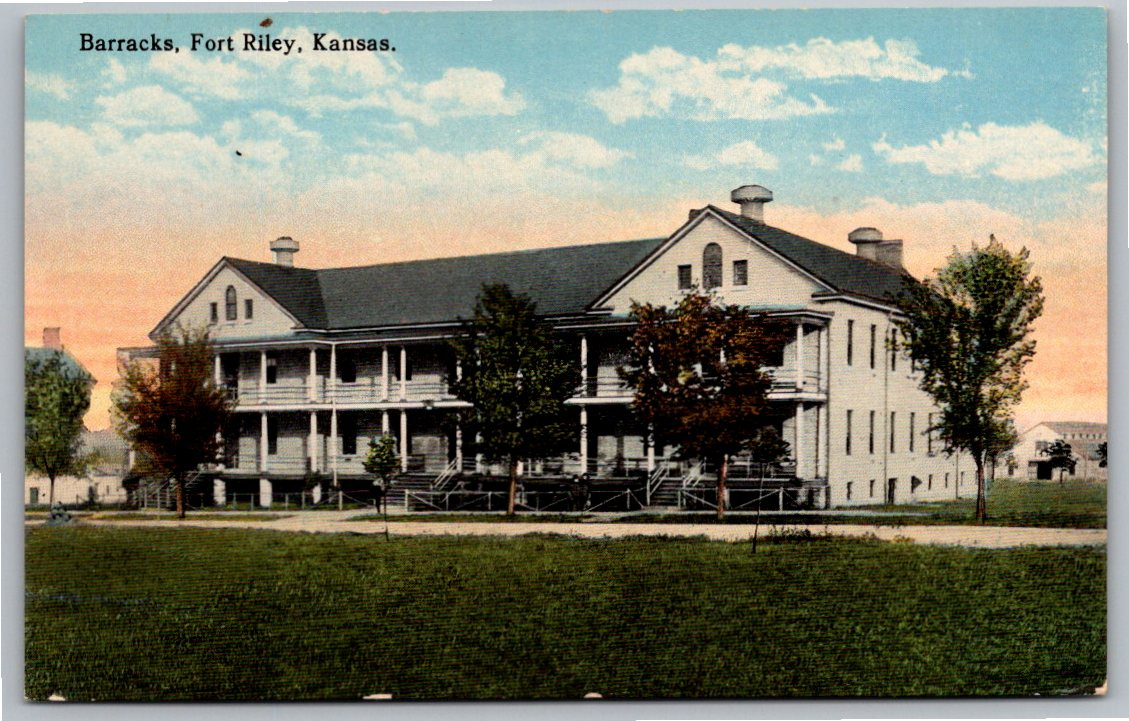
This early 1900s color lithograph postcard offers a striking visual document of Fort Riley’s troop housing during a pivotal era of modern expansion. The building depicted showcases the characteristic architectural style that defines the historical post: expansive two-story barracks framed by double-decked wooden verandas and sturdy limestone walls. Built using golden-hued limestone quarried directly from the surrounding native hills, these structures were designed to endure both the harsh Midwestern winters and scorching prairie summers. The double porches provided crucial shade and ventilation for soldiers off duty, serving as community spaces for troops stationed far from home.
During the early 1900s, living quarters like the ones shown on this card housed infantrymen and cavalry troops undergoing rigorous tactical exercises. As the threat of the western frontier waned, the U.S. Army shifted focus toward modernized combined-arms maneuvers, eventually establishing the Mounted Service School at Fort Riley in 1907. Consequently, the barracks were constantly filled with young recruits, officers, and equestrians who helped shape early twentieth-century American military strategy.
Local Publishing and Lithographic Heritage
Beyond its military significance, this vintage postcard is a captivating specimen of early American ephemera publishing. Printed during the "Golden Age" of postcards (1907–1915), the postcard features a divided back design, which was officially authorized by the U.S. Postal Service in March 1907 to allow senders to write a message on the left side while reserving the right exclusively for the address.
The reverse bears the imprint of E. D. Zellner, a prominent local merchant based in nearby Junction City, Kansas. Local shopkeepers often commissioned specialized postcards from major printing houses to sell to soldiers, visiting family members, and tourists. The production was executed by the legendary Curt Teich & Company of Chicago, identified by their distinctive C.T. Photochrom logo and production number (R-75077). Using early multi-color lithographic processes, Teich transformed original black-and-white photography into vibrant colorized views, capturing the crisp blue Kansas skies and lush manicured lawns surrounding the barracks.
Preserving Early Kansas History
Today, original postcards from Fort Riley offer collectors and military historians an unvarnished glimpse into turn-of-the-century post life. As many historical military structures undergo renovation or repurposing over the decades, vintage paper artifacts like this serve as vital photographic records, preserving the physical layout and daily atmosphere of a world-famous military installation during its golden era of equestrian soldiering.