Vintage 1908 Kansas City Postcard: Bird's Eye View From Long
📸 Click any thumbnail to inspect Front, Back & Angles (2 Photos)
As an eBay Partner, we may earn a commission if you make a purchase.
Item Specifications
- Era: Divided Back (c. 1907-1915)
- Publisher: The South-West News Company
- Printer: Litho-Chrome (Made in Germany)
- Location: Kansas City, Missouri
- Subject: Cityscape Birds Eye View
- Originality: Original Vintage
- Category: Postcards & Ephemera
- Format / Type: Vintage Postcards
Looking for Modern Alternatives?
Explore top-rated, modern Postcards & Ephemera and related historical accessories on Amazon.
Shop Postcards & Ephemera on Amazon →As an Amazon Associate, we earn from qualifying purchases.
Historical Context & Overview
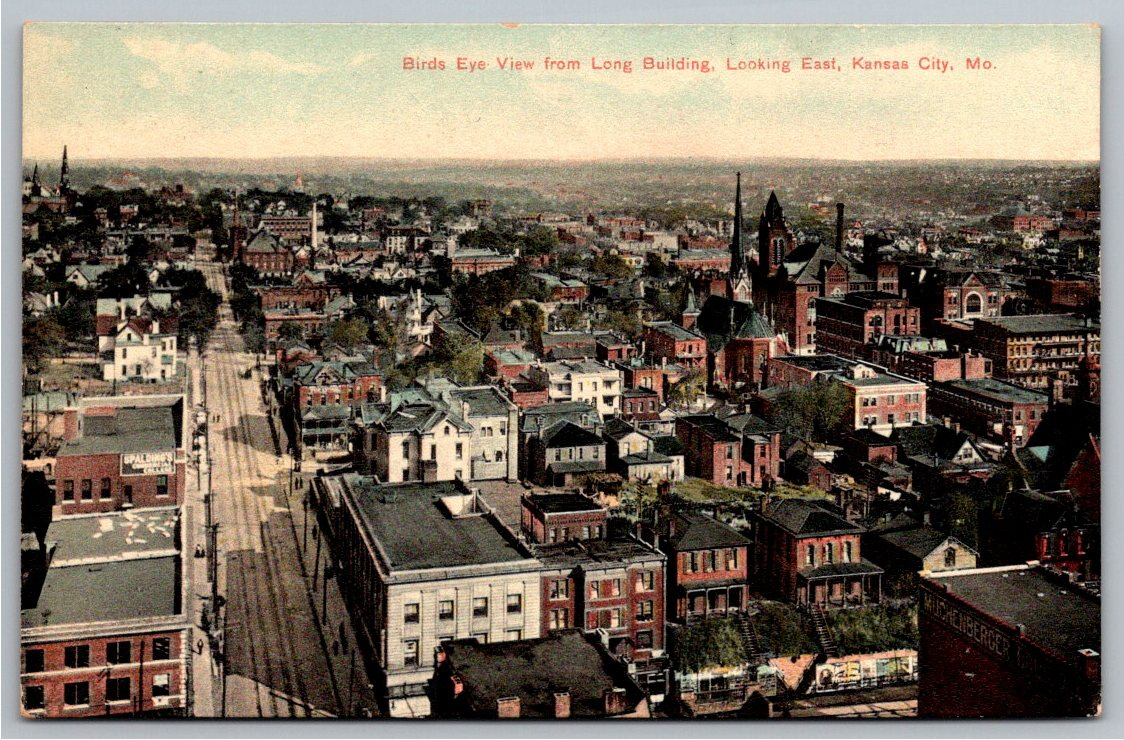
At the turn of the twentieth century, Kansas City, Missouri, was undergoing a dramatic transformation from a bustling Midwestern river port into a modern, vertical metropolis. Capturing this pivotal era of rapid urban growth, this circa 1908 vintage color postcard offers a captivating elevated "bird's eye view" looking east across the cityscape from the upper levels of the newly erected Long Building. Published locally by The South-West News Company and printed in Germany using the famed "Litho-Chrome" lithographic process, this card stands as both a fine example of Edwardian color printing and a fascinating historical document of Missouri's architectural evolution.
The Vantage Point: The Historic Long Building
Completed in 1907, the R.A. Long Building marked a monumental milestone in Kansas City's skyline history. Commissioned by prominent lumber industrialist and philanthropist Robert A. Long, the 16-story steel-frame skyscraper situated at 10th Street and Grand Avenue was one of the city's earliest true high-rises. Rising far above the surrounding low-rise brick structures, its upper floors provided artists and photographers with unprecedented panoramic vistas across the metropolitan area.
This particular vantage point, looking east toward the residential and commercial districts, captures a rich, detailed tapestry of early 20th-century urban life. In the lower left foreground, double streetcar tracks cut through the avenue, highlighting the vital role electric transit played in driving urban expansion. Interspersed among brick commercial blocks and multi-story residences are prominent church spires, industrial smokestacks, and distant rolling hills, illustrating the vibrant, densely packed character of Kansas City before mid-century re-zoning and highway construction altered the downtown landscape.
German Lithography and the Golden Age of Postcards
This postcard was produced during the height of the American postcard craze (1907–1915), a period during which millions of color cards were exchanged daily across the nation. To achieve superior visual fidelity, American publishers like The South-West News Company routinely outsourced printing to premier lithographic firms in Germany. German printers excelled in chromolithography, utilizing meticulous stone-engraving methods and multi-layered color inks that produced remarkable richness and tonal depth.
The reverse side features the iconic cloverleaf emblem of the "Litho-Chrome" process, along with the production origin of Dresden-Leipzig-Berlin and the publisher's catalog number C 11579. The divided back format—introduced by the U.S. Post Office in March 1907—allowed senders to write messages on the left side while reserving the right side exclusively for the address and a one-cent domestic postage stamp.
A Treasured Regional History Artifact
For collectors of Missouri history, urban planning enthusiasts, and deltiologists, elevated view postcards offer invaluable historical insight. Unlike standard street-level photographs, a high-angle panorama preserves the broader spatial relationships of lost neighborhoods, historic church spires, and early transportation corridors. Preserved in remarkable vintage condition, this 1908 color print remains a captivating window into the early days of Kansas City's rise as a heartland metropolis.