Vintage 1908 Fort Dodge, Iowa City Park & Downtown Postcard
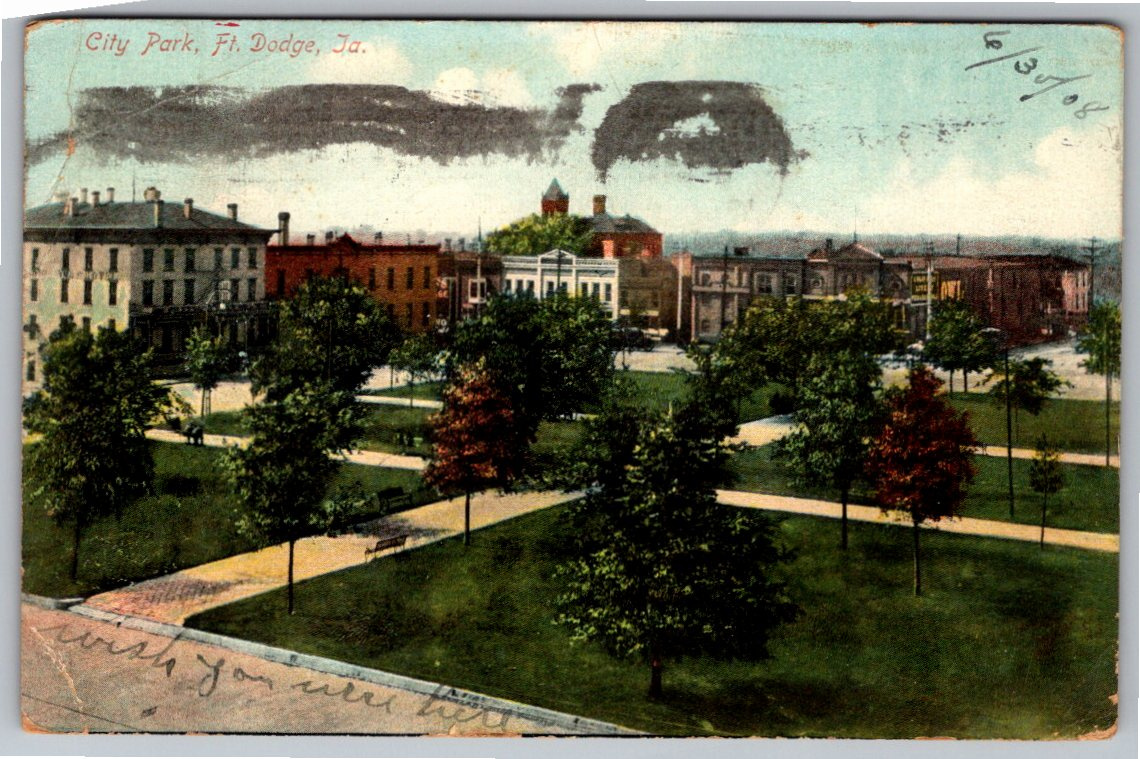
📸 Click any thumbnail to inspect Front, Back & Angles (2 Photos)
As an eBay Partner, we may earn a commission if you make a purchase.
Item Specifications
- Era: Divided Back (1907-1915)
- Year: 1908
- Location: Fort Dodge, Iowa
- Publisher: Jno. T. Faber
- Subject: City Park & Town Square
- Postmark Date: June 30, 1908
- Category: Postcards & Ephemera
- Format / Type: Vintage Postcards
Looking for Modern Alternatives?
Explore top-rated, modern Postcards & Ephemera and related historical accessories on Amazon.
Shop Postcards & Ephemera on Amazon →As an Amazon Associate, we earn from qualifying purchases.
Historical Context & Overview
At the turn of the twentieth century, Fort Dodge, Iowa, was establishing itself as a bustling regional hub driven by agriculture, gypsum mining, and expanded railroad connectivity. At the center of this growing Webster County community stood City Park—a green oasis designed as both a retreat from urban industry and a gathering square for civic pride. This colorized postcard, postmarked on June 30, 1908, captures the peaceful landscape of Fort Dodge’s downtown park during the height of the Golden Age of Postcards.
The Urban Sanctuary: Fort Dodge City Park
In 1908, city parks served a crucial function in American urban design. As Midwestern towns expanded rapid brick-and-mortar storefronts, public spaces were intentionally reserved to give citizens access to nature, fresh air, and social leisure. The perspective featured on this card looks across neatly manicured lawns and diagonal walking paths toward the surrounding commercial blocks. Lush trees frame the park perimeter, while multi-story hotels and commercial buildings anchor the background, reflecting the solid brick and stone architecture typical of Iowa county seat towns during the Edwardian era.
German Chromolithography and Early Postal Design
Published by the Jno. T. Faber Company of Milwaukee, Wisconsin, this card represents the exceptional printing quality that defined American ephemera prior to World War I. During this era, American postcard publishers routinely outsourced their color printing to German lithographers, who possessed superior technique in multi-color tinting and high-detail printing processes. The subtle shading of the summer foliage and early architectural details stand as a testament to German lithographic craftsmanship.
The reverse side of the postcard reflects important developments in United States postal history. On March 1, 1907, the Post Office Department permitted message text to share the back of postcards alongside the recipient's address, inaugurating the "Divided Back Era." This card features a distinct split reverse, complete with a dark green 1-cent Benjamin Franklin stamp and a clean machine flag cancellation from the Fort Dodge post office dated June 30, 1908.
A Handwritten Slice of Life
Beyond its topographical and architectural value, the card retains a compelling human connection. Mailed to Miss Susie Trotter in Gallatin, Missouri, the handwritten message gives details of upcoming travel arrangements ("I am going to Mo. in July..."), accompanied by a classic "Wish you were here" penned right onto the lower foreground of the color view. Such physical notes convert printed landscapes into tangible historical artifacts, offering modern collectors an authentic portal into everyday communication in early 1900s America.