1908 St. Louis Tower Grove Park Bench German Litho-Chrome
📸 Click any thumbnail to inspect Front, Back & Angles (2 Photos)
As an eBay Partner, we may earn a commission if you make a purchase.
Item Specifications
- Era: Divided Back (1907-1915)
- Year: 1908
- Location: St. Louis, Missouri
- Subject: Tower Grove Park
- Publisher: The St. Louis News Company
- Printer: Litho-Chrome (Germany)
- Category: Postcards & Ephemera
- Format / Type: Vintage Postcards
Looking for Modern Alternatives?
Explore top-rated, modern Postcards & Ephemera and related historical accessories on Amazon.
Shop Postcards & Ephemera on Amazon →As an Amazon Associate, we earn from qualifying purchases.
Historical Context & Overview
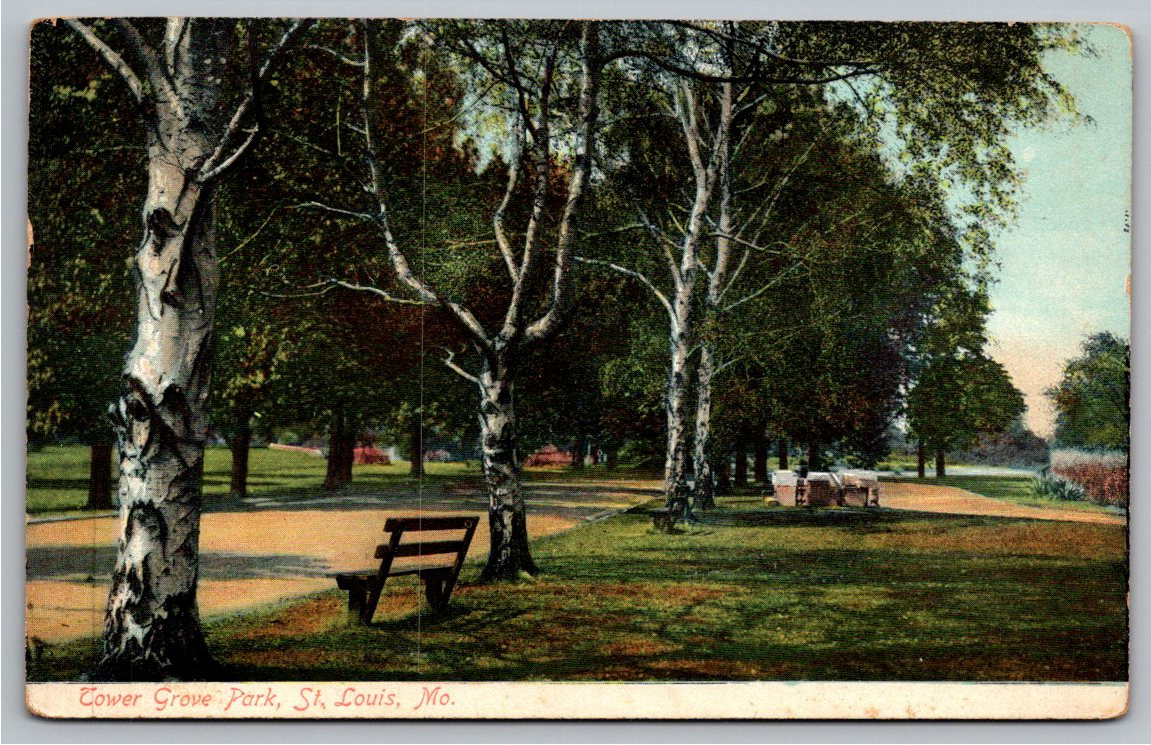
Tower Grove Park stands as one of the premier surviving examples of a 19th-century Victorian pleasure ground in the United States. Conceived and funded by local philanthropist Henry Shaw—who also established the adjacent Missouri Botanical Garden—the park was formally deeded to the city of St. Louis in 1868. Designed as an expansive botanical sanctuary to counter the soot and congestion of mid-19th-century industrial development, Tower Grove Park was landscaped with thousands of native and exotic tree specimens, winding carriage drives, and picturesque pavilions. This original vintage postcard, postmarked in the summer of 1908, offers an intimate look at the park’s manicured landscape during its prime.
German Litho-Chrome Craftsmanship
During the Golden Age of Postcards—a peak period of production and collecting spanning roughly from 1907 to 1915—the finest color view cards distributed throughout North America were manufactured in Germany. German lithographers were globally renowned for their mastery of chromolithography, utilizing fine-grain limestone plates to lay down successive layers of ink. This particular card was published locally by The St. Louis News Company and printed abroad under the trademarked "Litho-Chrome" process in Leipzig, Berlin, and Dresden.
The visual quality of this technique is striking. Delicate washes of verdant green, warm bronze, and pale cream render the sunlight filtering through the canopy of white birch trees. A rustic wooden bench sits invitingly along a crushed-gravel walkway, while Victorian-style pavilions peek through the distant foliage. The lower margin features classic red typography reading "Tower Grove Park, St. Louis, Mo.", framing a scene that embodied the civic pride of post-World's Fair St. Louis.
A Snapshot of Postal History in 1908
The reverse side of the postcard provides compelling documentation of early 20th-century American communications. Mailed from the main St. Louis post office on June 12, 1908, at 8:30 PM, the card bears a clear machine cancellation mark over a green one-cent Benjamin Franklin postage stamp (Scott #300 series). The card was addressed to Mr. J. H. Hyleshaw in Bluff City, Kansas, demonstrating how urban views were frequently dispatched to friends and family in rural communities across the Midwest.
Because the United States Post Office Department only legalized written messages on the address side of postcards in March 1907, this card represents the early adoption of the divided-back format. The clean back permitted senders to write notes alongside the address rather than defacing the image on the front, accelerating a nationwide postcard collecting craze.
Collector Appeal and Historic Legacy
Today, Tower Grove Park is recognized as a National Historic Landmark, famed for its extraordinary collection of historic trees, original gazebos, and architectural heritage. Early pictorial views of the park are highly sought after by Missouri regional historians, urban park enthusiasts, and deltiologists alike. The combination of historical location, high-grade German lithographic printing, and intact postal history makes this 1908 postcard a treasured tangible artifact from turn-of-the-century St. Louis.