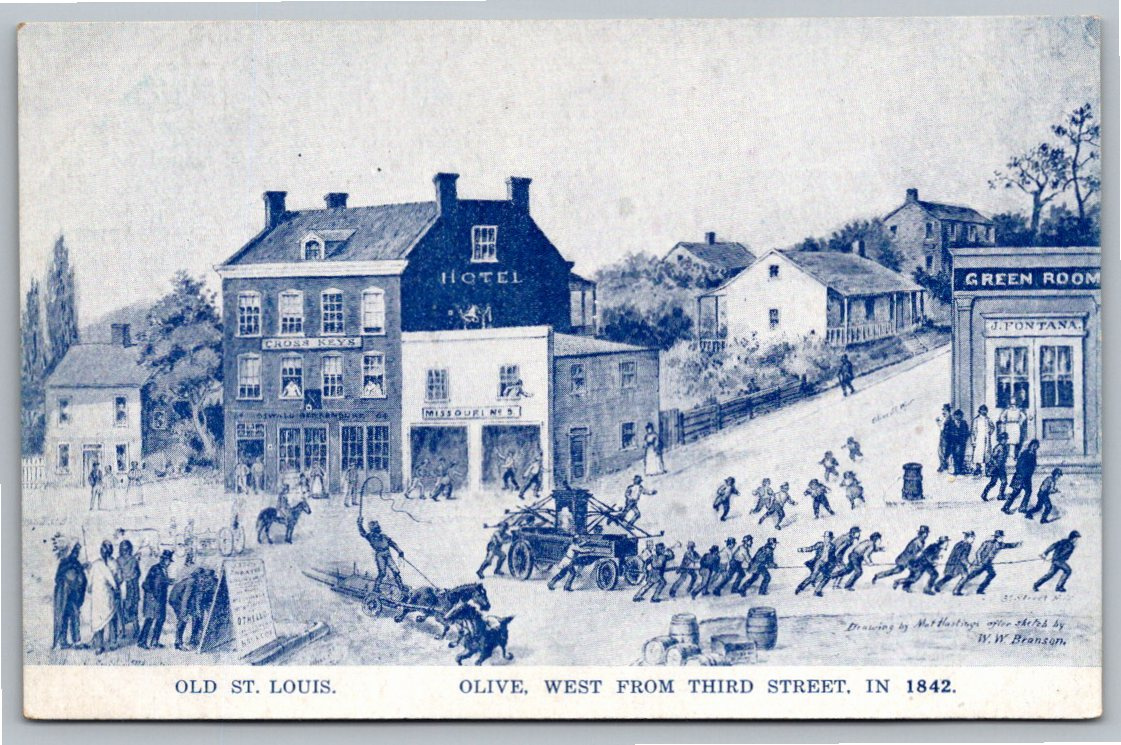
c. 1910 St. Louis Postcard: Olive Street & Cross Keys Hotel in
📸 Click any thumbnail to inspect Front, Back & Angles (2 Photos)
As an eBay Partner, we may earn a commission if you make a purchase.
Item Specifications
- Era: Divided Back (c. 1907-1915)
- Publisher: The Arrow Post Card Co.
- Location: St. Louis, Missouri
- Subject: Historical Olive Street Scene (1842)
- Artist: Mat Hastings (after W.W. Branson)
- Originality: Original Vintage Postcard
- Category: Postcards & Ephemera
- Format / Type: Vintage Postcards
Looking for Modern Alternatives?
Explore top-rated, modern Postcards & Ephemera and related historical accessories on Amazon.
Shop Postcards & Ephemera on Amazon →As an Amazon Associate, we earn from qualifying purchases.
Historical Context & Overview
Visualizing Frontier St. Louis: Olive Street in 1842
During the mid-19th century, St. Louis was rapidly expanding from a riverfront fur-trading outpost into the premier gateway to the American West. Published around 1910 by The Arrow Post Card Company of St. Louis, this fascinating vintage postcard offers a historical look back at the city as it appeared nearly seven decades earlier: looking west down Olive Street from Third Street in 1842.
Key Landmarks: The Cross Keys Hotel and Missouri No. 5
The detailed illustration captures a vibrant slice of early St. Louis street life. To the left stands the historic Cross Keys Hotel, a prominent early hostelry and gathering place for travelers, riverboat passengers, and locals. Adjacent to the hotel sits the quarters of Missouri No. 5, one of the city's early volunteer fire companies. Further up the hill on the right, the sign for J. Fontana's "Green Room" highlights the modest commercial storefronts that lined the dirt streets of early Missouri urban centers.
The Thrill of Early Volunteer Firefighting
One of the most dynamic elements of the image is the action in the foreground: volunteer firemen hauling a hand-pumper fire apparatus and hose carriage up the incline. Prior to the establishment of a fully paid municipal fire department in the 1850s, St. Louis relied entirely on volunteer bucket brigades and engine companies. When a blaze broke out, men rushed into the streets to manually pull heavy equipment toward the smoke—a dramatic scene rendered here with striking detail and energy.
Artistic Heritage: Mat Hastings and W.W. Branson
The image is attributed to Matthew "Mat" Hastings (1834–1919), one of St. Louis's most renowned 19th-century visual chroniclers. Hastings based his drawing on an earlier contemporary eye-witness sketch by W.W. Branson, ensuring historical accuracy in the depiction of architectural styles, early signage, and mid-century attire. Hastings was celebrated for his depictions of pioneer life, Native American delegations, and early riverfront scenes, making his historical retrospective drawings highly respected by local antiquarians.
Collector Appeal and Civic Nostalgia
Around the turn of the century—fueled by the excitement of the 1904 St. Louis World's Fair—local publishers like The Arrow Post Card Company produced historical views celebrating the city's rich history. Featuring a classic divided back format characteristic of the Golden Age of Postcards (1907–1915), this piece appeals immensely to collectors of Missouri regional history, antique firefighting memorabilia, and early American architectural illustrations.