Vintage 1910s Japanese Geisha Lantern Valentine Greeting Postcard
📸 Click any thumbnail to inspect Front, Back & Angles (2 Photos)
As an eBay Partner, we may earn a commission if you make a purchase.
Item Specifications
- Era: Divided Back (c. 1907-1915)
- Theme: Japonisme & Valentines Day
- Subject: Japanese Girl with Fan & Lanterns
- Series: Series No. 386
- Country of Origin: United States
- Originality: Original Vintage Postcard
- Category: Postcards & Ephemera
- Format / Type: Vintage Postcards
Looking for Modern Alternatives?
Explore top-rated, modern Postcards & Ephemera and related historical accessories on Amazon.
Shop Postcards & Ephemera on Amazon →As an Amazon Associate, we earn from qualifying purchases.
Historical Context & Overview
During the Golden Age of Postcards in the early twentieth century, American publishers frequently drew inspiration from foreign cultures to create charming, novel holiday greetings. Among the most popular aesthetic movements of the era was Japonisme—a Western fascination with Japanese art, fashion, and motif that swept through decorative arts and stationery design. This exquisite 1910s Valentine's Day postcard perfectly captures that cultural trend, pairing Eastern aesthetic influences with Western romantic tradition.
Japonisme in Early 20th-Century Holiday Greetings
Following the opening of Japan to international trade in the late nineteenth century, Western artists and illustrators became captivated by traditional Japanese woodblock prints, textiles, and decorative items. By the 1910s, motifs such as cherry blossoms, folding fans, kimonos, and paper lanterns were commonly adapted into mainstream American illustration. Publisher series during this era often created themed sets that combined exotic elegance with lighthearted poetry, offering senders a stylish alternative to conventional lace-and-cupid Valentines.
Artistic Breakdown and Poetic Imagery
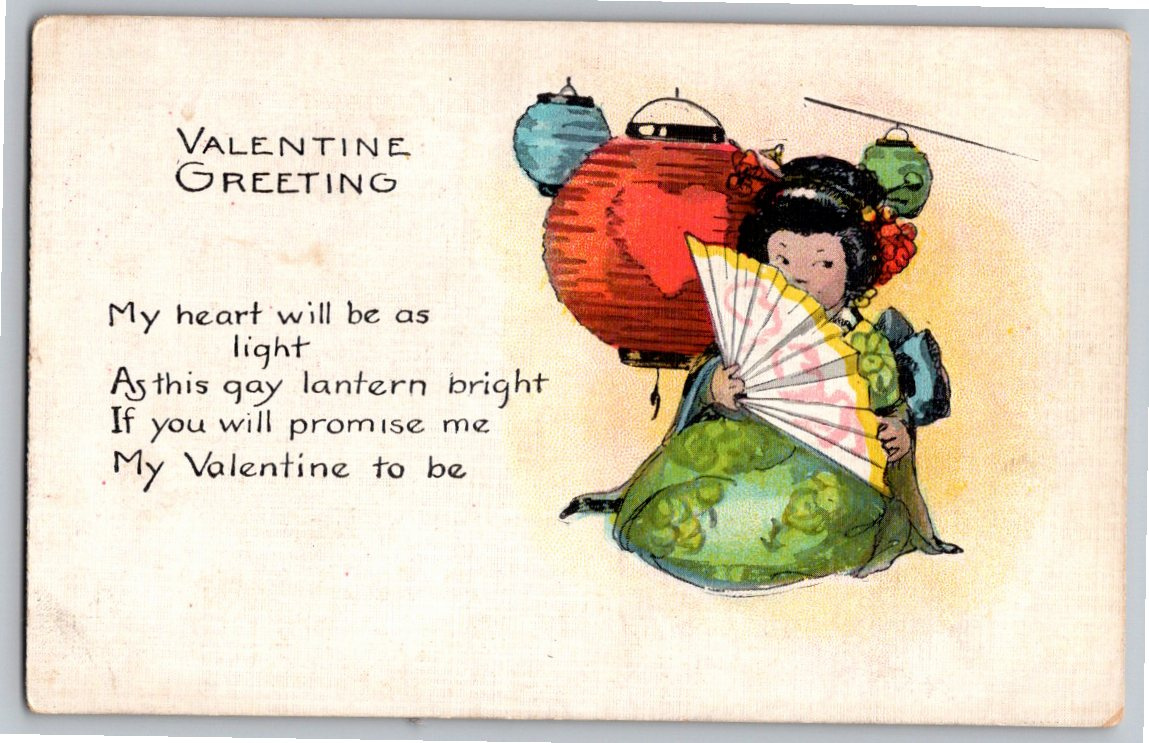
The front illustration features a young Japanese girl in a green kimono accented with floral patterns and a wide blue sash. She modestly holds an open paper folding fan decorated with pink hearts up to her face, gazing slightly toward the viewer. Positioned behind her are three hanging paper lanterns in shades of blue, green, and bright red—the central lantern prominently displaying a red heart emblem. Beside the artwork, an endearing four-line poetic verse reads:
"My heart will be as light
As this gay lantern bright
If you will promise me
My Valentine to be"
The play on words connects the physical weightlessness and glow of paper lanterns with the emotional joy of romantic devotion, characteristic of 1910s holiday sentimentality.
Printing Details and Postal History
The reverse side of the postcard reflects standard publishing practices of the Divided Back era (1907–1915). Prior to 1907, United States postal regulations restricted the back of postcards exclusively to the recipient's address, forcing senders to write messages on the front artwork. Once the divided back format was authorized, senders gained a dedicated section for correspondence alongside the address line.
This particular card is printed with the publisher's identification, designated as "Series No. 386 Valentine 6 designs." The "Made in USA" marking along the center divider further situates its production during the early 1910s, when American lithographers were rapidly expanding domestic printing operations to satisfy the nation's burgeoning postcard collecting craze.
Legacy for Ephemera Collectors
Today, holiday postcards featuring cross-cultural imagery remain prized among ephemera enthusiasts and vintage postcard collectors. Unused, clean examples from themed series—especially those showcasing fine color preservation and intact margins—provide a fascinating visual record of social history, popular illustration trends, and holiday traditions from over a century ago.