1920s Ridge Route Summit Postcard: Early California Motoring
📸 Click any thumbnail to inspect Front, Back & Angles (2 Photos)
As an eBay Partner, we may earn a commission if you make a purchase.
Item Specifications
- Era: 1920s White Border
- Publisher: Western Publishing & Novelty Co.
- Location: Los Angeles to Bakersfield, CA
- Subject: Early Automobiles & Mountain Highway
- Originality: Original Vintage
- Card Number: R-3 / 84437
- Category: Postcards & Ephemera
- Format / Type: Vintage Postcards
Looking for Modern Alternatives?
Explore top-rated, modern Postcards & Ephemera and related historical accessories on Amazon.
Shop Postcards & Ephemera on Amazon →As an Amazon Associate, we earn from qualifying purchases.
Historical Context & Overview
Conquering the Mountains: California's Historic Ridge Route
In the early twentieth century, traveling between the booming metropolis of Los Angeles and the agricultural heartland of the San Joaquin Valley was an arduous journey. Drivers were forced to navigate treacherous dirt tracks, deep canyons, or detour along coastal passes. Everything changed with the opening of the Ridge Route—officially the Castaic-Tejon Route—a monumental highway engineering feat that carved a paved road directly over the rugged mountains of Southern California.
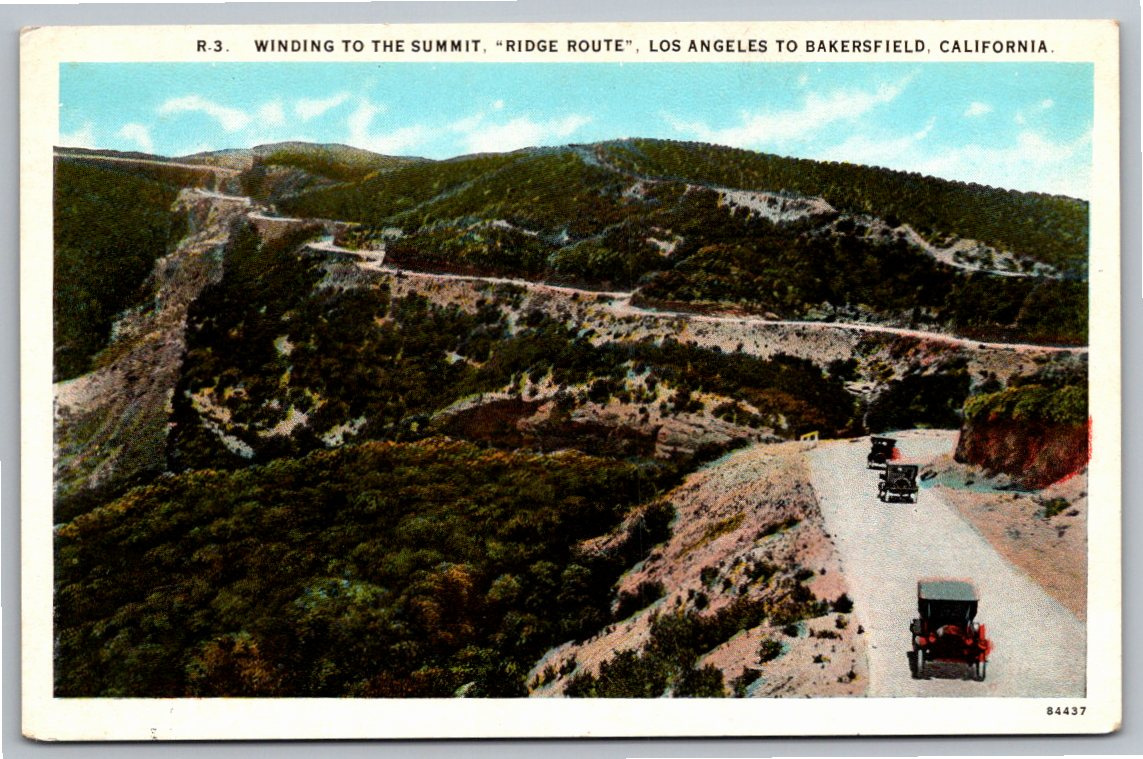
This color postcard, produced in the early 1920s, captures the sheer scale and dramatic topography of this famed mountain highway. Viewers can see early open-top touring cars and Model T automobiles carefully negotiating a sweeping ledge high above the canyons as the road serpentines toward the summit. The printed title at the top, "R-3. WINDING TO THE SUMMIT, 'RIDGE ROUTE', LOS ANGELES TO BAKERSFIELD, CALIFORNIA," perfectly encapsulates the sense of wonder and adventure that early automobile travel inspired.
An Engineering Marvel of the Early Automotive Era
Surveyed and constructed between 1914 and 1919, the original Ridge Route followed the high crests of the Sierra Pelona and San Gabriel mountains to avoid flash flooding in the valley floors below. Paved with reinforced concrete in four-inch thick slabs, it was considered a triumph of modern highway construction. However, its design was relentlessly challenging: the highway featured over 640 curves, which collectively added up to more than ninety full circles over its nearly fifty-mile length.
For motorists during the 1920s, navigating the summit required skill and endurance. Mechanical brakes frequently overheated on long downhill stretches, radiator water boiled away during summer ascents, and dense mountain fog could descend without warning. To accommodate stranded motorists, a network of mountain inns, garages, and cafes sprang up along the route, transforming the isolated crest into a vibrant highway corridor.
A Window into 1920s Ephemera and Print History
Published by the Western Publishing & Novelty Company of Los Angeles, this card is a classic representation of the White Border Era (1915–1930) of postcard manufacturing. During this period, American publishers utilized cost-saving white margins around the imagery while employing rich, hand-colored lithographic techniques to render vivid landscapes. The production serial code "84437" printed in the bottom corner reflects the meticulous cataloging systems of early mid-century print houses.
Preserving Golden State Heritage
By the 1930s, the original Ridge Route was largely bypassed by three-lane realignments, which eventually evolved into modern Interstate 5. Today, sections of the original 1915 concrete roadbed survive as protected historical landmarks. Vintage postcards like this item offer collectors and historians a rare, colorful glimpse back to the dawn of California's world-famous car culture, celebrating a time when driving to Bakersfield was not merely a commute, but a grand mountain expedition.