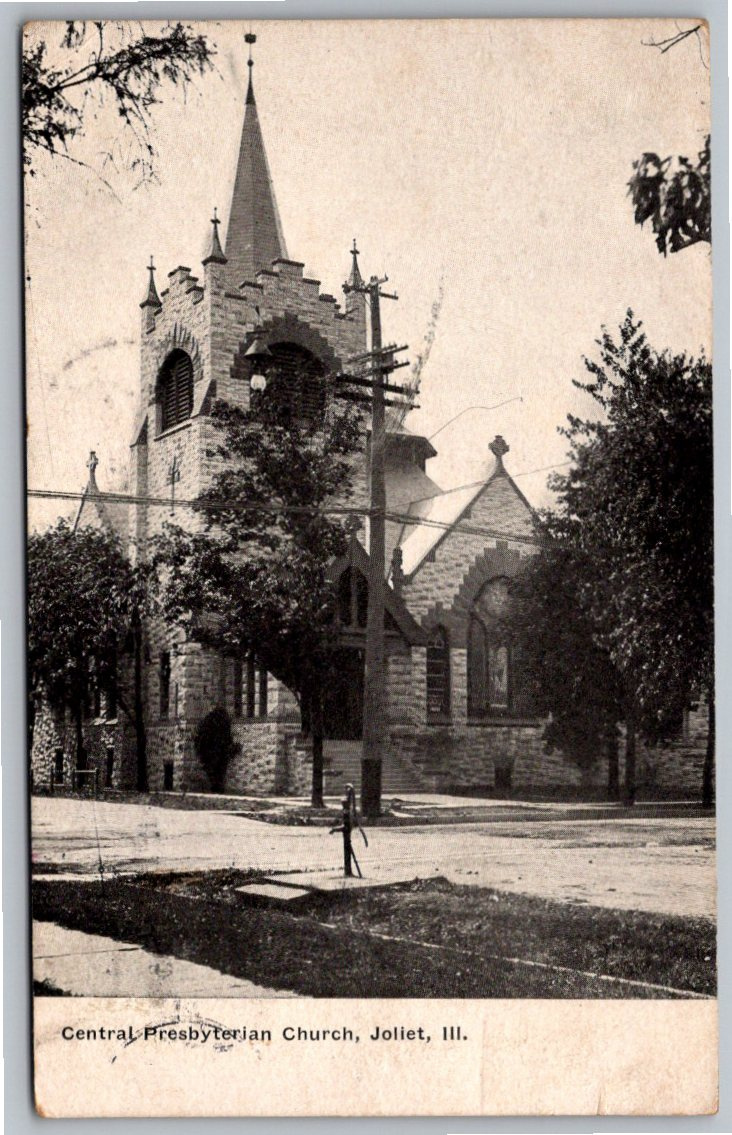
Central Presbyterian Church Joliet Illinois 1912 Antique Postcard
📸 Click any thumbnail to inspect Front, Back & Angles (2 Photos)
As an eBay Partner, we may earn a commission if you make a purchase.
Item Specifications
- Type: Printed Monochrome
- Era: Divided Back (1907-1915)
- Year: 1912
- Location: Joliet, Illinois
- Subject: Central Presbyterian Church
- Postmark Date: July 1912
- Category: Postcards & Ephemera
- Format / Type: Vintage Postcards
Looking for Modern Alternatives?
Explore top-rated, modern Postcards & Ephemera and related historical accessories on Amazon.
Shop Postcards & Ephemera on Amazon →As an Amazon Associate, we earn from qualifying purchases.
Historical Context & Overview
A Window into Joliet's Architectural Heritage
At the turn of the twentieth century, Joliet, Illinois was proudly known across the Midwest as the "Stone City." Renowned for its rich quarries of durable, light-colored Joliet limestone, the municipality used this indigenous rock to erect many of its most magnificent civic, commercial, and religious landmarks. Captured on crisp black-and-white phototype in approximately 1912, this vintage postcard highlights one of the city's finest ecclesiastical structures: the Central Presbyterian Church.
The postcard illustrates a striking example of American church architecture from the late Victorian and early Edwardian periods. Heavily influenced by the Richardsonian Romanesque and Gothic Revival styles, the church features massive, rusticated stone walls, deep-set round arches, and an imposing corner bell tower topped with a slender spire. The intricate stone masonry contrasts sharply with the delicate stained-glass window arches and timber porch elements, standing as a testament to the master stonecutters and artisans who shaped Will County during its industrial heyday.
Social Ephemera of the Divided Back Era
Beyond its architectural value, this piece serves as an authentic slice of social history from the postcard boom era (1907–1915). Prior to 1907, United States Postal Service regulations restricted the back of a postcard exclusively to the recipient's address. The introduction of the "divided back" allowed senders to write personal notes alongside the address, transforming postcards into the quick-communication network of their day—the turn-of-the-century equivalent to a modern text message or instant status update.
The reverse side of this card features a clear, crisp Joliet postmark dated July 1912, alongside a green one-cent Washington-Franklin series postage stamp. The cursive message penned in fountain pen reveals a heartfelt personal note from a resident living on Oneida Street in Joliet to a family friend in St. Louis, Missouri. Such personal correspondences provide modern historians with invaluable insight into community networks, migration patterns, and daily life in small-town America during the early 1900s.
Collector Value and Historical Significance
For regional historians, municipal archivists, and deltiologists (postcard collectors), localized church postcards represent one of the most desirable categories of early paper ephemera. Many original religious structures from this era have undergone significant structural alterations, changed denominations, or were tragically lost to urban renewal and fire. This fine monochrome impression provides an unblemished, period-accurate look at Central Presbyterian Church during an era when electric utility poles and dirt-paved streets coexisted, capturing a fleeting moment in Midwestern American history.