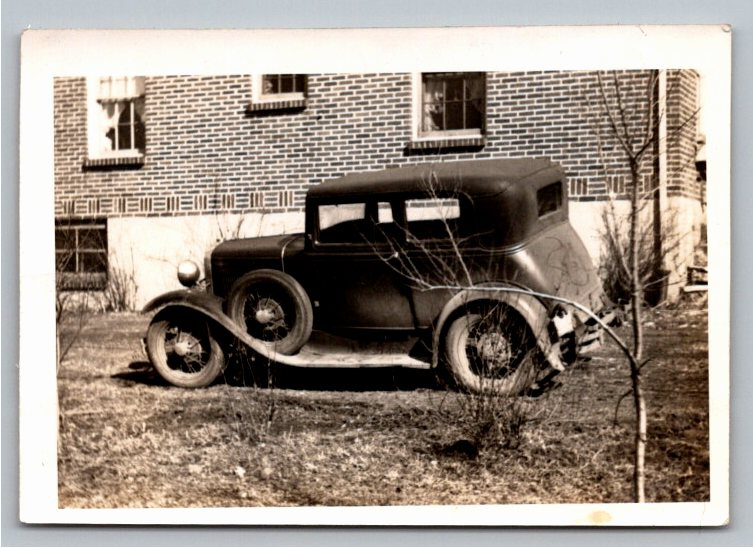
1931 Ford Model A Victoria Coupe Vintage Black & White Photograph
📸 Click any thumbnail to inspect Front, Back & Angles (2 Photos)
As an eBay Partner, we may earn a commission if you make a purchase.
Item Specifications
- Era: 1930s Vintage Automotive
- Subject: 1931 Ford Model A Victoria Coupe
- Medium: Silver Gelatin Print
- Vehicle Body Style: 190-A Victoria Coupe
- Theme: Depression-Era American Transportation
- Condition: Original Vintage Snapshot
- Category: Vintage Photography
- Format / Type: Snapshots
Looking for Modern Alternatives?
Explore top-rated, modern Vintage Photography and related historical accessories on Amazon.
Shop Vintage Photography on Amazon →As an Amazon Associate, we earn from qualifying purchases.
Historical Context & Overview
Captured in crisp monochrome contrast, this authentic candid snapshot offers a striking visual document of American automotive styling during the twilight of the Model A era. Positioned in profile against the textured background of a brick building, the photograph depicts a 1931 Ford Model A Victoria Coupe—one of the most stylish and distinctive body configurations produced during Henry Ford’s celebrated post-Model T epoch.
The Evolution of the Model A Victoria
Introduced late in the Model A production run in late 1930 for the 1931 model year, the Victoria Coupe (designated internally as body style 190-A) represented a sophisticated departure from standard coupe silhouettes. Designed with substantial input from Edsel Ford, who championed sleek lines and modern European-inspired aesthetics, the Victoria bridged the gap between sporty coupes and spacious closed sedans. Ford contracted body production out to prestigious coachbuilders, primarily the Murray Body Corporation and Briggs Manufacturing, to realize the complex curves of the vehicle.
Key design elements visible on the subject vehicle include its characteristic lowered roofline, slanted windshield, and unique rear "bustle" back that housed a compact interior luggage space. The snapshot highlights the fender-mounted spare tire—a deluxe feature that freed up space at the rear and enhanced the streamlined, sportive stance of the automobile. The padded fabric or leatherette top covering on the rear roof section further distinguishes the Victoria from standard steel-roof coupe counterparts of the era.
A Window into Depression-Era Daily Life
Beyond its automotive historical value, this snapshot exemplifies the charm of early 20th-century vernacular photography. Taken in an everyday residential or commercial setting, the composition pairs the industrial precision of Henry Ford’s engineering with the organic, unposed atmosphere of 1930s American life. The backdrop of multi-patterned brickwork and small leafless saplings anchors the car in a specific time and place, reflecting how these prized automobiles functioned in routine daily transport rather than pristine museum displays.
Significance for Automotive & Vintage Photo Collectors
Original silver gelatin snapshots from the 1930s featuring rare body styles are exceptionally desirable among collector-historians. While standard Ford Tudors and Coupes dominated sales figures, the short-lived Victoria Coupe remains one of the most celebrated variants among early V8 precursors and late Model A enthusiasts. Preserved photographs like this serve as vital reference materials for historic auto restorers, detailing original trim placements, wheel options, and period stance, while standing as an attractive piece of mid-century Americana photography.