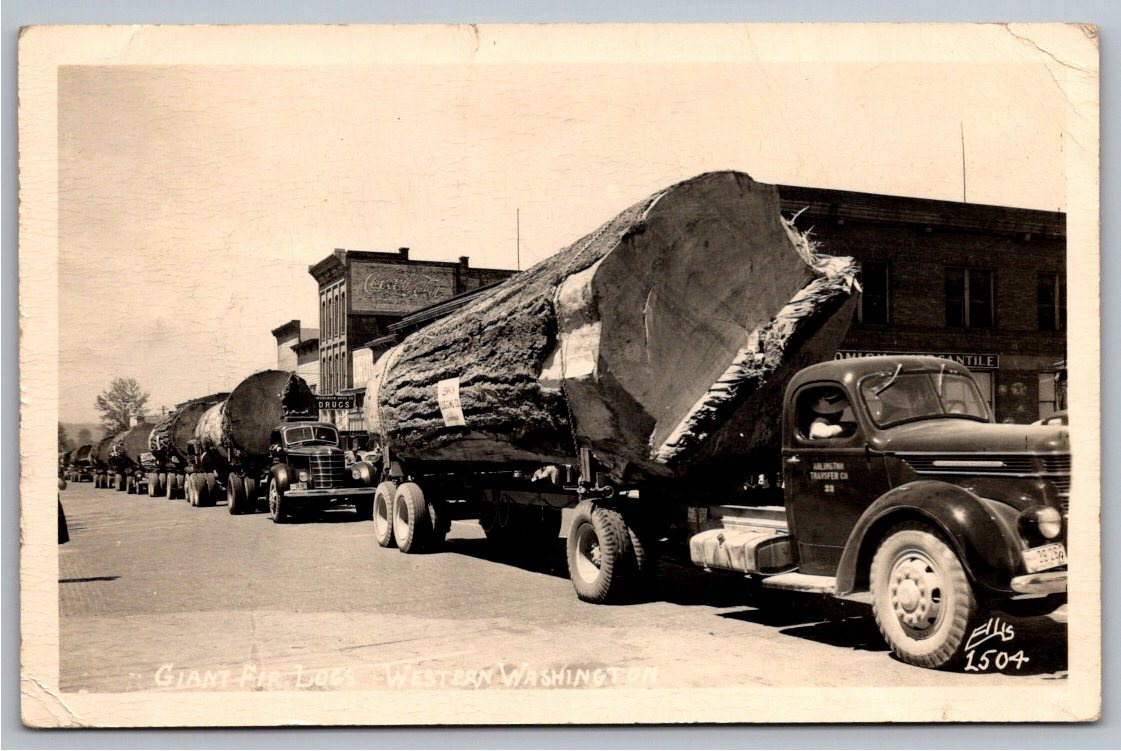
1948 Giant Fir Logs Vintage RPPC Postcard: Western Washington
📸 Click any thumbnail to inspect Front, Back & Angles (2 Photos)
As an eBay Partner, we may earn a commission if you make a purchase.
Item Specifications
- Era: 1940s Post-War
- Publisher: Ellis Photographic
- Location: Snoqualmie Valley, Washington
- Subject: Timber Logging & Heavy Hauling Trucks
- Postmark Date: August 2, 1948
- Originality: Original Vintage Postcard
- Category: Postcards & Ephemera
- Format / Type: Real Photo Postcards (RPPC)
Looking for Modern Alternatives?
Explore top-rated, modern Postcards & Ephemera and related historical accessories on Amazon.
Shop Postcards & Ephemera on Amazon →As an Amazon Associate, we earn from qualifying purchases.
Historical Context & Overview
The Golden Age of Pacific Northwest Timber Transport
In the post-World War II era, the Pacific Northwest was the beating heart of America’s timber industry. Western Washington’s dense rainforests produced some of the largest Douglas fir trees in recorded history, specimens that had stood for centuries before the arrival of modern heavy-duty forestry equipment. Capturing this industrial spectacle, real photo postcards from the period documented the immense engineering effort required to fell, load, and transport these colossal ancient trees from forest clearings to urban sawmills.
This striking original real photo postcard (RPPC) features a dramatic convoy of heavy-duty logging trucks making their way through a Washington town, each laden with monstrous single-log cut section. The scale of the front log is extraordinary, stretching the entire length of the flatbed trailer and eclipsing the cab of the truck driving it. Scenes like this were a frequent sight along highway corridors near logging hubs like Snohomish, North Bend, and Snoqualmie during the late 1940s, symbolizing both economic prosperity and technological ambition.
Heavy-Duty Hauling: The Transition to Highway Transport
Prior to the late 1930s and 1940s, the vast majority of Pacific Northwest timber was moved using steam-powered logging trains over narrow-gauge railways. However, advancements in diesel truck engineering, heavy-duty tandem axles, and pneumatic tires permitted timber companies to venture deeper into rugged mountain terrain without laying down expensive rail tracks.
By 1948, specialized logging rigs—such as those manufactured by Sterling, Peterbilt, Kenworth, and International—became the backbone of the logging industry. These heavy trucks possessed the torque and braking power needed to navigate steep, muddy logging roads with immense pay loads. Seeing a line of these industrial giants rolling slowly through downtown commercial districts was a point of civic pride, drawing onlookers to marvel at the raw strength of the regional timber workforce.
Ellis Studio and the Art of Real Photo Postcards
This photograph bears the signature marking of Ellis Photographic Studio (numbered 1504), a prominent regional photography outfit renowned for documenting life, wilderness, and industry across Washington State throughout the early-to-mid 20th century. Unlike standard mass-printed color or lithographic postcards, Real Photo Postcards were produced by exposing photographic negatives directly onto photo-sensitive postcard stock.
Because RPPCs preserve silver gelatin image details with rich contrast, viewers can clearly discern fine textures: the deeply grooved bark of the ancient firs, the white lettering painted on the trucks, and the period brick facades of nearby town storefronts. Collectors deeply value Ellis RPPCs for their candid historical accuracy and razor-sharp clarity.
A Documented Slice of 1948 History
The reverse side of this postcard adds significant historical provenance. Canceled with a clear circular postmark from North Bend, Washington, on August 2, 1948, it features a green one-cent George Washington stamp along with a brief handwritten message sent across the country to Nebraska. The writer specifically references nearby Snoqualmie, placing the postcard squarely within the vibrant timber region surrounding the Cascade foothills during the summer of 1948.
As old-growth forestry practices evolved over subsequent decades, photos depicting mammoth single-log loads became rare historical artifacts. Today, this vintage RPPC stands as a compelling visual testament to the mid-century timber boom, the rugged machinery of post-war America, and the legendary giant trees of Western Washington.