Vintage c.1910 Real Photo Postcard: Boy Hugging Dog in Oversized
📸 Click any thumbnail to inspect Front, Back & Angles (2 Photos)
As an eBay Partner, we may earn a commission if you make a purchase.
Item Specifications
- Type: Real Photo Postcard (RPPC)
- Era: Divided Back (c. 1904-1918)
- Stamp Box: AZO (Four Triangles Up)
- Subject: Young Boy & Dog Portrait
- Finish: Black & White Silver Gelatin
- Originality: Original Vintage Postcard
- Category: Postcards & Ephemera
- Format / Type: Real Photo Postcards (RPPC)
Looking for Modern Alternatives?
Explore top-rated, modern Postcards & Ephemera and related historical accessories on Amazon.
Shop Postcards & Ephemera on Amazon →As an Amazon Associate, we earn from qualifying purchases.
Historical Context & Overview
In the early decades of the twentieth century, the advent of real photo postcards (RPPCs) revolutionized vernacular photography across North America. No longer confined to the stiff poses and formal backdrops of commercial photo studios, ordinary families gained the ability to capture playful, heartfelt glimpses of daily life right in their own front yards. This endearing original Real Photo Postcard, dating to approximately 1910, stands as a quintessential specimen of early American snapshot portraiture, freezing in time an innocent moment between a child and his canine companion.
A Candid Glimpse into Early American Childhood
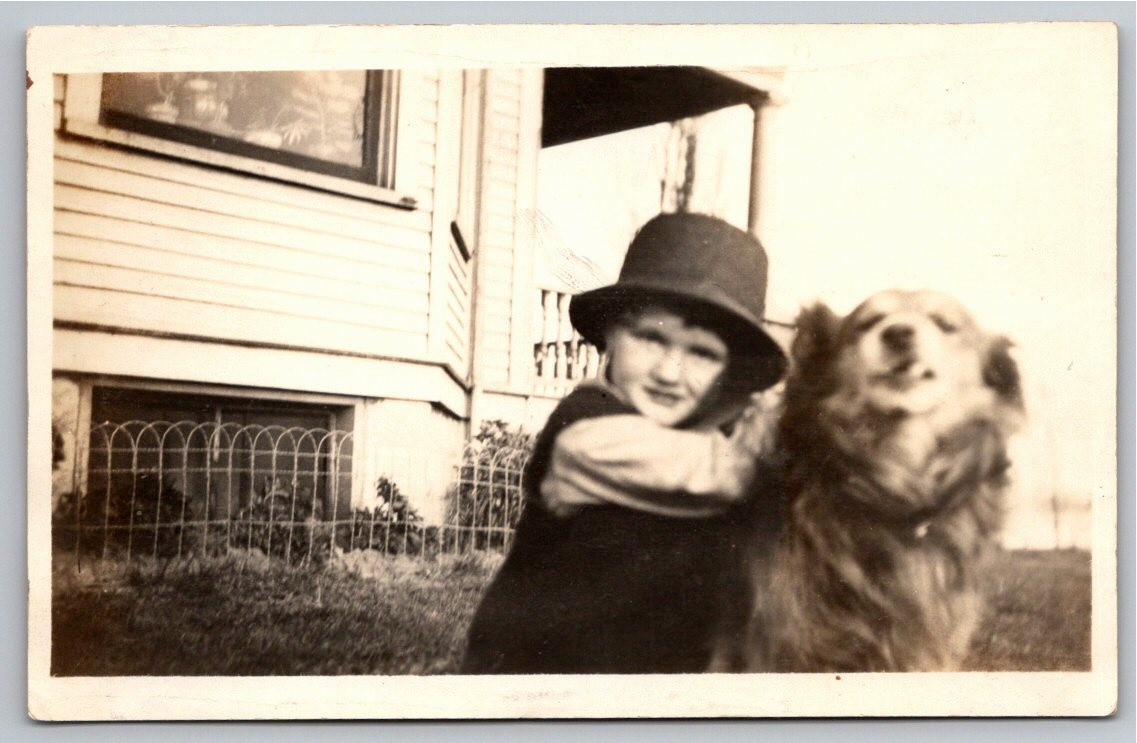
The image depicts a young boy sitting outdoors on a patch of lawn, his arm wrapped warmly around a fluffy, long-haired dog. Adding a layer of whimsical character to the photograph, the boy wears an oversized hat—likely borrowed from an older relative—tilted charmingly over his forehead. The unscripted nature of the scene, paired with the canine's calm demeanour, creates an authentic narrative of companionship that resonates just as strongly today as it did over a century ago.
Behind the duo, the photograph preserves subtle architectural details typical of turn-of-the-century residential homes. Painted wooden clapboard siding, a raised covered porch with decorative balusters, a low cellar window, and arched wire garden fencing provide rich context for historians studying suburban and rural American domestic life during the Progressive Era.
Dating the Artifact: The AZO Stamp Box
Understanding Early Kodak Paper Marks
One of the most reliable methods for dating unmailed Real Photo Postcards is examining the stamp box printed on the reverse side. The back of this postcard displays the classic "AZO" stamp box emblem flanked by four solid triangles pointing upward in each corner. Eastman Kodak manufactured paper stock with this specific "AZO" corner arrangement between 1904 and 1918, perfectly aligning with the visual cues of fashion and architecture present in the front image.
Condition and Archival Appeal
Preserved in its original silver gelatin photographic print format, the postcard retains excellent tonal contrast and clear focus. The reverse side remains unposted and unwritten, featuring clean "Post Card," "Correspondence," and "Address" divider markings characteristic of the Divided Back era (1907–1915). Free from severe creasing or heavy surface loss, it offers collectors a pristine historical document.
Collecting Vernacular RPPCs
Real photo postcards featuring domestic pets and children remain among the most sought-after genres in deltiology. Because RPPCs were produced in very limited quantities—often as one-of-a-kind family keepsakes—each surviving card is inherently rare. This captivating photograph is not merely a piece of vintage ephemera; it is a heartwarming piece of social history that captures the timeless connection between humans and their pets.