1930s The Wayside Hawthorne Home Concord MA Vintage Photo
📸 Click any thumbnail to inspect Front, Back & Angles (2 Photos)
🔗 Embed / Cite This Archival Image (Free with Attribution)Get HTML Code
© USA RESELL. Bloggers, historians, and website owners may embed this image for free by copying the HTML code below (which includes the required credit link back to this page):
USA RESELL is a living historical archive. Because original artifacts are one-of-a-kind and source records change rapidly, use the button above to check live marketplace availability or locate surviving examples. As an eBay Partner, we may earn a commission on qualifying purchases.
Item Specifications
- City: Concord
- State: Massachusetts
- Country: United States
- Era: Early 20th Century
- Subject: The Wayside Nathaniel Hawthorne Margaret Sidney Historic
- Theme: Americana
- Category: Vintage Photography
- Format / Type: Vintage Photographs
Historical Context & Overview
Visual and Architectural Overview of The Wayside
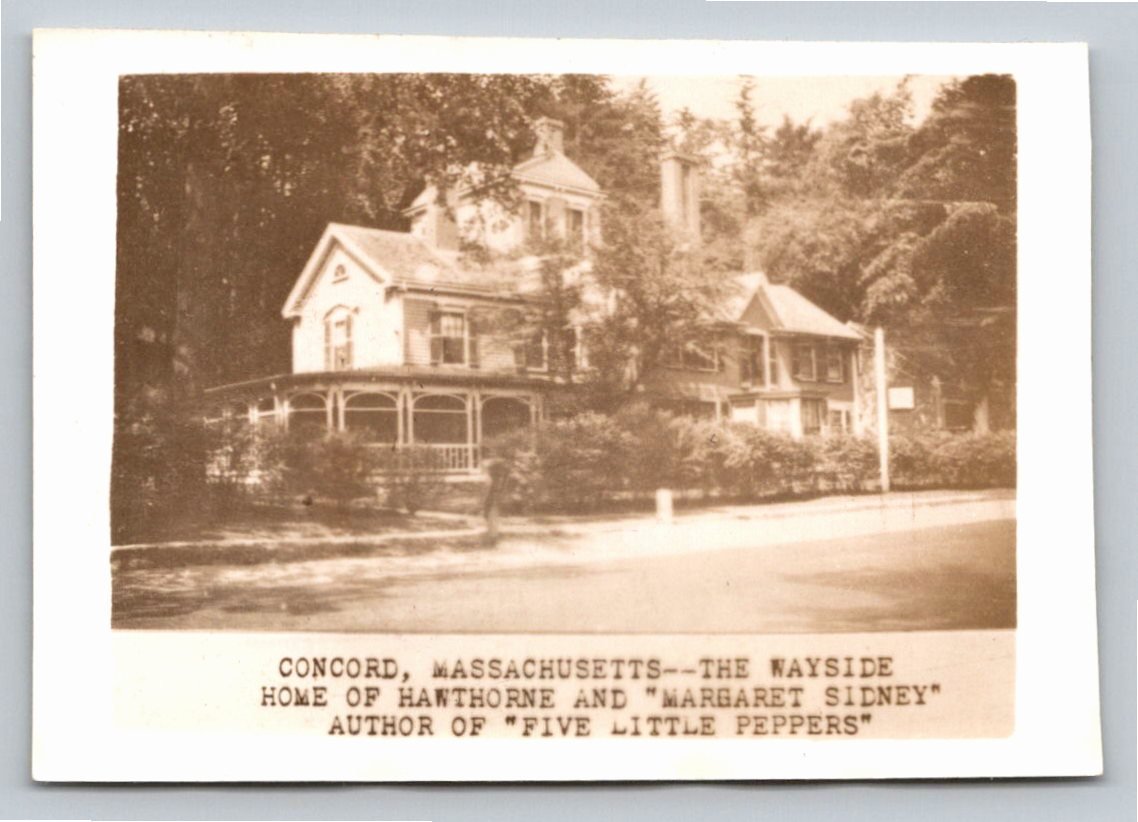
This evocative vintage photograph documents The Wayside, one of the most culturally significant historic residences in Concord, Massachusetts. Captured in a warm, sepia-toned exposure dating to the interwar era between 1920 and 1939, the composition highlights the building's distinctive vernacular evolution. Set back slightly from the roadway behind manicured plantings and shaded by towering mature trees, the exterior showcases its prominent three-story central tower, steep gables, and the sprawling covered front veranda that defines its welcoming facade.
A mechanically imprinted caption along the bottom white margin identifies the property clearly: "CONCORD, MASSACHUSETTS--THE WAYSIDE HOME OF HAWTHORNE AND 'MARGARET SIDNEY' AUTHOR OF 'FIVE LITTLE PEPPERS'". The lens captures fine exterior details, from the screened archways of the wraparound porch to the multi-pane sash windows and classic timber siding. The daylight casts gentle shadows across the yard and street, evoking the peaceful ambiance of early 20th-century New England heritage tourism.
Literary Heritage and Historical Significance
Few domestic residences in the United States claim a literary lineage as rich as The Wayside. Originally constructed in the early eighteenth century, the house gained fame through its illustrious inhabitants. It served as a childhood residence for Louisa May Alcott and her family before being purchased in 1852 by renowned novelist Nathaniel Hawthorne. Hawthorne lived here until his death in 1864, famously adding the third-story tower study to provide a secluded creative haven where he penned several of his final writings.
Later in the nineteenth century, the residence became the creative sanctuary of Harriet Mulford Stone Lothrop, who wrote beloved children's literature under the pseudonym Margaret Sidney. Her enduring series, Five Little Peppers and How They Grew, brought national acclaim and immortalized the estate among generations of young readers. Lothrop was instrumental in preserving the property's historical integrity, ensuring that both Hawthorne's legacy and the architectural eccentricities of the house survived intact for future generations.
Physical Attributes, Technique, and Collector Value
Printed on medium-weight paper stock, this authentic vintage photograph measures approximately 3.5 by 2.4 inches. Developed using standard chemical darkroom processes typical of twentieth-century commemorative and tourist photography, it features a smooth matte finish with balanced mid-tones and clear definition. The reverse of the print is completely blank photographic paper stock, confirming that it was produced as an individual snapshot print rather than a commercial mailing card.
Preserved in very good vintage condition, the piece shows crisp, unbent edges and minimal signs of handling, save for a minuscule age spot on the upper edge of the reverse side. The warm toning across the image layer remains uniform and free from silver mirroring or surface cracking. For enthusiasts of American transcendentalism, nineteenth-century literature, and historical Concord ephemera, this snapshot offers an authentic window into a foundational landmark of American literary history.