Vintage Treasury Street Postcard: St. Augustine's Narrowest
📸 Click any thumbnail to inspect Front, Back & Angles (2 Photos)
As an eBay Partner, we may earn a commission if you make a purchase.
Item Specifications
- Era: 1910s Divided Back
- Publisher: Curt Teich & Co. / W.J. Harris Co.
- Location: St. Augustine, Florida
- Subject: Treasury Street
- Thoroughfare Width: 6 Feet 1 Inch
- Originality: Original Vintage Postcard
- Category: Postcards & Ephemera
- Format / Type: Printed Postcards
Looking for Modern Alternatives?
Explore top-rated, modern Postcards & Ephemera and related historical accessories on Amazon.
Shop Postcards & Ephemera on Amazon →As an Amazon Associate, we earn from qualifying purchases.
Historical Context & Overview
The Charming Curiosity of America’s Narrowest Thoroughfare
In the heart of historic St. Augustine, Florida, lies a quaint passage with a rich colonial legacy: Treasury Street. Measuring a mere six feet and one inch at its narrowest point, this tight alleyway earned national fame as the narrowest public highway in the United States. During Florida’s early boom of railway and heritage tourism, postcards like this captured the imagination of winter visitors fascinated by the ancient city's European urban layout.
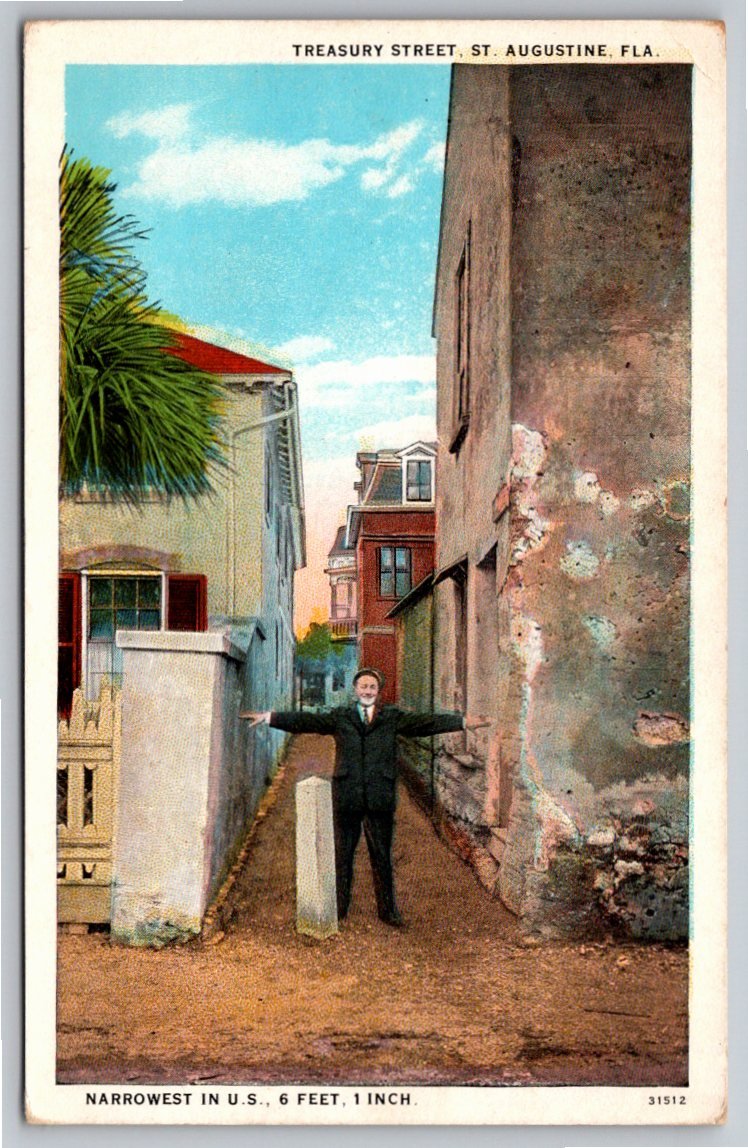
The iconic visual associated with Treasury Street—a gentleman standing in the center with arms extended to touch the historic walls on both sides simultaneously—became a quintessential souvenir image. Published locally by the W.J. Harris Company of St. Augustine, this original antique postcard offers a whimsical look at early twentieth-century Florida sightseeing while preserving a physical record of Spanish colonial architectural heritage.
Spanish Colonial Strategy and Architectural Design
Treasury Street was far from an urban accident; its razor-thin proportions were calculated and intentional. Laid out during the Spanish colonial period, the street ran directly from the city's bayfront harbor west toward the Royal Treasury, or La Real Hacienda. Spanish military engineers purposefully restricted the lane's width to prevent horse-drawn wagons and carriages from accessing the passage, forcing all official business to be conducted on foot or via small handcarts. This design made it virtually impossible for raiding pirates or privateers to dock at the harbor and quickly haul heavy chests of bullion away from the treasury vault.
Beyond security, the street's dense arrangement served vital environmental functions. In the heat of sub-tropical Florida summers, the tall coquina stone and tabby structures cast deep, overlapping shadows across the corridor. This kept the walkway significantly cooler than surrounding open squares and provided shade for pedestrians going to and from the waterfront.
Printing Heritage: Curt Teich's American Art Colored Technique
Produced by the celebrated Chicago lithography printer Curt Teich & Co. on behalf of local retailer W.J. Harris, this postcard displays the firm's distinctive "C.T. American Art Colored" lithographic process. Renowned for saturated tints and vivid sky tones, Teich’s process transformed monochrome photographic prints into alluring colorized scenes that persuaded thousands of Northern travelers to journey south.
Bearing crisp front captions documenting the famous six-foot, one-inch dimension and an unposted reverse side, this specimen stands out as a pristine relic of Sunshine State ephemera. It represents a fantastic inclusion for collectors of St. Augustine history, unusual American roadways, and early architectural postcard art.