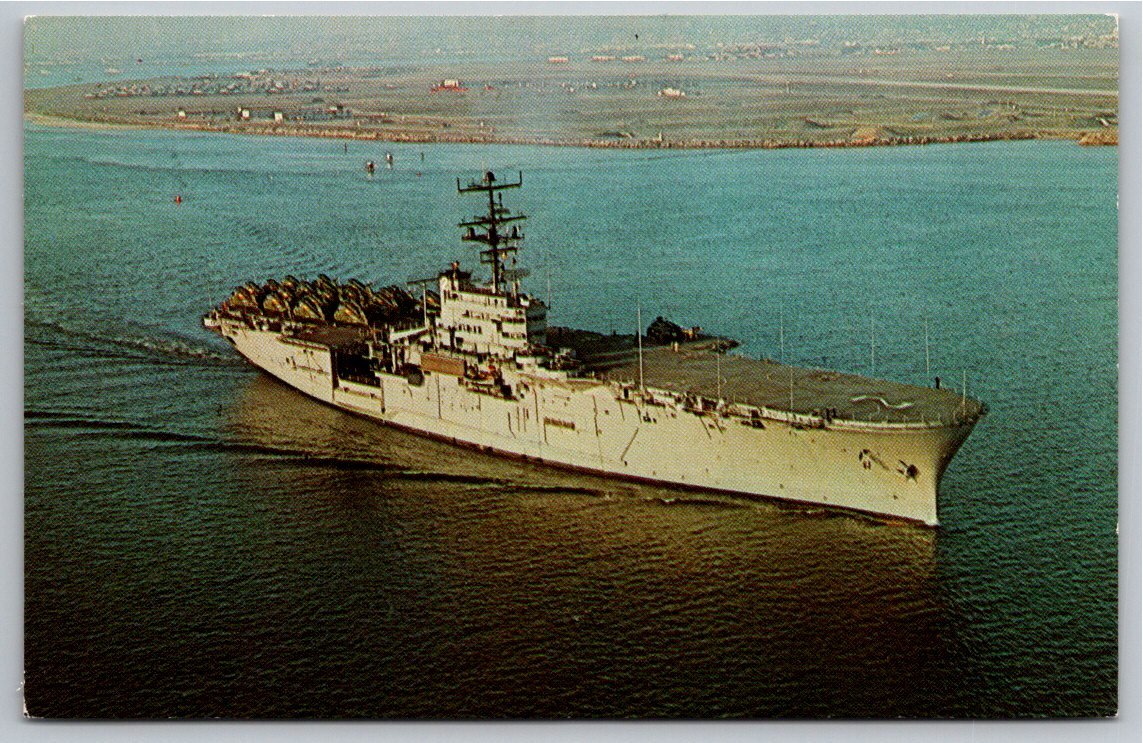
Vintage USS Iwo Jima LPH-2 Navy Amphibious Assault Ship Postcard
📸 Click any thumbnail to inspect Front, Back & Angles (2 Photos)
As an eBay Partner, we may earn a commission if you make a purchase.
Item Specifications
- Type: Amphibious Assault Ship
- Era: 1960s Chrome
- Publisher: Dexter Press
- Vessel: USS Iwo Jima (LPH-2)
- Originality: Original Vintage
- Card Number: 65005-B
- Category: Postcards & Ephemera
- Format / Type: Vintage Postcards
Looking for Modern Alternatives?
Explore top-rated, modern Postcards & Ephemera and related historical accessories on Amazon.
Shop Postcards & Ephemera on Amazon →As an Amazon Associate, we earn from qualifying purchases.
Historical Context & Overview
The Dawn of Vertical Envelopment: USS Iwo Jima (LPH-2)
In the post-World War II era, naval warfare underwent a dramatic doctrine revolution. Recognizing the vital need for rapid force projection without relying exclusively on traditional landing craft storming defended beaches, the United States Navy and Marine Corps pioneered the strategy of "vertical envelopment." This military concept utilized transport helicopters to airlift combat troops and heavy equipment directly over coastal defenses and into key positions inland. While initial operational trials adapted existing escort aircraft carriers, the USS Iwo Jima (LPH-2) holds a permanent place in naval history as the very first vessel designed and constructed from the keel up specifically as a helicopter amphibious assault ship.
Laid down at the historic Puget Sound Naval Shipyard in Bremerton, Washington, and commissioned on August 26, 1961, the USS Iwo Jima represented the flagship of a brand-new warship class. Named in honor of the fierce World War II battle fought by U.S. Marines in 1945, the ship featured a broad, uninterrupted flight deck capable of launching and receiving multiple troop-transport helicopters simultaneously. With a full combat landing team of Marines and a dedicated aviation squadron aboard, the Iwo Jima quickly became a mainstay of American forward-deployed amphibious readiness.
From Cold War Patrols to the Vietnam War
Shortly after her commissioning, the USS Iwo Jima entered active service during one of the tense heights of the Cold War. In October 1962, during the Cuban Missile Crisis, she deployed swiftly as part of the Caribbean blockade fleet. By the mid-1960s, her operational focus shifted toward Southeast Asia. Throughout the Vietnam War, the vessel completed numerous deployments to the South China Sea, serving as an essential command platform for Special Landing Forces. Her helicopter squadrons inserted Marines directly into critical combat zones during major operations, confirming the tactical value of modern vertical assault capabilities.
A Starlight Role in the NASA Apollo Space Program
Beyond her extensive combat record, the USS Iwo Jima achieved lasting global fame through her involvement with NASA during the Space Race. In December 1968, she served as the primary recovery vessel for Apollo 8, the historic mission that saw humans orbit the Moon for the first time. However, her most famous moment came on April 17, 1970, following the heroic rescue of the Apollo 13 crew.
After a mid-flight oxygen tank explosion crippled their spacecraft en route to the Moon, astronauts James Lovell, Jack Swigert, and Fred Haise navigated their damaged lunar module back to Earth in a fight for survival. The USS Iwo Jima waited in the South Pacific target zone as the command module Odyssey parachuted safely into the ocean. The ship's crew retrieved the capsule and brought the three astronauts aboard, marking one of the most celebrated rescue operations in aviation and spaceflight history.
A Classic Mid-Century Military Keepable
This original vintage chrome postcard, published by Marine Photos & Publishing Co. of San Diego, California, and produced by the famed Dexter Press of West Nyack, New York (card number 65005-B), captures the USS Iwo Jima underway with her flight deck fully staged with military transport helicopters. Featuring brilliant period color and crisp composition, this historical collectible offers an enduring window into mid-20th-century U.S. naval power, aviation history, and American maritime heritage.