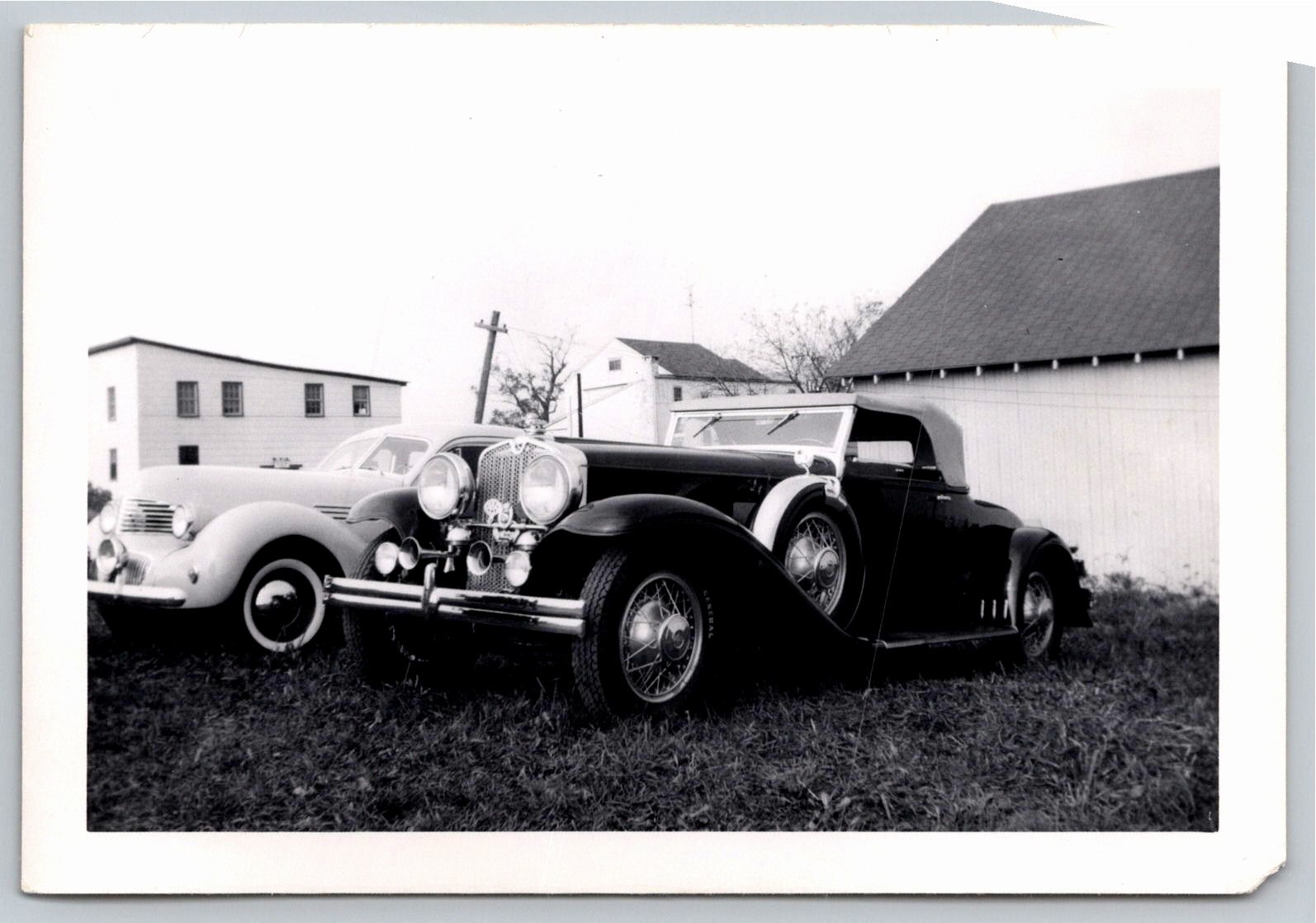
1930s Cord 810 Coffin Nose & Packard Roadster Vintage Photo
📸 Click any thumbnail to inspect Front, Back & Angles (2 Photos)
🔗 Embed / Cite This Archival Image (Free with Attribution)Get HTML Code
© USA RESELL. Bloggers, historians, and researchers may embed this image for free by keeping the credit link below intact:
As an eBay Partner, we may earn a commission if you make a purchase.
Item Specifications
- Country: United States
- Era: 1930s
- Subject: Automobiles
- Original/Licensed Reprint: Original Vintage
- Image Color: Black and White
- Production Technique: Gelatin-Silver Print
- Category: Vintage Photography
- Format / Type: Vintage Photographs
Looking for Modern Alternatives?
Explore top-rated, modern Vintage Photography and related historical accessories on Amazon.
Shop Vintage Photography on Amazon →As an Amazon Associate, we earn from qualifying purchases.
Historical Context & Overview
Few eras in American automotive history produced machine design as daring and majestic as the 1930s. This original vintage snapshot captures two towering icons of pre-war motoring parked side-by-side on a quiet rural property, framed by classic wooden farm buildings. In one expressive exposure, the photograph bridges the transition from traditional luxury coachwork to radical, forward-looking aerodynamic design.
The Avant-Garde 1936 Cord 810 'Coffin Nose'
On the left sits the revolutionary Cord 810, engineered by the Auburn Automobile Company and styled by master designer Gordon Buehrig. Introduced for the 1936 model year, the Cord 810 reshaped luxury automobile aesthetics overnight. Known affectionately among collectors as the "Coffin Nose" due to its distinctive flat-topped, louvered front hood, the vehicle dispensed with traditional radiator grilles, running boards, and exposed door hinges.
Buehrig’s design was equally famous for introducing retractable hidden headlights—operated manually via hand cranks on either side of the dashboard—and flared pontoon fenders that integrated smoothly into the streamlined silhouette. Beneath its sleek sheet metal, the Cord 810 featured an advanced front-wheel-drive system and a Lycoming V8 engine mated to a semi-automatic pre-selector transmission. Today, the Cord 810/812 series remains one of the few motorcars officially recognized by the Museum of Modern Art as an exceptional work of industrial sculpture.
Traditional Elegance: The Early 1930s Packard Convertible Roadster
Standing prominently in the right foreground is an early 1930s Packard Convertible Roadster, embodying the pinnacle of traditional American prestige and craftsmanship. Packard's long-hood, low-slung stance was legendary among wealthy motorist circles, representing uncompromising quality and mechanical refinement.
This particular roadster boasts iconic period accents that define the golden age of classic motoring: sparkling wire-spoked wheels, dual side-mounted spare tires set into sweeping front fenders, a chrome-finished radiator stone guard, and auxiliary driving lamps mounted low to illuminate unpaved country roads. The contrast between Packard's classic, upright elegance and Cord's futuristic minimalism makes this dual-subject composition extraordinarily rare and visually captivating.
Photographic Attributes and Collector Preservation
Printed on authentic vintage gelatin-silver paper, this snapshot measures approximately 5.0 by 3.4 inches. Gelatin-silver prints from the 1930s are highly prized for their deep black tones, clean highlights, and archival longevity. The image displays exceptional contrast and sharp visual detail, preserving the intricate chrome work, tire treads, and architectural textures of the background barn.
The reverse side presents a plain paper finish marked only by a faint, stamped inventory catalog number '280' near the lower edge. Light, age-appropriate corner wear attests to its authenticity without compromising the clear focal subjects. For historians of vintage coachbuilding, antique car enthusiasts, and caretakers of mid-century photography, this original snapshot serves as a evocative document of American automotive artistry.