1930s Needles Eye Tunnel South Dakota Custer Park Photo
📸 Click any thumbnail to inspect Front, Back & Angles (2 Photos)
🔗 Embed / Cite This Archival Image (Free with Attribution)Get HTML Code
© USA RESELL. Bloggers, historians, and website owners may embed this image for free by copying the HTML code below (which includes the required credit link back to this page):
USA RESELL is a living historical archive. Because original artifacts are one-of-a-kind and source records change rapidly, use the button above to check live marketplace availability or locate surviving examples. As an eBay Partner, we may earn a commission on qualifying purchases.
Item Specifications
- City: Custer
- State: South Dakota
- Country: United States
- Era: Early 20th Century
- Subject: Needles Eye Tunnel Needles Highway Black Hills Rock Formation
- Theme: Americana
- Category: Vintage Photography
- Format / Type: Vintage Photographs
Historical Context & Overview
Visual Composition of the Black Hills Granite Spires
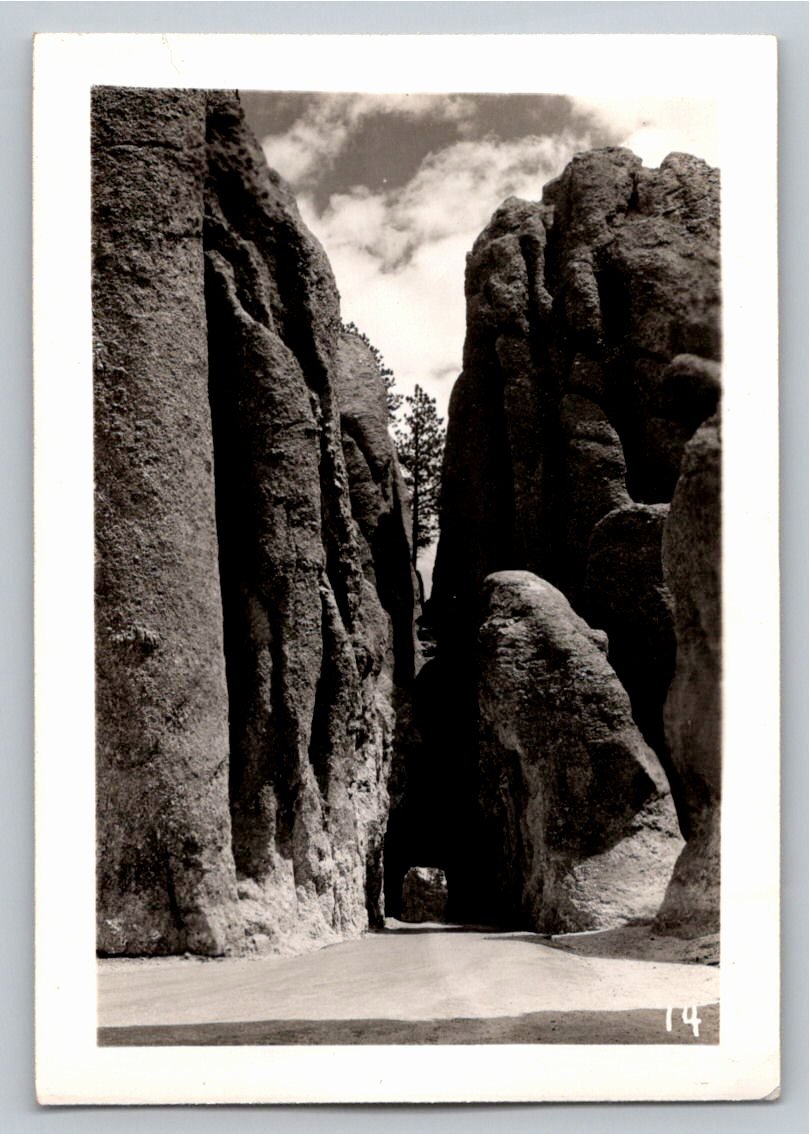
This striking original silver gelatin print presents an intimate vertical perspective of the famed Needles Eye Tunnel carved through the ancient granite spires of South Dakota’s Black Hills. Towering rock sentinels rise up both flanks of the composition, their craggy surfaces defined by deep shadows and glistening highlights that showcase the textured minerals of the formation. At the base of these immense monoliths rests a smoothly graded single-lane roadway, disappearing directly into the narrow rectangular aperture blasted straight through the stone wall.
Framed naturally between the sheer stone columns, a solitary evergreen tree perches high on an elevated ledge, silhouetted against a dramatic sky filled with billowy cumulus clouds. The low-angle framing emphasizes the sheer verticality of the landscape, capturing the precarious sense of scale that travelers felt when first navigating early alpine roadways in twentieth-century motorcars. Light pours into the scene from an elevated angle, illuminating the dusty curve of the roadway leading into the dark void of the passageway.
Engineering the Needles Highway and Early Motoring Lore
The Needles Highway, designated formally as South Dakota Highway 87, stands as one of the crowning achievements of early American scenic road engineering. Conceived during the administration of Governor Peter Norbeck and completed in the early 1920s, the highway was deliberately plotted on horseback and foot rather than modern survey lines to ensure motorists were intimately immersed in Custer State Park’s dramatic geological formations. The passage through the Needles Eye was blasted by hand and dynamite, leaving behind a claustrophobic portal measuring barely over eight feet wide.
During the 1920s and 1930s, the route developed legendary status among cross-country motorists heading west toward Mount Rushmore and Yellowstone. Traversing the Needles Eye Tunnel required intense driver concentration, as wider passenger cars and commercial tour buses had to crawl slowly through the rock opening with mere inches to spare on either running board. The landmark immediately established itself as an essential stop for adventurous touring families eager to document their vehicles juxtaposed against the colossal stone needles.
Physical Print Characteristics, Provenance, and Condition
Printed on classic period photographic paper, this authentic silver gelatin snapshot measures approximately 2.4 by 3.5 inches, a standard handheld vest-pocket camera format popular among vacationers of the 1930s. The front image displays a clean white margin, with the photographer's negative index number "14" printed in white within the lower right corner of the active image area. The reverse features entirely blank photo paper aside from a faint matching pencil notation of "14," clearly signifying that this artifact was preserved from a private personal album rather than produced as a mass-market commercial souvenir.
The print remains in remarkable vintage condition, retaining rich tonal depth across the entire greyscale spectrum, from velvety black rock crevices to brilliant cloud highlights. The paper structure is structurally sound with no tears, creases, or surface fractures, displaying only subtle, microscopic edge wear consistent with careful preservation over many decades. As an authentic piece of mid-century Americana and western tourism photography, this snapshot represents a pristine visual record of early Black Hills motorized exploration.