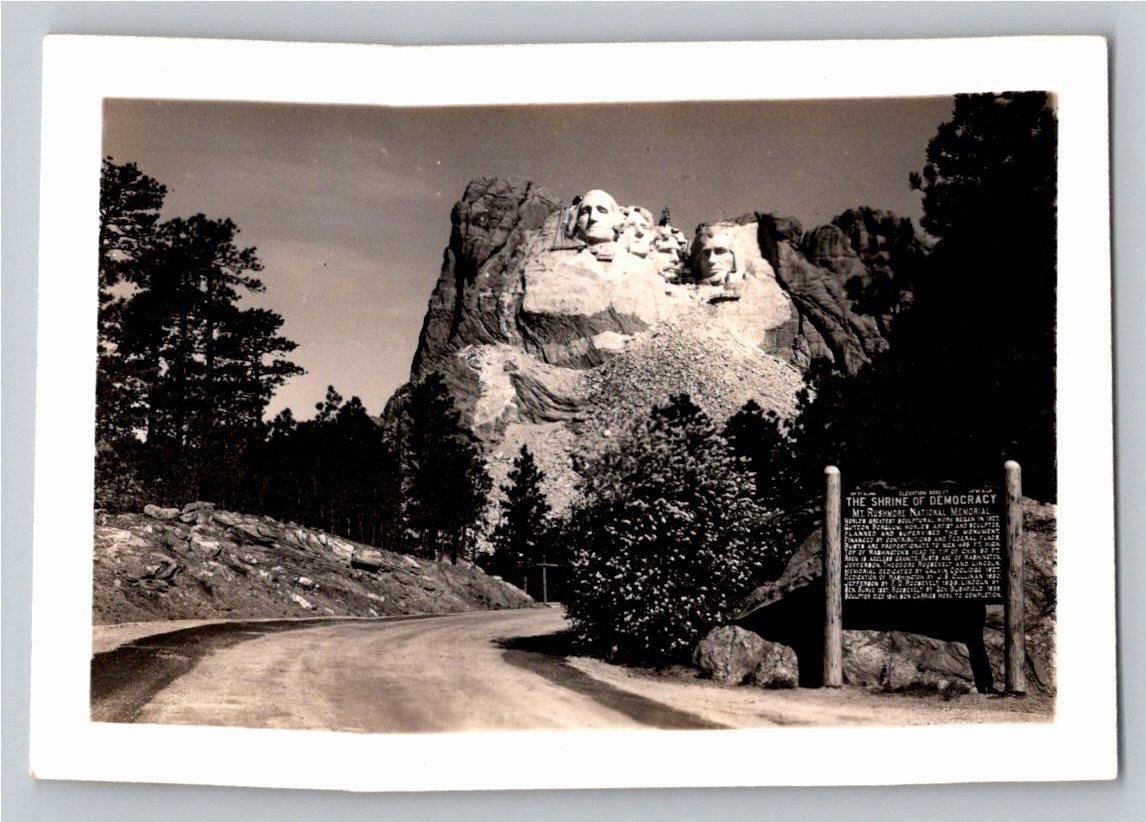
1940s Mount Rushmore Shrine of Democracy Sign Black Hills Photo
📸 Click any thumbnail to inspect Front, Back & Angles (2 Photos)
🔗 Embed / Cite This Archival Image (Free with Attribution)Get HTML Code
© USA RESELL. Bloggers, historians, and website owners may embed this image for free by copying the HTML code below (which includes the required credit link back to this page):
USA RESELL is a living historical archive. Because original artifacts are one-of-a-kind and source records change rapidly, use the button above to check live marketplace availability or locate surviving examples. As an eBay Partner, we may earn a commission on qualifying purchases.
Item Specifications
- Type: Photograph
- Original/Licensed Reprint: Original Vintage
- Subject: Mount Rushmore National Parks Monuments
- Theme: Americana Travel Tourism History
- Image Color: Black and White
- Production Technique: Gelatin-Silver Print
- Category: Vintage Photography
- Format / Type: Snapshots
Historical Context & Overview
Mid-Century Roadway Vista of Mount Rushmore
This striking original vintage black-and-white snapshot captures an iconic mid-century vantage point of Mount Rushmore National Memorial, nestled high within the granite crags of the Black Hills near Keystone, South Dakota. Taken directly from the ascending gravel approach road, the composition frames the vast natural landscape with native ponderosa pines and craggy hillside embankments. In the foreground along the curve of the highway stands a rustic, dark-stained timber informational signboard proudly headed "The Shrine of Democracy."
Rising dramatically in the background across the open horizon are the mammoth stone likenesses of American presidents George Washington, Thomas Jefferson, Theodore Roosevelt, and Abraham Lincoln. Towering above the massive slope of fractured talus stone below, the monumental sculpture reflects brilliant natural sunlight, casting deep, sculptural shadows across the facial profiles. This vantage encapsulates the classic family automobile vacation era of the 1940s, when motorists wound along narrow scenic roads to behold newly completed national monuments firsthand.
Historical Context of the Shrine of Democracy
The prominent roadside plaque depicted in the photograph serves as an informative time capsule of early visitor interpretation at the memorial. The sign text recounts the monumental endeavor conceived and directed by sculptor Gutzon Borglum, whose massive carving work began in 1927. It details the timeline of individual presidential dedications, including Washington in 1930, Jefferson in 1936, Lincoln in 1937, and Roosevelt in 1939, along with Borglum's death in March 1941, after which his son Lincoln Borglum brought the monumental undertaking to its formal conclusion.
During the immediate post-World War II period, domestic tourism throughout the American West surged as families took to newly expanded highways in search of inspiring heritage landmarks. Signage like this was strategically situated along pull-offs to orient tourists before modern visitor centers, paved pedestrian avenues, and formal amphitheaters reshaped the visitor experience. Such photographs highlight an intimate era of national park visitation where the rustic, frontier atmosphere still remained front and center.
Format, Materiality, and Photographic Provenance
Measuring approximately 3.5 by 2.4 inches, this authentic piece of vernacular photography is rendered as a traditional gelatin silver print on glossy white-bordered photographic paper. The print exhibits excellent tonal separation, delivering deep, velvety shadows among the pine needles and crisp, well-defined highlights along the sunlit granite faces and painted sign lettering. The clean white borders provide a pleasing natural frame characteristic of mid-century commercial photofinishing labs.
The reverse side of the snapshot confirms its status as an authentic personal print rather than a souvenir photograph. It displays a clean, plain paper backing bearing only a solitary machine-stamped numeral "6" centered toward the top margin, indicative of standard darkroom processing batch numbers. Preserved in very good vintage condition with gentle corner handling consistent with its age, this snapshot stands as a captivating historical artifact of mid-20th-century Black Hills travel and classic Americana photography.