Vintage Postcard: Original Block House, St. Helen's Island
📸 Click any thumbnail to inspect Front, Back & Angles (2 Photos)
As an eBay Partner, we may earn a commission if you make a purchase.
Item Specifications
- Era: 1950s-1960s Plastichrome
- Publisher: Benjamin News Company
- Location: St. Helens Island, Montreal, Quebec, Canada
- Subject: Original Blockhouse & Cannon
- Condition: Used / Postally Used
- Originality: Original Vintage
- Category: Postcards & Ephemera
- Format / Type: Vintage Postcards
Looking for Modern Alternatives?
Explore top-rated, modern Postcards & Ephemera and related historical accessories on Amazon.
Shop Postcards & Ephemera on Amazon →As an Amazon Associate, we earn from qualifying purchases.
Historical Context & Overview
Rising quietly above the waters of the St. Lawrence River, St. Helen’s Island (Île Sainte-Hélène) has long served as a strategic guardian of Montreal's eastern maritime approach. Following the conclusion of the War of 1812, imperial British forces recognized the vulnerability of lower Canada to potential invasion from the south. Under the direction of Lieutenant-Colonel Elias Walker Durnford of the Royal Engineers, a complex system of defense works, storehouses, and garrisons was established on the island between 1820 and 1824. Among these military works stood the wooden blockhouse, an essential defensive stronghold designed to shield soldiers and protect ammunition stockpiles.
Architectural Features of 19th-Century Timber Defenses
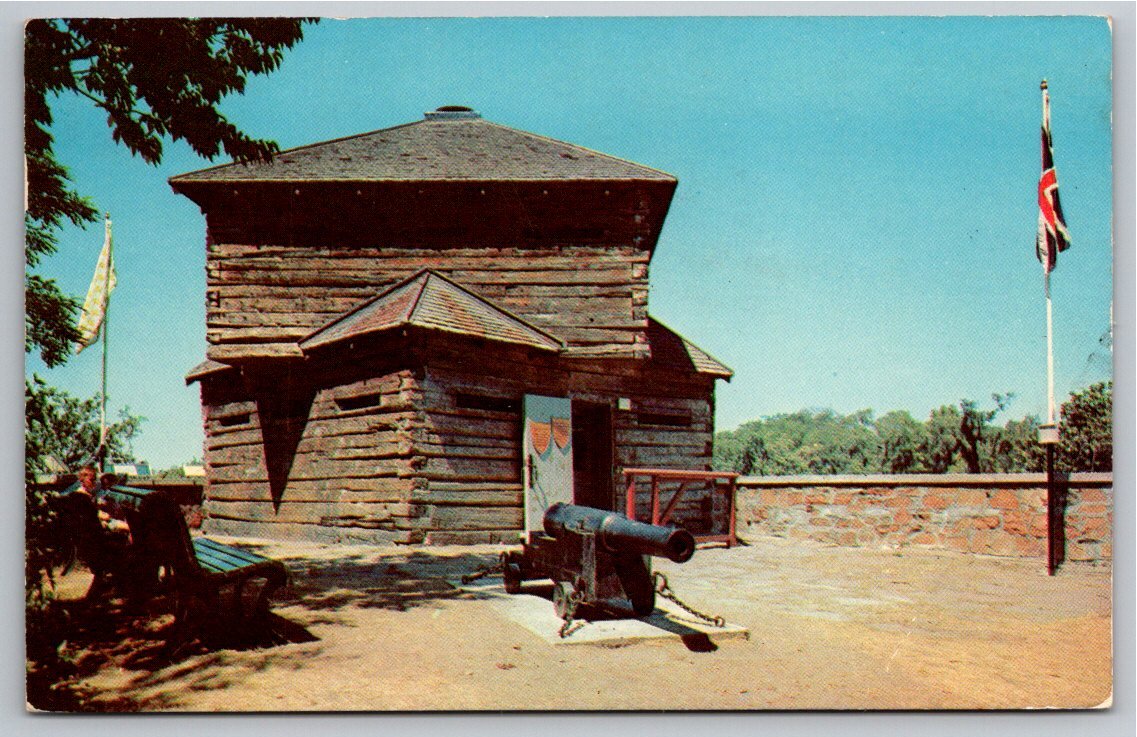
The vivid color image on this mid-century postcard captures the classic architecture of British colonial military construction. Built from heavy squared timber logs stacked horizontal and tightly notched at the corners, the blockhouse features a classic cantilevered or jettied upper level. This overhanging second story allowed defenders inside the building to drop projectiles or direct rifle fire downward against attackers attempting to scale or burn the lower structure. Narrow horizontal loopholes were carved directly through the thick timber walls, providing wide firing angles for small-arms defense while offering maximum cover from enemy return fire.
Adjacent to the timber blockhouse sits a heavy iron cannon mounted on a wheeled carriage, positioned on a paved stone terrace that looks out over the surrounding riverbanks. Above the fort, a Union Flag flies proudly on a white flagpole, commemorating the British garrison era before the site was transferred to Canadian authorities in 1870 and eventually repurposed into a public civic park.
Mid-Century Tourism and Postcard Printing History
During the mid-20th century, St. Helen's Island transitioned into one of Montreal's most popular tourist, recreational, and historical centers, culminating in the establishment of the David M. Stewart Museum and later serving as a major hub for Expo 67. Postcards like this example brought Montreal's rich military lineage to travelers across North America.
This particular postcard was produced using the famous "Plastichrome" process developed by Colourpicture of Boston and distributed locally by the Benjamin News Company, located at 425 Guy Street in Montreal. Printed on high-gloss stock, Plastichrome cards were celebrated for their rich, saturated colors and crisp visual depth. The back of the postcard bears a postmarked four-cent purple postage stamp featuring the portrait of Queen Elizabeth II, alongside a handwritten personal message sent to Ohio describing the crisp Canadian weather. As an authentic piece of mid-century ephemera, it captures both military heritage and mid-century Canadian travel culture.