1940s Sacramento River California Industrial Dredger Photo
📸 Click any thumbnail to inspect Front, Back & Angles (2 Photos)
🔗 Embed / Cite This Archival Image (Free with Attribution)Get HTML Code
© USA RESELL. Bloggers, historians, and website owners may embed this image for free by copying the HTML code below (which includes the required credit link back to this page):
USA RESELL is a living historical archive. Because original artifacts are one-of-a-kind and source records change rapidly, use the button above to check live marketplace availability or locate surviving examples. As an eBay Partner, we may earn a commission on qualifying purchases.
Item Specifications
- City: Sacramento
- State: California
- Country: United States
- Era: Mid-Century
- Subject: Dredge
- Theme: Industrial
- Category: Vintage Photography
- Format / Type: Snapshots
Historical Context & Overview
Visual & Historical Overview: Riverfront Engineering in Mid-Century California
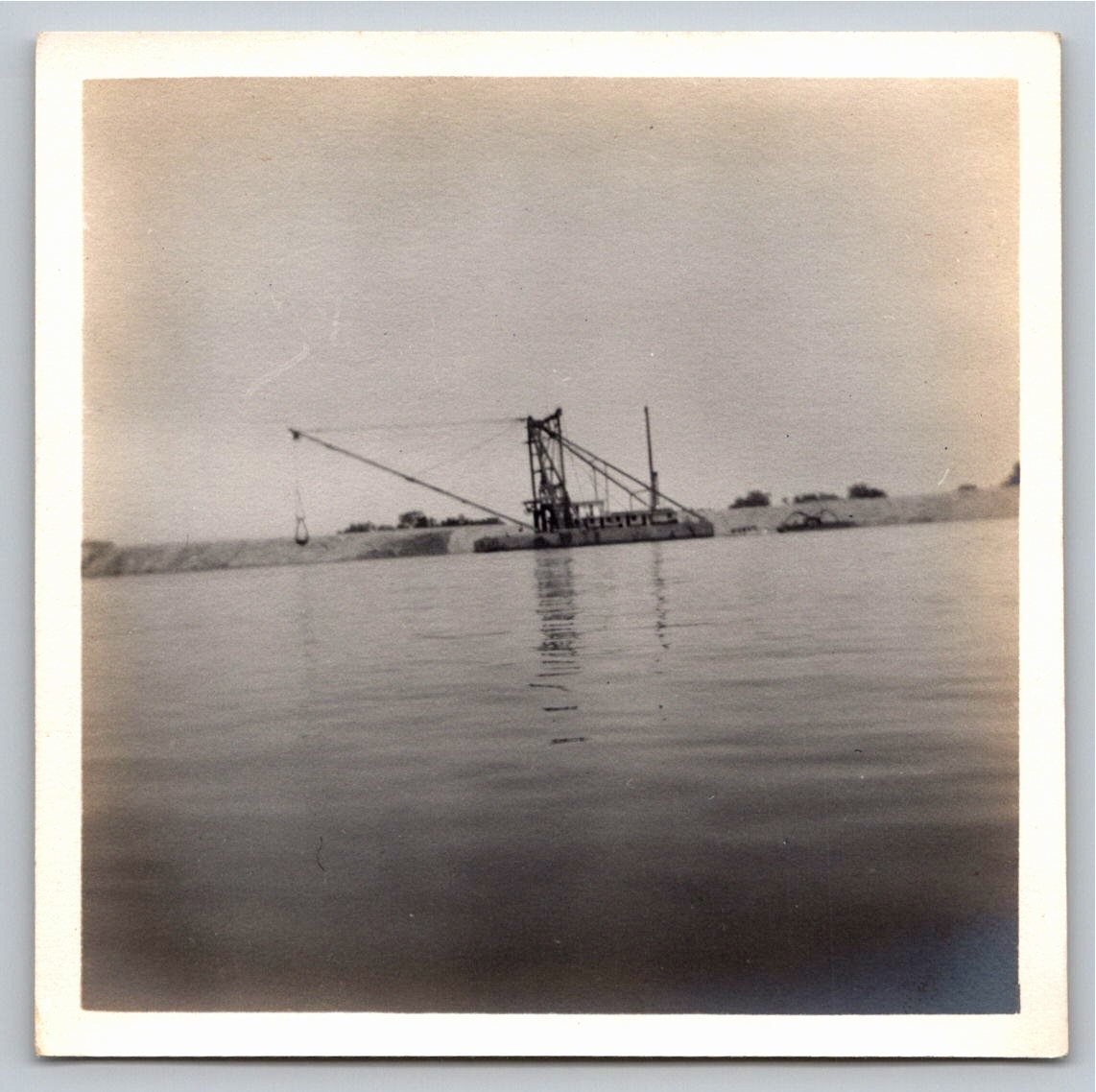
This evocative mid-century snapshot offers a compelling window into the heavy industrial machinery that helped tame Northern California’s inland waterways. Floating along the calm surface of the Sacramento River, a formidable clam-shell barge dredger rests against the riverbank. The wide expanse of water occupies the lower half of the frame, capturing the faint, rippling reflection of the barge and its intricate superstructure. Along the levee crest in the background, low-lying shrubs and distant embankment earthworks emphasize the vast scale of the Central Valley landscape.
The dredger itself dominates the upper center of the composition, presenting an imposing silhouette of utilitarian design. Its tall structural derrick framework supports a long, slender boom extending outward toward the riverbank, suspended by heavy steel cables. A bucket mechanism dangles from the boom tip, poised to scoop silt, gravel, and sediment from the riverbed or pile defensive earthen berms along the perimeter. Captured under soft daylight, the scene preserves an authentic everyday moment of civil engineering in action.
Industrial Significance: Levee Fortification and Delta Navigation
Dredging operations on the Sacramento River and throughout the broader Sacramento-San Joaquin River Delta were essential to the survival and economic prosperity of California’s agricultural heartland. Following decades of hydraulic gold mining in the nineteenth century, massive quantities of washed-down sediment repeatedly choked the river channels, elevating water levels and creating catastrophic flooding risks. Floating industrial dredgers like the one documented here served as the front line of defense, constantly deepening navigable ship corridors and building massive earthen levees to safeguard low-lying farmland.
On the reverse side of this print, an authentic period pencil inscription neat in its execution reads: "Dredger on Sacramento River." This contemporary notation anchors the vessel to a vital chapter of mid-twentieth-century industrial development, when federal and regional reclamation authorities relied heavily on barge-mounted draglines and clamshell rigs. These powerful floating workhorses helped secure transport lanes between the agricultural delta and the deepwater ports connecting out to the San Francisco Bay.
Provenance, Format, and Archival Collector Appeal
This original black-and-white print is produced in the iconic square snapshot format popular throughout the 1940s and early 1950s, measuring approximately 3.5 by 3.5 inches with narrow, even white borders framing the exposure. Printed on matte paper stock, the photograph displays a delicate tonal range, moving gracefully from rich, deep charcoal shadows around the dredger's machinery to luminous pale gray tones across the open sky and water.
Surviving in admirable vintage condition, the photograph shows crisp clarity in the mechanical truss work and cable rigging, along with sharp, clean perimeter edges. The blank back displays light age-related surface patina and natural spotting consistent with period storage in a private album, while retaining its clear handwritten identification. For collectors of maritime machinery, California civil engineering history, and mid-century industrial vernacular photography, this snapshot represents a rare, authentic primary visual record.