1940s WWII Jeep POV Dirt Road Landscape Snapshot Photo
📸 Click any thumbnail to inspect Front, Back & Angles (2 Photos)
🔗 Embed / Cite This Archival Image (Free with Attribution)Get HTML Code
© USA RESELL. Bloggers, historians, and website owners may embed this image for free by copying the HTML code below (which includes the required credit link back to this page):
USA RESELL is a living historical archive. Because original artifacts are one-of-a-kind and source records change rapidly, use the button above to check live marketplace availability or locate surviving examples. As an eBay Partner, we may earn a commission on qualifying purchases.
Item Specifications
- Type: Photograph
- Original/Licensed Reprint: Original
- Image Color: Black and White
- Production Technique: Gelatin-Silver Print
- Material: Paper
- Finish: Matte
- Category: Vintage Photography
- Format / Type: Snapshots
Historical Context & Overview
Visual & Historical Overview: A Traveler’s View from the Hood
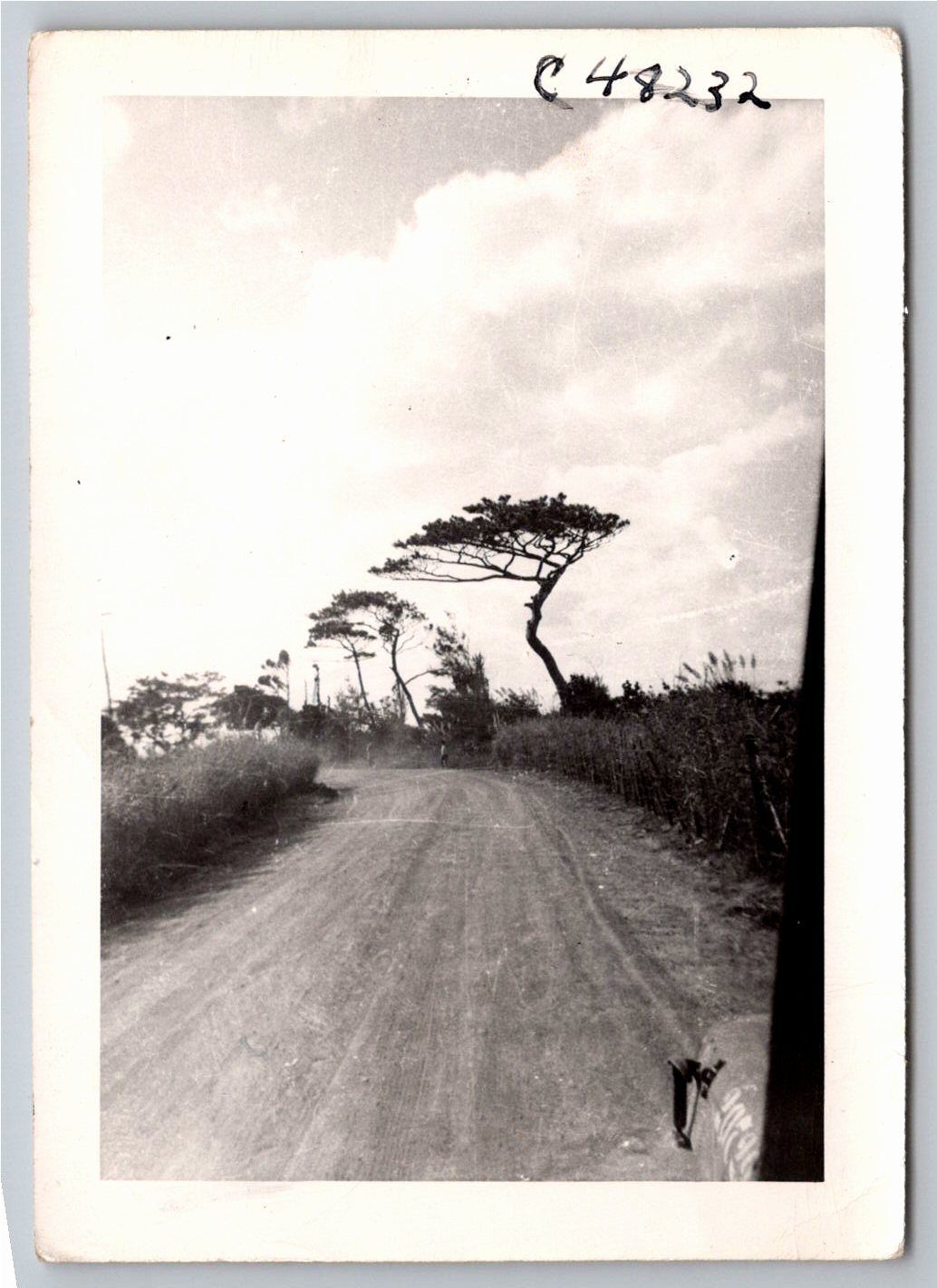
Captured from the passenger vantage of a moving vehicle, this authentic 1940s snapshot offers an immediate point-of-view perspective traversing an unpaved rural corridor. In the lower right corner, the distinct contours of a curved vehicle fender and mechanical hood latch betray the conveyance—almost certainly a light utility vehicle or military reconnaissance Jeep. The unpaved dirt roadway winds gently forward, flanked by dense overgrowth, tall roadside grasses, and distinct, wind-sheared tropical or coastal pine trees silhouetted against a brilliant sky populated by soft cumulus clouds.
The composition evokes the daily reality of mid-century transport across non-standard terrain. Whether recorded in the Pacific Theater of operations, the Hawaiian Islands, or an isolated continental military proving ground, the photograph captures a moment of quiet transit. The stark interplay of deep tonal foliage against the pale, dusty tire tracks creates an atmospheric snapshot that moves beyond standard portraiture into the realm of authentic wartime vernacular landscape documentation.
Historical Context: Wartime Vernacular Documentation and Field Notes
During the Second World War, personal cameras carried by military personnel and civilian contractors recorded an informal, uncurated archive of geographic movement. Service members routinely photographed remote road networks, encampments, and untamed terrain to preserve memories of unfamiliar landscapes. Such photographs served as visual records sent home to families or compiled into personal scrapbooks to document long deployments across varied island chains and remote outposts.
The reverse side of this photograph carries subtle historical markers that contextualize its production. Inscribed in period graphite pencil is the brief, direct caption, "This is one of the roads," offering an understated commentary on the rough transit conditions encountered by the traveler. Adjacent to the handwriting is an inverted commercial processing or unit stamp reading "719N," while the upper front white border features a hand-inked reference number, "C 48232," indicative of negative organization or wartime photographic cataloging.
Physical Characteristics, Technique, and Collector Value
This original black-and-white print is produced via the traditional gelatin silver development process on matte-to-semi-gloss photographic paper stock. Measuring approximately 3.1 by 4.4 inches, it retains the classic proportions typical of portable mid-century snapshot cameras. The tonal range remains well-balanced, exhibiting crisp contrast between the deeply shaded canopy of the roadside flora and the bright horizon.
Preserved in very good vintage condition, the print displays authentic hallmarks of age, including subtle corner softening, gentle edge wear, and mild perimeter toning consistent with proper period storage. The central visual field remains clear and uncreased, with no tears or structural damage. For collectors of World War II militaria, transportation ephemera, and vintage vernacular photography, this point-of-view snapshot serves as an evocative primary source artifact from a defining era.