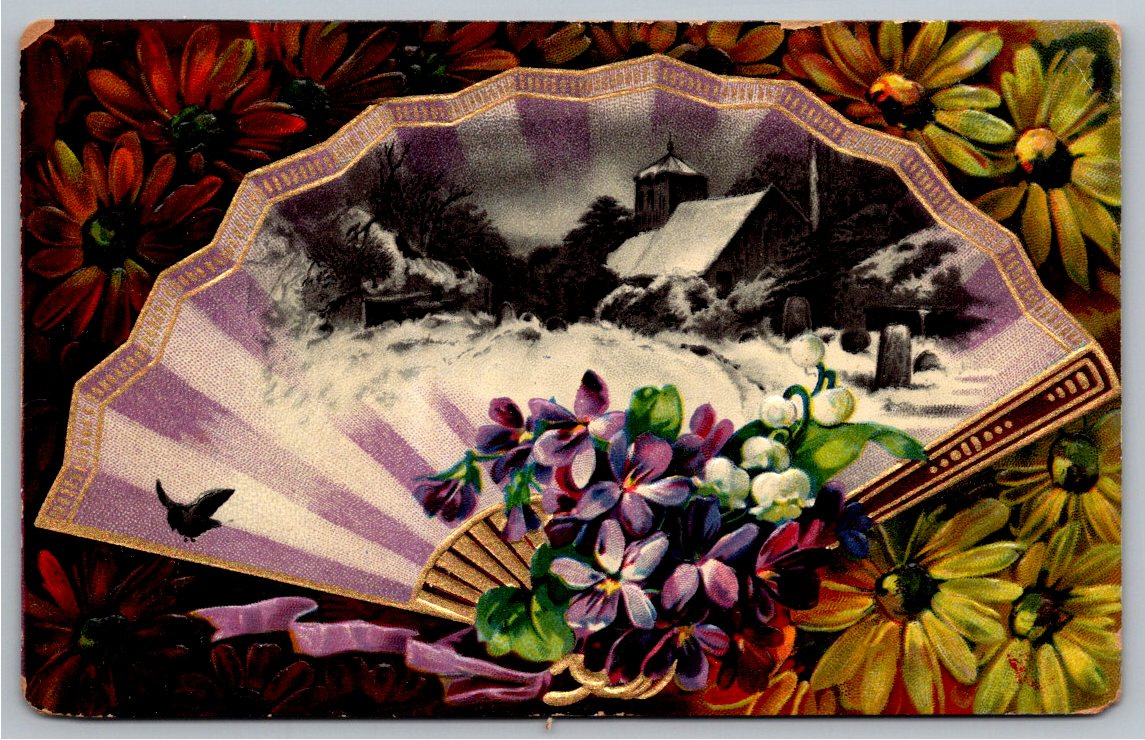
1908 Embossed German Fan Postcard: Winter Church & Floral
📸 Click any thumbnail to inspect Front, Back & Angles (2 Photos)
As an eBay Partner, we may earn a commission if you make a purchase.
Item Specifications
- Era: Divided Back (1907–1915)
- Postmark Year: 1908
- Origin: Germany
- Theme: Winter Village & Floral
- Printing Technique: Embossed Chromolithography
- Postal Status: Postally Used
- Category: Postcards & Ephemera
- Format / Type: Vintage Postcards
Looking for Modern Alternatives?
Explore top-rated, modern Postcards & Ephemera and related historical accessories on Amazon.
Shop Postcards & Ephemera on Amazon →As an Amazon Associate, we earn from qualifying purchases.
Historical Context & Overview
The Zenith of Golden Age German Lithography
Mailed in April 1908, this exquisite vintage postcard captures the peak of the "Golden Age of Postcards" (1898–1915). During this era, German master printers set the global standard for lithographic precision, heavy paper embossing, and rich color application. American and European publishers routinely outsourced their finest novelty postcard designs to Saxony and Bavaria, where generations of craftsmen perfected high-relief die-stamping and multi-stone chromolithography.
Intricate Die-Cut Fan Vignette and Floral Motif
The composition on the front of this postcard is a triumph of turn-of-the-century decorative design. Framed within the silhouette of a widely opened oriental fan—a wildly popular design element in Art Nouveau and late Victorian aesthetic movements—is a monochrome winter night scene. The fan depicts a snow-laden church tower and rural churchyard bathed in moonlight, rendered with delicate tonal shading that contrasts strikingly against the vivid colors surrounding it.
Cascading across the fan's handle is a lush bouquet of purple violets and white lilies of the valley, symbols long associated in Edwardian floriography with modesty, devotion, and the return of happiness. Surrounding the central vignette is a frame of deep golden-yellow chrysanthemums against a dark, moody background. Heavy gold leaf gilding along the fan's ribs and border adds metallic shine and dimension, creating a multi-layered, tactile surface that elevated a simple postcard into an object of keepsake art.
A Window into Early 20th-Century Postal History
The reverse side offers an equally fascinating snapshot of American postal history. The card features a clear, crisp circular cancellation stamp from Rolla, Missouri, dated April 2, 1908, alongside a green one-cent Benjamin Franklin stamp. It adheres to the landmark United States Postal Service regulation passed just a year earlier in March 1907, which allowed senders to write personal messages on the left side of the back ("Divided Back Era"), leaving the right side exclusively for the recipient's address.
Carefully penned in cursive fountain pen ink, the sender writes to a family member in St. Louis, remarking on the spring weather and personal health. In small vertical type along the left margin sits the origin mark "PRINTED IN GERMANY" alongside a publisher's geometric logo, confirming its fine European manufacture prior to import.
A Treasured Find for Deltiologists
Embossed German novelty postcards featuring complex die-cut motifs like fans, flowers, and seasonal landscapes remain highly sought after by postcard collectors and postal historians alike. The combination of intricate relief stamping, vibrant color retention over more than a century, and documented 1908 postal usage makes this piece a outstanding example of Edwardian paper craft.