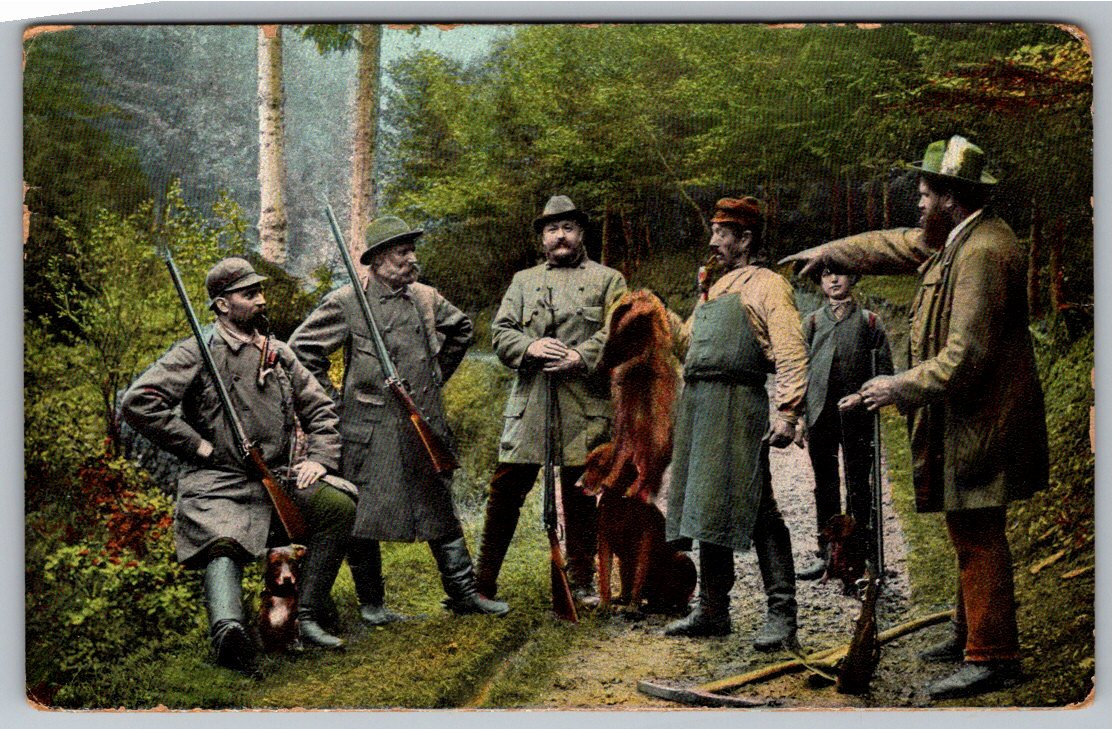
1910 German Hunters Postcard: Hunting Party in the Forest Trail
📸 Click any thumbnail to inspect Front, Back & Angles (2 Photos)
As an eBay Partner, we may earn a commission if you make a purchase.
Item Specifications
- Era: Divided Back (1907–1915)
- Postmark Year: 1910
- Publisher: Th. E. L. Serie 978
- Subject: German Hunting Party & Game
- Postmark Location: St. Louis, Missouri
- Originality: Original Vintage Postcard
- Category: Postcards & Ephemera
- Format / Type: Vintage Postcards
Looking for Modern Alternatives?
Explore top-rated, modern Postcards & Ephemera and related historical accessories on Amazon.
Shop Postcards & Ephemera on Amazon →As an Amazon Associate, we earn from qualifying purchases.
Historical Context & Overview
In early 20th-century Central Europe, hunting was far more than a recreational pastime; it was an ingrained cultural institution defined by strict etiquette, regional customs, and deep reverence for the natural world. Known in German-speaking lands as Jagdkultur, this tradition emphasized sportsmanship, stewardship of forest lands, and camaraderie among woodsmen. This captivating hand-colored postcard, postmarked in May 1910, offers a preserved glimpse into that world, showcasing a fully outfitted hunting party pausing along a dense woodland trail.
A Detailed Tableau of Central European Hunting Tradition
The composition brings together a diverse cast of woodsmen, trackers, and local gamekeepers gathered on a narrow forest path. Each figure represents a distinct role within the traditional hunting hierarchy. On the left, seasoned hunters rest with long-barreled sporting rifles slung over their shoulders or resting across their knees. Their attire—heavy woolen coats, gaiters, stout leather boots, and traditional brimmed felt hats adorned with gamsbart or feather trim—reflects the rugged practicality required for long days navigating timbered hillsides.
In the center of the frame, a gamekeeper in a heavy work apron holds up the day's yield—a rich red fox pelt—while loyal hunting hounds sit patiently at his boots. Small hunting dogs, such as Dachshunds and German hunting terriers, were indispensable companions during these expeditions, prized for their courage in flushing game from burrows and tracking scents through thick underbrush. To the right, an authoritative figure gestured down the trail, gesturing toward the next leg of the trek while a young apprentice looks on, demonstrating how hunting knowledge was passed down through generations.
Printing Craftsmanship and Ephemera Significance
Produced during the golden age of postcards (roughly 1898 to 1915), this piece displays the rich, saturated tones characteristic of tinting techniques from German printers of the era. German postcard publishing houses were world-renowned for their advanced lithographic and photographic reproduction processes, supplying millions of cards globally.
The reverse side features the classic divided back structure permitted by international postal regulations starting around 1907. Marked with the publisher catalog code "TH. E. L. SERIE 978," the card bears a green one-cent Benjamin Franklin stamp alongside a clear machine cancellation from St. Louis, Missouri, dated May 23, 1910. The handwritten message reflects daily family correspondence, highlighting how European pictorial views were routinely bought, collected, and mailed across the United States as novel keepsakes.
An Authentic Artifact for Sporting and Postal Historians
For collectors of vintage sporting memorabilia, forestry history, and early photographic postcards, this original 1910 card is a compelling historical document. It preserves not only the material culture of early modern European hunting—from firearms and outerwear to canine breeds—but also illustrates the international trade in visual media that defined early 20th-century pop culture.