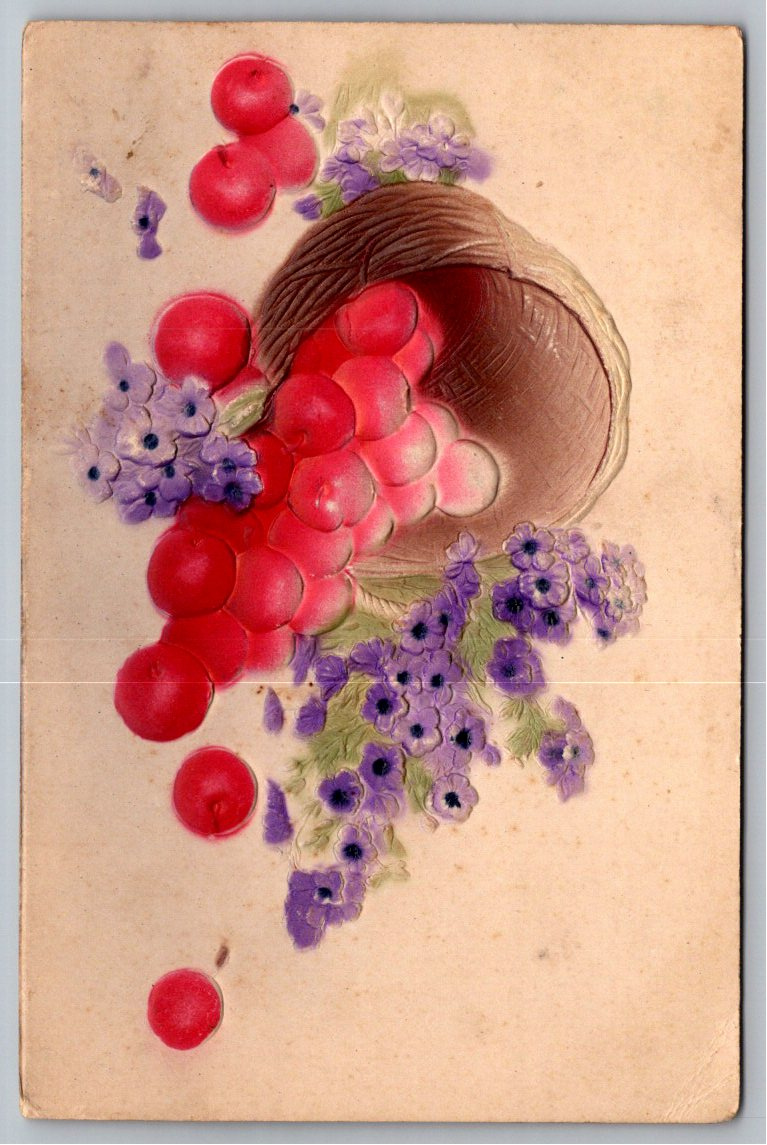
1909 Embossed German Floral Postcard: Fruit Basket & Violets
📸 Click any thumbnail to inspect Front, Back & Angles (2 Photos)
As an eBay Partner, we may earn a commission if you make a purchase.
Item Specifications
- Era: Divided Back (1907–1915)
- Year: 1909
- Origin: Germany
- Postmark Location: Kansas City, Kansas
- Destination: Higgins, Texas
- Subject: Fruit Basket & Violets
- Category: Postcards & Ephemera
- Format / Type: Vintage Postcards
Looking for Modern Alternatives?
Explore top-rated, modern Postcards & Ephemera and related historical accessories on Amazon.
Shop Postcards & Ephemera on Amazon →As an Amazon Associate, we earn from qualifying purchases.
Historical Context & Overview
During the Golden Age of Postcards (roughly 1907 to 1915), international postal exchange was transformed by advancements in fine art printing. Among the most cherished artifacts from this era are heavily embossed still-life post cards produced in Germany, which dominated the global stationery market prior to World War I. This original 1909 example displays a tipped woven basket cascading with lustrous red fruit and violet-hued floral blossoms, rendered with remarkable tactile relief and vivid color saturation.
The Mastery of German Embossed Chromolithography
At the turn of the twentieth century, German print houses were world-renowned for their mastery of chromolithography—a multi-stage color printing process using stone or zinc plates. To achieve the dramatic dimensional depth seen on this piece, printers subjected heavy card stock to precision-engraved brass dies after the color inks were applied. This technique raised the surface of the paper, giving the plums, apples, and intricate floral petals a lifelike, three-dimensional quality.
American publishers frequently contracted German lithographers to produce high-end inventory, as domestic printing technology had not yet matched the fidelity, ink permanence, or die-cutting precision of European workshops. Cards bearing the imprint "Made in Germany" represented the gold standard of decorative correspondence for holiday greetings, birthdays, and everyday sentimentality.
A Snapshot of Turn-of-the-Century Postal History
The reverse side of this postcard reveals a fascinating narrative from the Divided Back Era. Introduced in the United States in March 1907, the divided back permitted senders to write a personal message on the left side while reserving the right side exclusively for the recipient's address. Prior to this innovation, regulations dictated that only the recipient's address could appear on the back, forcing senders to write across the front illustration.
Postmarked in Kansas City, Kansas, in 1909, this card bears a green one-cent Benjamin Franklin stamp from the famous Washington-Franklin issue utilized by the United States Post Office Department. Addressed to Higgins, Texas, the brief handwritten note captures an authentic slice of everyday American life at the close of the Edwardian era, connecting Midwestern industrial hubs with rural panhandle towns.
Preservation and Legacy for Modern Collectors
Relief-embossed postcards require careful preservation, as the raised paper fibers are inherently vulnerable to flattening, surface abrasion, and edge wear over time. Collectors evaluate these delicate artifacts based on the crispness of the embossing impression, color retention, and the historical clarity of the postal markings. Featuring intact relief work and historical Midwestern provenance, this 1909 German-printed floral postcard remains a striking example of early twentieth-century printmaking and social correspondence.