1930s Dapper Man in Summer Suit & White Trousers Snapshot
📸 Click any thumbnail to inspect Front, Back & Angles (2 Photos)
🔗 Embed / Cite This Archival Image (Free with Attribution)Get HTML Code
© USA RESELL. Bloggers, historians, and website owners may embed this image for free by copying the HTML code below (which includes the required credit link back to this page):
USA RESELL is a living historical archive. Because original artifacts are one-of-a-kind and source records change rapidly, use the button above to check live marketplace availability or locate surviving examples. As an eBay Partner, we may earn a commission on qualifying purchases.
Item Specifications
- City: Unspecified
- Country: United States
- Era: Interwar (1918-1939)
- Subject: Mens Fashion Cigarette Smoking Portrait
- Theme: Americana Fashion Domestic and Family Life
- Year of Production: 1930
- Category: Vintage Photography
- Format / Type: Snapshots
Historical Context & Overview
Visual & Historical Overview: Jazz Age Elegance on the Suburban Lawn
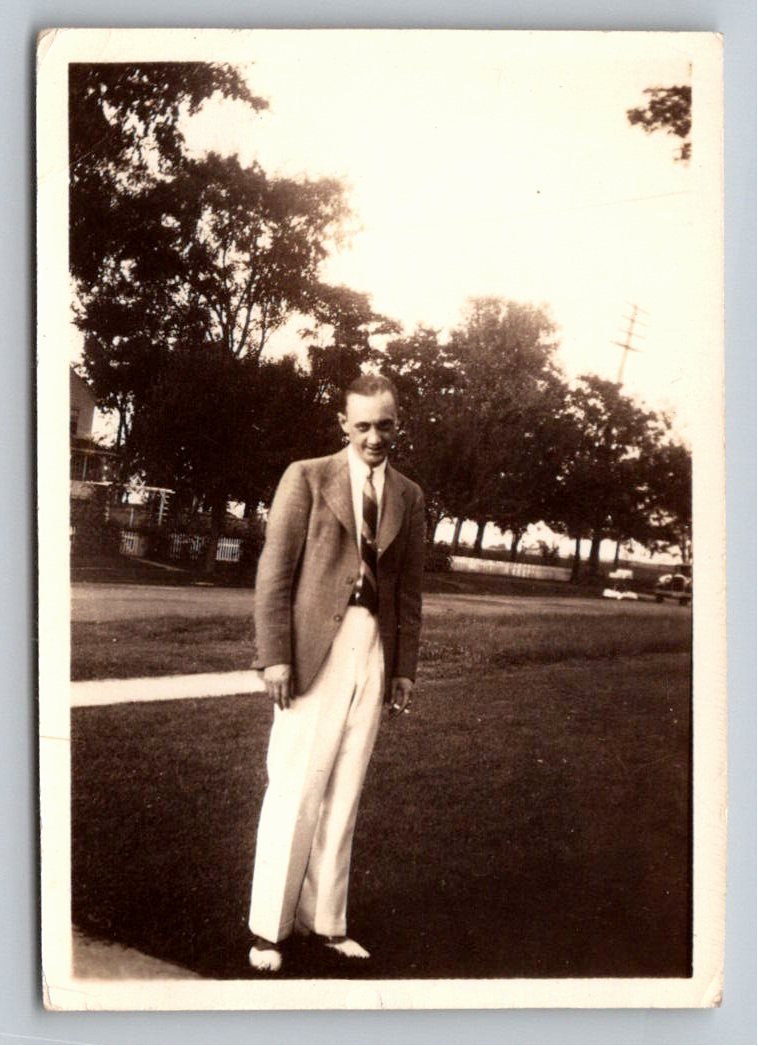
This striking original vintage gelatin silver snapshot offers an evocative glimpse into interwar American menswear and casual portraiture. Captured outdoors in full daylight, the composition centers on a remarkably well-dressed young gentleman posed on an expansive residential lawn. Bathed in natural sunlight, he gazes directly toward the lens with an air of relaxed confidence, holding a lit cigarette casually between the fingers of his left hand. The suburban setting behind him, complete with mature shade trees, distant picket fencing, and the quiet curve of a neighborhood road, reinforces the quintessentially American character of the scene.
The young man's attire serves as a textbook study in early 1930s warm-weather sartorial elegance. He sports a tailored tweed sport jacket paired with high-waisted white trousers—likely fashioned from linen or lightweight flannel—cut with the generous drape characteristic of the late Jazz Age. Underneath the single-breasted jacket, a crisp white collared shirt is fastened with a wide, patterned necktie. Completing the ensemble is a pair of classic two-tone spectator oxford shoes, a signature hallmark of resort wear, country club culture, and collegiate youth fashion during the interwar years.
Sartorial Shifts and the Cultural Rise of Vernacular Photography
During the transition from the roaring 1920s into the early 1930s, menswear experienced a profound evolution away from stiff Edwardian formality toward comfortable, athletic tailoring. Sport coats paired with contrasting trousers became the standard uniform for social outings, collegiate campuses, and leisure weekends. The presence of spectator shoes and casual cigarette smoking reflects the modern youth demeanor of the period, where personal style merged sophisticated tailoring with an easygoing, youthful attitude that challenged earlier Victorian rigidity.
At the same time, portable roll-film cameras, such as the Kodak Brownie and folding pocket cameras, transformed everyday Americans into visual chroniclers of their own lives. No longer confined to rigid commercial photo studios with painted backdrops, subjects could be photographed naturally in their front yards, capturing unscripted moments of personal poise. This photograph perfectly embodies that vernacular snapshot tradition, capturing authentic styling without the artificial stiffness of studio posing stands.
Physical Attributes, Production Method, and Collector Value
The photograph measures approximately 2.2 by 3.2 inches, a standard contact print size typical of popular consumer roll films like 120 or 116 format negatives. Developed as a traditional gelatin silver print on semi-gloss paper stock, it displays warm, rich sepia-toned black-and-white tonal gradations. The image is framed by clean, narrow white margins, indicative of period corner-drugstore developing services that catered to home photography enthusiasts throughout the late 1920s and 1930s.
In terms of condition, this antique snapshot is exceptionally well preserved. The paper remains structurally sound with crisp edges, no creasing, and no surface tears or paper loss. The reverse is completely blank and uncaptioned, showing only a subtle, natural age patina consistent with decades of careful album storage. For collectors of vernacular photography, vintage menswear history, and early 20th-century Americana, this artifact stands as an authentic and sharply detailed document of interwar style.