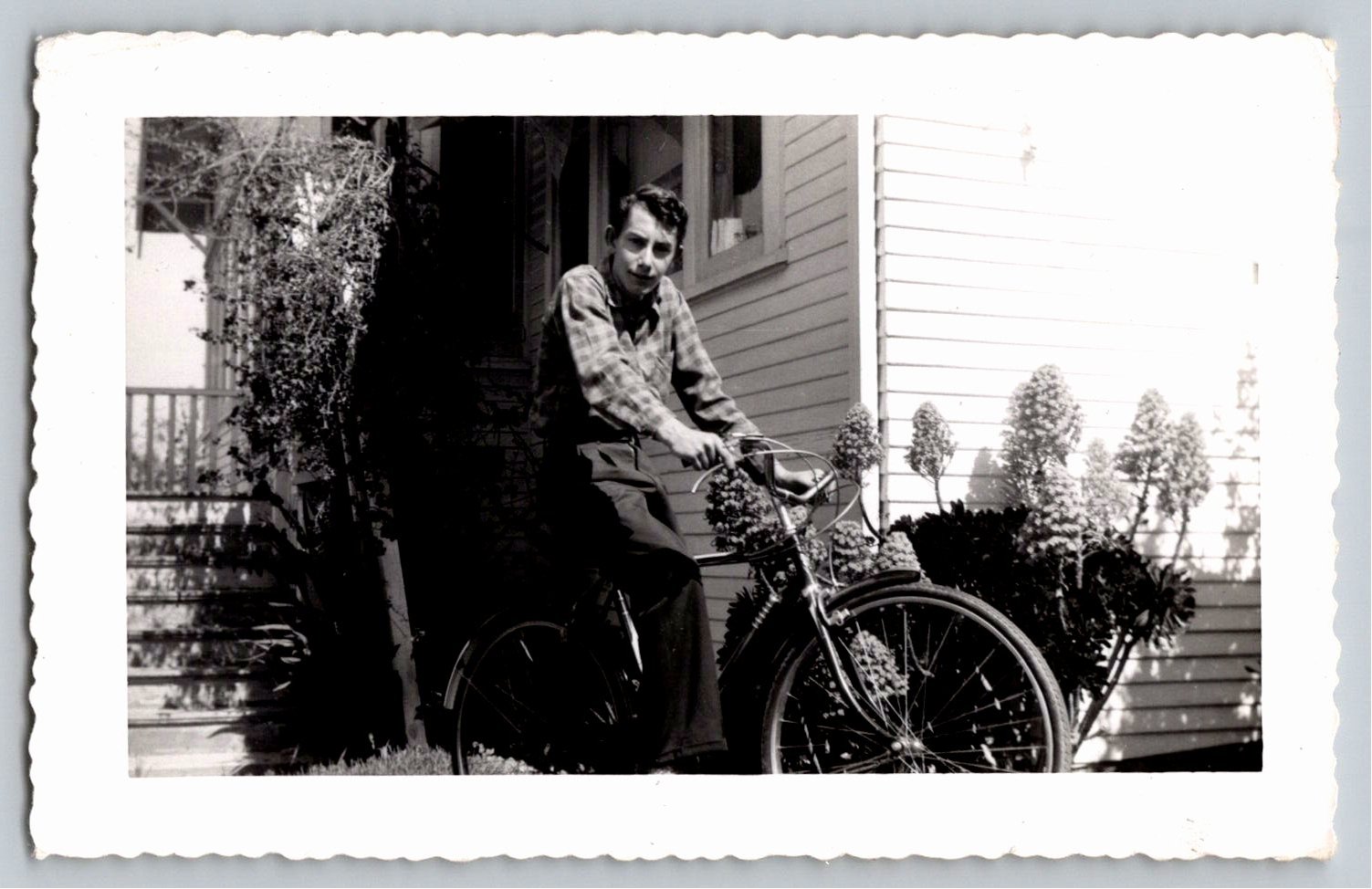
1940s Teen Boy on Cruiser Bicycle Deckled Photo Snapshot
📸 Click any thumbnail to inspect Front, Back & Angles (2 Photos)
🔗 Embed / Cite This Archival Image (Free with Attribution)Get HTML Code
© USA RESELL. Bloggers, historians, and website owners may embed this image for free by copying the HTML code below (which includes the required credit link back to this page):
USA RESELL is a living historical archive. Because original artifacts are one-of-a-kind and source records change rapidly, use the button above to check live marketplace availability or locate surviving examples. As an eBay Partner, we may earn a commission on qualifying purchases.
Item Specifications
- City: Unspecified
- Country: United States
- Era: 1940-1949
- Subject: Bicycle Teenager
- Theme: Americana Transportation
- Year of Production: 1948
- Category: Vintage Photography
- Format / Type: Snapshots
Historical Context & Overview
Visual & Historical Overview of Mid-Century Suburban Youth
This striking original vintage snapshot offers an authentic, unvarnished window into mid-century American adolescence. Captured outdoors during the post-World War II era, the composition features a teenage boy seated casually on a classic balloon-tire cruiser bicycle. Dressed in the quintessential youth fashion of the late 1940s—a bold plaid flannel button-up shirt paired with dark, pressed trousers—he leans over the swept-back chrome handlebars with an easy, relaxed posture. The backdrop is a classic slice of suburban domesticity, showcasing the horizontal clapboard siding of a family residence, a wooden front stairway, and large, flowering shrubs bathed in bright afternoon sunlight.
The play of strong natural light and cast leafy shadows lends dramatic contrast to the scene, accentuating the metallic sheen of the bicycle frame, fenders, and spokes. During the late 1940s, bicycles represented far more than mere recreational equipment; they served as the primary instrument of personal freedom, independent transit, and after-school utility for teenagers across the United States. Whether utilized for neighborhood paper routes, riding to high school classes, or exploring quiet residential avenues, a sturdy cruiser bicycle was a prized personal possession, proudly documented here by a family camera.
Cruiser Bicycle Culture and Deckled Border Aesthetics
The balloon-tire bicycle featured in this image exemplifies the heavy, streamlined design language popularized by American cycle manufacturers such as Schwinn, Columbia, and Huffman during the 1930s and 1940s. Built to withstand rough sidewalks and unpaved suburban lanes, these bicycles incorporated wide tires, robust tubular steel frames, and swept handlebars designed for an upright, comfortable cruising position. The youth's proud stance over the bike highlights how central vehicle culture was to mid-century American youth, serving as an important rite of passage prior to acquiring an automobile.
Complementing the subject matter is the distinctive scalloped, or deckled, border finishing that frames the photographic print. Throughout the 1940s and early 1950s, commercial photo finishing laboratories across North America utilized specialized shearing blades that trimmed customer prints with decorative zigzag or scalloped margins. This aesthetic treatment was designed to elevate everyday snapshots into elegant presentation keepsakes, ideal for mounting into black-paper family albums with corner mounts. The decorative edge immediately contextualizes the photograph within the golden age of amateur domestic documentation.
Material Specifications, Condition, and Archival Appeal
Physically, this historic item is an authentic black and white gelatin-silver photograph rendered on glossy, period-correct paper stock. It measures approximately 2.9 by 4.7 inches, retaining its original proportions and manufacturer trimming. The reverse side is entirely blank, free from studio stamps, personal handwriting, or postal elements, underscoring its private origins as a candid family snapshot rather than a commercial photograph. The chemical development exhibits deep blacks, balanced mid-tones, and clean white highlights, preserving fine details in the youth's facial expression, the texture of his flannel shirt, and the mechanical assembly of the bicycle.
The photograph remains in very good vintage condition, exhibiting remarkable structural integrity. The delicate scalloped borders are crisp and well-preserved, showing only nominal handling wear and faint age toning around the peripheral margins consistent with an artifact over seven decades old. For collectors of vernacular photography, vintage bicycling history, and mid-century Americana, this snapshot stands out as an exceptional, highly evocative historical artifact representing post-war youth culture.