1940s Boy with Metal Pail Town Square Park Cars Photo
📸 Click any thumbnail to inspect Front, Back & Angles (2 Photos)
🔗 Embed / Cite This Archival Image (Free with Attribution)Get HTML Code
© USA RESELL. Bloggers, historians, and website owners may embed this image for free by copying the HTML code below (which includes the required credit link back to this page):
USA RESELL is a living historical archive. Because original artifacts are one-of-a-kind and source records change rapidly, use the button above to check live marketplace availability or locate surviving examples. As an eBay Partner, we may earn a commission on qualifying purchases.
Item Specifications
- City: Unspecified
- Country: United States
- Era: 1940s
- Subject: Boy with Pail Town Square Classic Cars Street Scene
- Theme: Americana
- Year of Production: 1940
- Category: Vintage Photography
- Format / Type: Snapshots
Historical Context & Overview
Visual & Historical Overview: Small-Town Americana in the 1940s
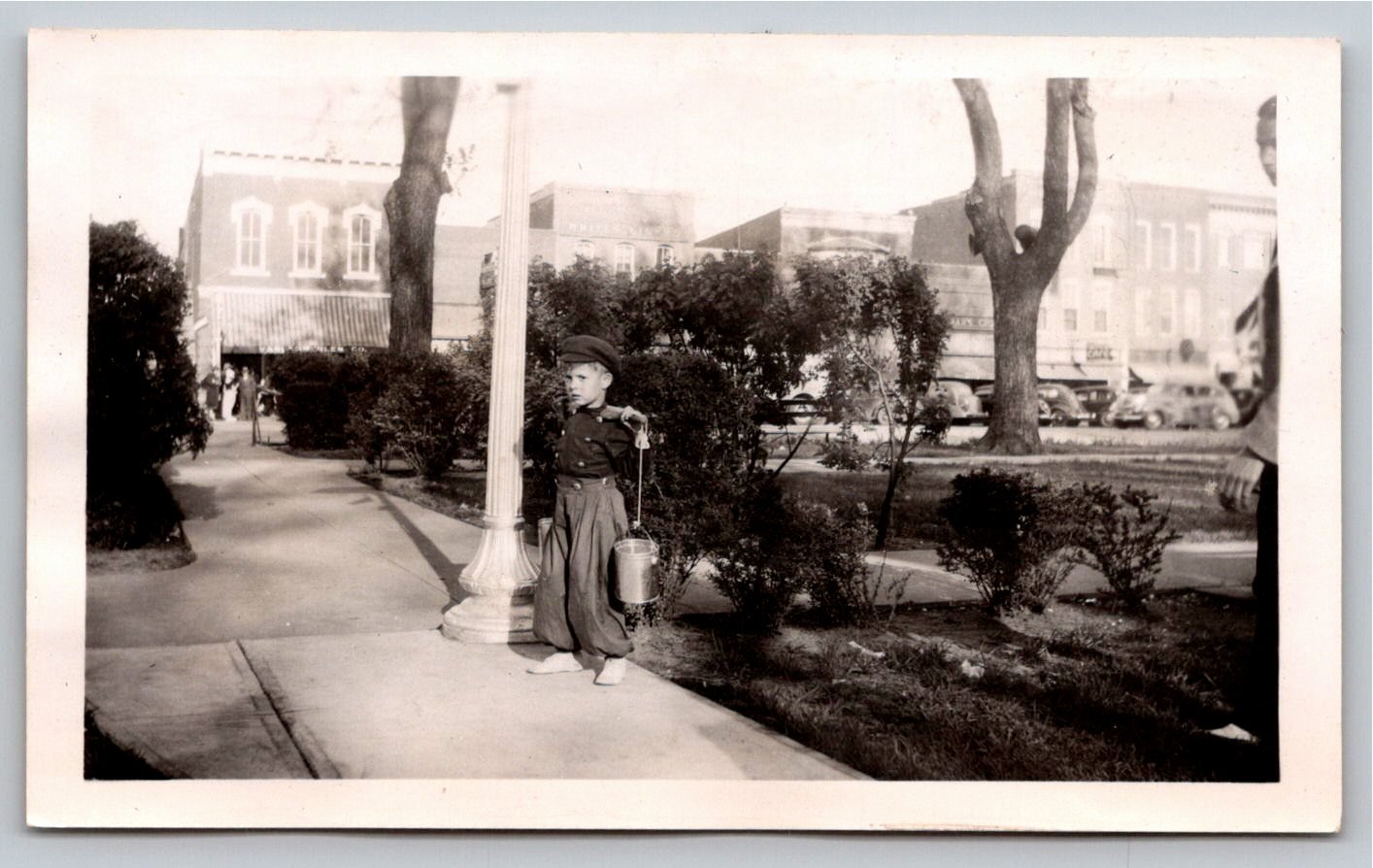
This striking original vintage black-and-white snapshot transports the viewer directly into the heart of mid-century community life. In the foreground, a young boy pauses along a concrete sidewalk running through a landscaped public park or courthouse square. Dressed in utilitarian period attire—a fitted newsboy-style work cap, a buttoned collared dark shirt, and relaxed, cuffed trousers—he carries a small metal pail suspended from a long wire handle. Standing close beside a classical fluted streetlamp post, his candid pose captures a quintessential moment of everyday childhood, whether running an errand, helping with morning chores, or heading out on an afternoon adventure.
Beyond the lawn and decorative manicured shrubbery, the town's vibrant commercial district unfolds with remarkable period clarity. Traditional brick storefronts display arched upper-story windows, fabric sun awnings, and prominent signboards. Lined neatly along the opposite curb are several late 1930s and 1940s passenger cars, including bulbous-fendered coupes and sedans. The harmonious balance between public civic greenery and commercial street architecture epitomizes the quintessential layout of American county seats and agricultural hubs during the Second World War and immediate postwar era.
Everyday Life and Automotive Landscape of Mid-Century Towns
During the 1940s, town squares served as the social and economic nucleus of American municipalities. Central parks surrounding municipal halls, courthouses, or town commons provided shaded pedestrian corridors where citizens met between visits to local dry goods merchants, banks, and pharmacies. The boy's attire and simple tin or galvanized pail reflect an era when children regularly participated in household tasks, carrying water, collecting produce, or carrying work lunches. Such spontaneous snapshots offer historians candid, unvarnished records of working-class family routines free from the stiffness of studio portraiture.
The row of automobiles visible along the perimeter street further anchors the scene firmly in the mid-20th century. The aerodynamic streamline styling, rounded grilles, and distinct running boards of the vehicles parked parallel to the park reflect Detroit's pre-war automotive design language, which remained dominant throughout the 1940s due to wartime civilian manufacturing halts. Combined with the pedestrian bustle along the shopfronts in the background, this print documents not just an individual subject, but the broader rhythm of mid-century urban transit and public space design.
Physical Print Characteristics, Provenance, and Archival Value
This authentic vintage photograph is rendered as a gelatin silver print on classic matte photographic paper stock, measuring approximately 4.4 inches by 2.7 inches. The image exhibits notable clarity, preserving subtle textures across the boy's clothing, the foliage of the deciduous shade trees, and the ornate base of the park lamppost. The exposure displays rich mid-tones, deep shadow depth, and clean borders, demonstrating high-quality period developing and fixing technique typical of amateur roll-film processing during the 1940s.
The reverse side of the print features dense black fibrous construction paper residue, physical evidence of its long-term preservation within a personal vintage photo album or family scrapbook. While this mount residue covers the reverse, the photograph itself remains structurally sound and entirely uncompromised on the viewing surface. For collectors of mid-century vernacular photography, antique automotive streetscapes, and authentic Americana, this candid snapshot stands as an evocative, well-preserved piece of visual history.