Antique Tuck's Oilette Postcard Ireland MacGillycuddy Reeks 1907
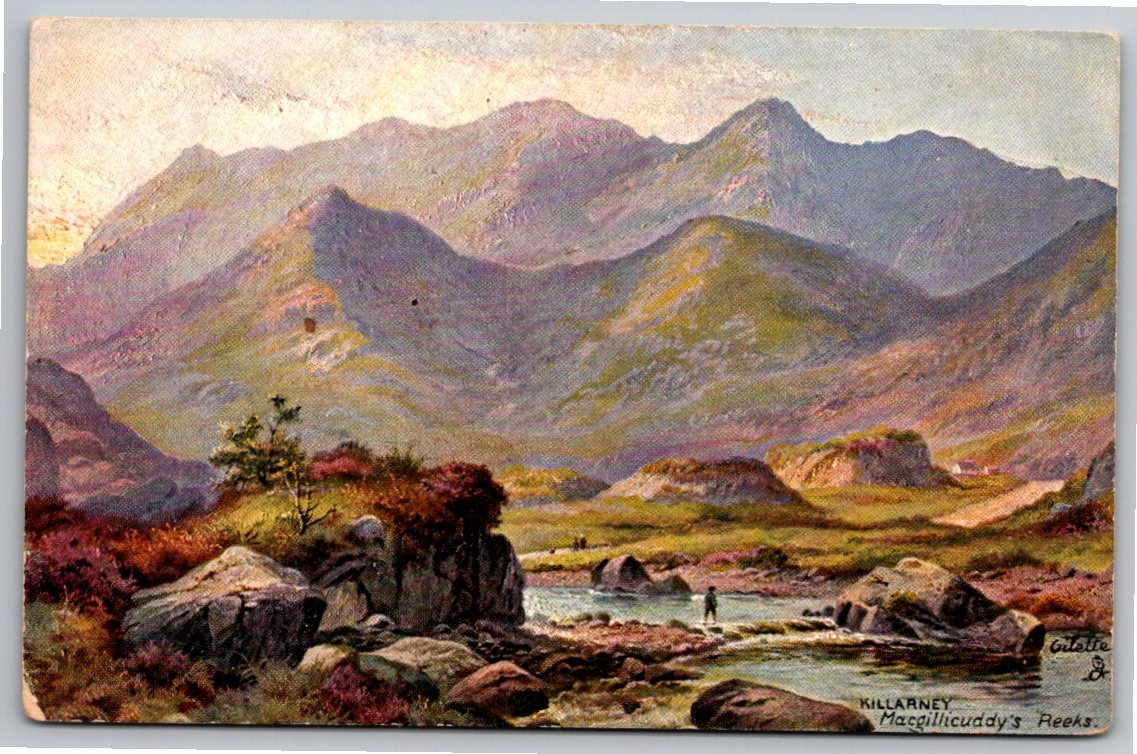
📸 Click any thumbnail to inspect Front, Back & Angles (2 Photos)
As an eBay Partner, we may earn a commission if you make a purchase.
Item Specifications
- Type: Oilette Postcard
- Publisher: Raphael Tuck & Sons
- Series: Killarney Series IV (No. 7402)
- Era: Divided Back (1907)
- Location: County Kerry, Ireland
- Subject: MacGillycuddys Reeks
- Category: Postcards & Ephemera
- Format / Type: Vintage Postcards
Looking for Modern Alternatives?
Explore top-rated, modern Postcards & Ephemera and related historical accessories on Amazon.
Shop Postcards & Ephemera on Amazon →As an Amazon Associate, we earn from qualifying purchases.
Historical Context & Overview
An Impressionistic View of Ireland’s Majestic Heights
During the Golden Age of Postcards at the turn of the twentieth century, British publisher Raphael Tuck & Sons set an international benchmark for fine art reproduction. Awarded a prestigious Royal Warrant, Tuck created a vast catalog of top-tier ephemera. Among their most celebrated product lines was the trademarked "Oilette" series, specifically designed to imitate the rich brushwork, impasto texture, and luminous color palette of original oil paintings. This example, published as Postcard No. 7402 in Tuck’s celebrated Killarney Series IV, presents a breathtaking vista of MacGillycuddy’s Reeks in County Kerry, Ireland.
The Artistic Craftsmanship of the "Oilette" Process
Patented and endlessly refined by Raphael Tuck & Sons, the "Oilette" printing technique effectively converted postcard collection into a widespread cultural pastime. Rather than publishing standard monochrome photos or hand-tinted halftones, Tuck commissioned fine artists to render vibrant paintings on canvas. These original compositions were subsequently transferred to heavy card stock using multi-stage chromolithographic printing. The front of this card depicts dramatic, mist-shrouded mountain summits, rolling heathland dotted with native heather, and a traveler standing near a mountain stream—a composition that perfectly captures the romanticized allure of Edwardian Ireland.
History and Heritage of MacGillycuddy’s Reeks
Spanning South Kerry, MacGillycuddy’s Reeks is home to the highest mountain peaks on the island of Ireland, headlined by Carrauntoohil standing at 3,414 feet above sea level. Named for the ancient MacGillycuddy of the Reeks clan who held authority over the land for centuries, these steep sandstone ridges served as formidable mountain fastnesses during times of conflict. The narrative printed on the reverse calls attention to key geographical features within the range, including the dramatic ravine of Hag's Glen and the secluded glacial waters of Loughs Callee and Gouragh. By the early 1900s, Killarney was widely regarded as the crown jewel of Irish tourism, drawing visitors from across Europe and North America.
Postal Artifacts and Early Twentieth-Century Ephemera
Beyond its fine art appeal, this card remains an exceptional historical artifact. Mailed in May 1907 between Merced and Amsterdam, California, it carries a crisp one-cent Benjamin Franklin postage stamp accompanied by dual circular machine postmarks. Notably, 1907 marked a pivotal transition year in postal history when the U.S. Post Office Department permitted senders to write messages on the left side of the address card—the "divided back" format. The handwritten note from "Maggie" praising a previous card as "real cute" provides a delightful window into the social exchanges of the era, making this piece a valued acquisition for collectors of Irish heritage, Tuck postcards, and early postal history.