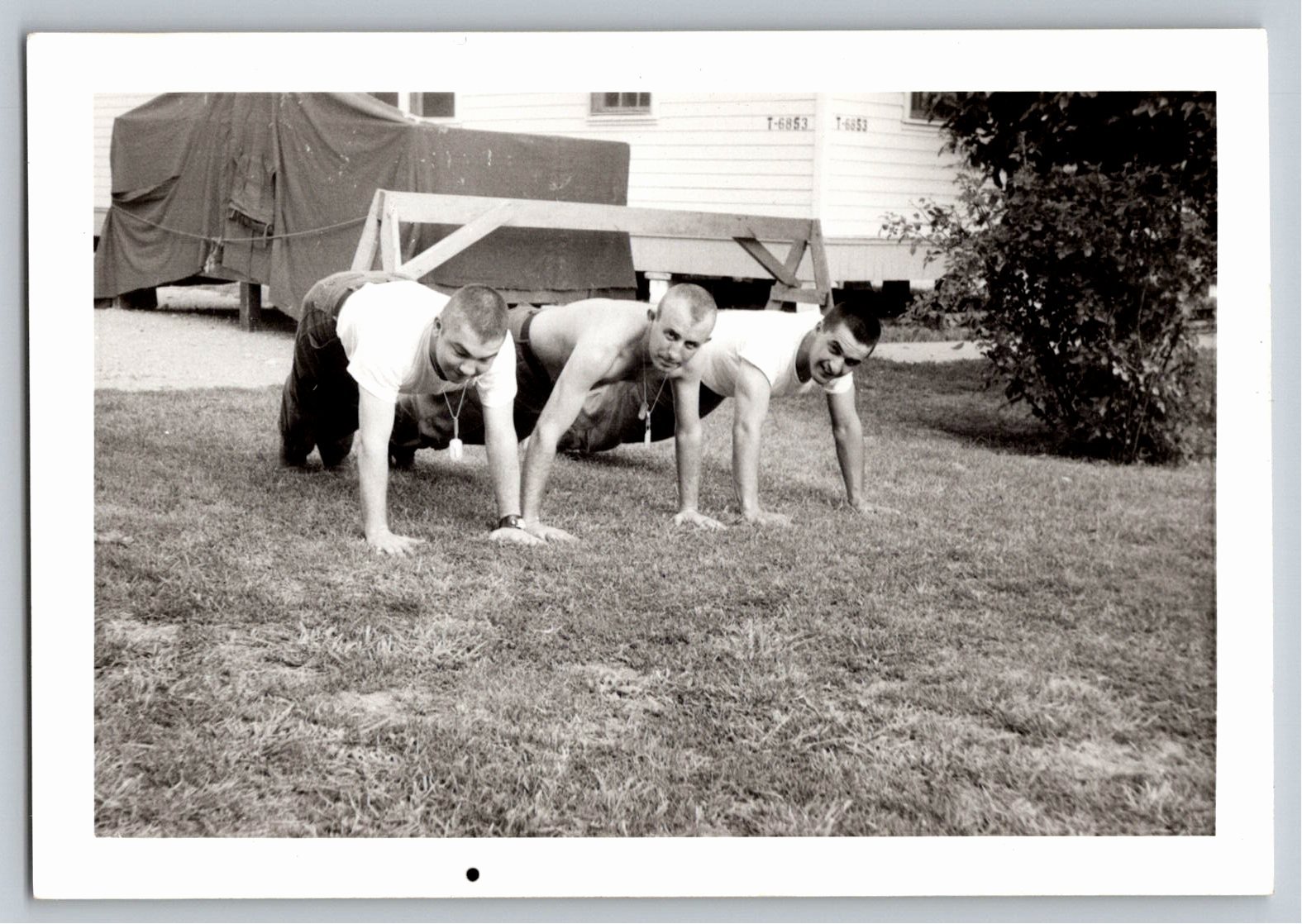
1950s US Army Recruits Push Ups Barracks PT Vintage Photo
📸 Click any thumbnail to inspect Front, Back & Angles (2 Photos)
🔗 Embed / Cite This Archival Image (Free with Attribution)Get HTML Code
© USA RESELL. Bloggers, historians, and website owners may embed this image for free by copying the HTML code below (which includes the required credit link back to this page):
USA RESELL is a living historical archive. Because original artifacts are one-of-a-kind and source records change rapidly, use the button above to check live marketplace availability or locate surviving examples. As an eBay Partner, we may earn a commission on qualifying purchases.
Item Specifications
- Type: Photograph
- Original/Licensed Reprint: Original
- Image Color: Black and White
- Subject: Military Soldiers Basic Training Physical Training Barracks
- Theme: Militaria Americana History
- Time Period Manufactured: 1950-1959
- Category: Vintage Photography
- Format / Type: Snapshots
Historical Context & Overview
Visual & Historical Overview of Basic Training Physical Culture
This mid-20th-century black-and-white vernacular photograph captures a spirited moment among three young American servicemen undergoing physical training during basic training. Posed horizontally side-by-side on an unmanicured grassy lawn, the soldiers maintain push-up positions while looking up toward the camera with candid, good-humored expressions. Each recruit sports the quintessential military induction buzz cut. The trainee on the left wears a clean regulation white cotton undershirt with utility trousers, the center soldier is stripped down to the waist, and the recruit on the right mirrors the attire of the first. Identification dog tags hang freely from their necks, suspended toward the turf beneath them.
The environmental context provides unmistakable hallmarks of a United States military training installation from the Cold War or Korean War eras. In the background behind a heavy wooden sawhorse hurdle stands a standard temporary wooden cantonment structure. Clearly stenciled beside the window frame is the official facility designation "T-6853," indicating a temporary cantonment building design typical of the rapid mid-century military infrastructure boom. A canvas-tarped vehicle or equipment supply rack sits parked adjacent to the structure, completing an authentic portrait of everyday life on an American army post.
Cantonment Architecture and Cold War Era Conscription
The "T-" prefix visible on the siding stands for "Temporary," a naming convention heavily utilized by the U.S. Army Corps of Engineers beginning in the mobilization buildup of the 1940s and continuing through the 1950s. Designed for rapid assembly utilizing simple wood-frame construction and lap siding, these cantonment barracks housed millions of inductees passing through Basic Combat Training (BCT). While utilitarian and austere, these installations served as the backdrop where young men from all walks of civilian life were forged into unified military units through strenuous daily routines, rigorous inspections, and relentless physical conditioning.
Vernacular military photography from this period holds special cultural significance because it bypasses staged public relations imagery to reveal genuine camaraderie. Calisthenics such as push-ups, jumping jacks, and distance marches formed the bedrock of daily physical fitness regimes overseen by drill instructors. The relaxed demeanor and playful smirks captured in this shot demonstrate how soldiers found levity and brotherhood amidst the strict discipline of military indoctrination, preserving personal memories through personal pocket camera snapshots sent home to family and sweethearts.
Provenance, Print Characteristics, and Collector Significance
Produced on classic gelatin silver photographic paper, this original snapshot measures approximately 5.0 by 3.4 inches. The print features crisp delineation, excellent mid-tone grayscale balance, and strong contrast between the soldiers' white undershirts, the grassy drill grounds, and the weathered barracks exterior. The print retains its original white borders, including a small dark circular printer registration mark centered cleanly on the bottom border margin—a characteristic trait of mid-century commercial photofinishing labs.
The reverse side of the photographic stock is completely blank, displaying clean vintage paper tone with only a faint archival collector notation in graphite pencil reading "#26" positioned along the lower edge. The photograph remains in very good vintage condition, exhibiting sharp structural integrity and minimal edge or surface handling wear. For collectors of Cold War militaria, mid-century Americana, and authentic vernacular portraiture, this image stands as an evocative, unstaged record of service life and military brotherhood.